
Cloud-SaaS for Industry 4.0: Bridging Big Data Storage and Customer Loyalty
SPECIAL SECTION ON KEY TECHNOLOGIES FOR SMART FACTORY OF INDUSTRY 4.0
The paper introduces a Cloud-based Software as a Service (SaaS) architecture designed for retention marketing within the Industry 4.0 framework. It specifically addresses customer loyalty programs by integrating an Event Bus, NoSQL storage (MongoDB), and Machine Learning components to provide personalized product recommendations.
TL;DR
In the era of Industry 4.0, the focus is often on the "Smart Factory" floor, but what about the customers buying the products? This paper proposes a Cloud-based SaaS architecture specifically designed for retention marketing. By leveraging NoSQL (MongoDB) and Machine Learning (Collaborative Filtering), the system transforms raw purchase data into personalized loyalty programs, proving that a hybrid cloud approach can significantly outperform local private clusters in handling complex big data queries.
Problem & Motivation: The Missing Link in Industry 4.0
While Cyber-Physical Systems (CPS) and IoT have revolutionized how we make things, the industry has been slower to revolutionize how we keep customers. As we move toward a "buyers' market," companies must move beyond just acquiring new users to maximizing the lifetime value of existing ones through retention marketing.
The technical challenge is non-trivial: a multinational corporation generates massive volumes of unstructured data (purchases, ranks, geolocation). Storing this "Big Data" and processing it in a way that allows a marketing manager to query candidate pools in real-time requires more than a simple database—it requires a scalable, cloud-native architecture.
Methodology: The H2M and M2H Workflows
The authors decompose the loyalty program process into two distinct logic flows:
- Human-to-Machine (H2M): A marketing operator uses a dashboard to "pre-select" candidates based on specific criteria (e.g., total purchases in 2017, location, or cancelled orders). This requires high-performance NoSQL querying.
- Machine-to-Human (M2H): Once candidates are selected, a Machine Learning cluster uses Collaborative Filtering (CF) with the Alternating Least Squares (ALS) method to match customers with suggested products, which are then delivered via an automated Email Marketing Microservice.
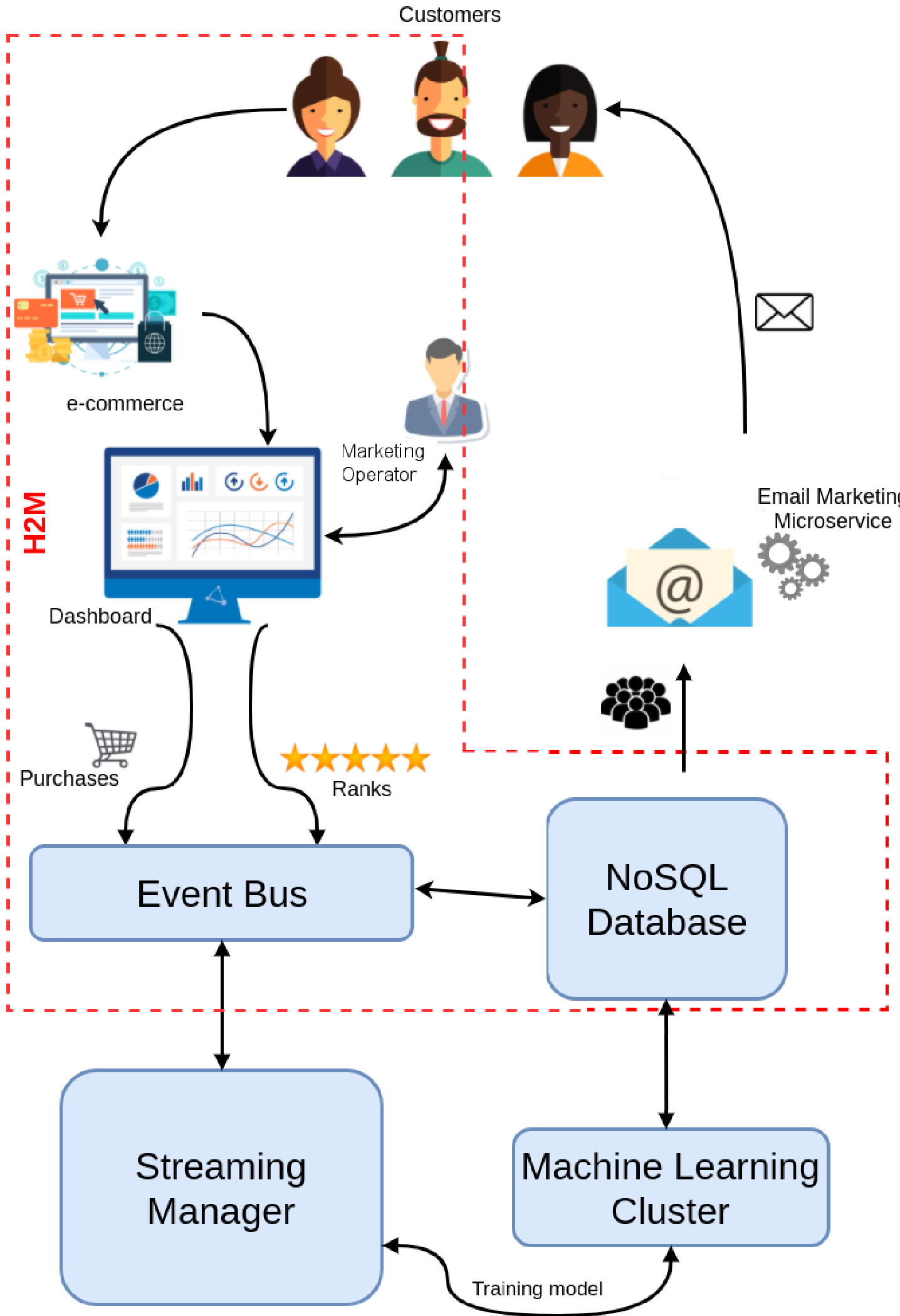 Figure 1: The overarching SaaS architecture, highlighting the interaction between the Event Bus, MongoDB, and the ML Cluster.
Experiments & Results: Private vs. Hybrid Cloud
The core of the paper’s evaluation lies in its comparison of two deployment strategies:
- Scenario 1 (Private Cloud): Both the database and the compute nodes are in the same local network.
- Scenario 2 (Hybrid Cloud): MongoDB is hosted on Amazon EC2, while the ML interface remains local.
The "Sweet Spot" of Query Complexity
Interestingly, the researchers found that query performance isn't linear relative to the number of filters (category tags).
- 3 Tags: High network overhead because too many results are returned.
- 7 Tags: High processing overhead because the NoSQL query becomes too complex.
- 5 Tags: The Goldilocks zone—the perfect balance between processing time and data transfer.
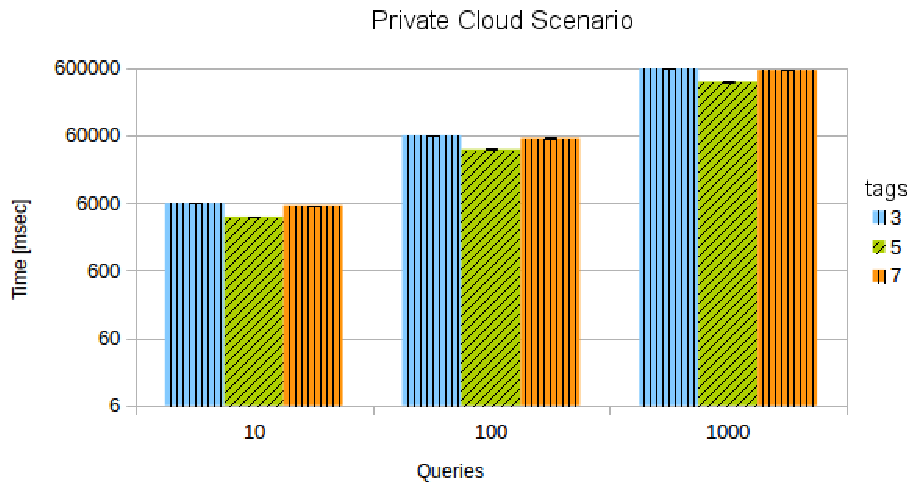 Figure 2: Response times in the private cloud scenario across different query intensities.
The Hybrid Cloud (Scenario 2) consistently outperformed the local setup. Despite the latency of a DSL connection to Amazon EC2, the superior virtual hardware capabilities of the public cloud saved significant time at scale (up to 100 seconds for 1,000 queries).
Critical Analysis & Conclusion
Takeaway
The paper successfully demonstrates that retention marketing is a viable and necessary component of the Industry 4.0 ecosystem. By using a decoupled SaaS architecture, companies can turn historical purchase data into a "self-adapting" production cycle where customer feedback directly influences future manufacturing priorities.
Limitations & Future Work
The authors identify a major concern: Security. In the hybrid cloud model, raw customer data is transferred over public networks. To address this, the authors propose exploring Homomorphic Encryption in future work—a technique that would allow the system to perform analytics on data while it remains encrypted, ensuring privacy without sacrificing the performance benefits of the public cloud.
Conclusion
This work provides a blueprint for manufacturers looking to modernize their marketing stack alongside their production line, proving that NoSQL and Cloud-SaaS are essential tools for customer loyalty in the digital age.