
Smart Homes for the Elderly: Bridging the Gap Between Isolation and Community Care
Smart Home Supporting Integrated Health and Care Services for Older Adults in the Community: Literature review and research agenda
This paper provides a comprehensive literature review and research agenda on Smart Home and Ambient Assisted Living (AAL) technologies for older adults. It identifies critical gaps in current research and proposes a multidisciplinary framework to integrate technological innovations with community health and social care infrastructure to support aging-in-place.
TL;DR
As the global population ages, "Aging-in-Place" has become a critical social and economic goal. This paper reviews 20 years of research on Smart Homes and Ambient Assisted Living (AAL). It finds that while the technology (IoT, sensors, AI) exists, it fails to be adopted because it isn't integrated into the social and physical infrastructure of our neighborhoods. The authors propose a shift from building "smart gadgets" to building "smart care networks."
Background: The Crisis of Autonomy
By 2050, older adults will represent 30% of the EU population. The loss of functional capacity often leads to a "relocation trigger" where individuals must move to nursing homes, often resulting in depression and accelerated decline. Smart Homes are positioned as the solution to postpone this relocation, yet the market for these technologies has not realized its potential.
Why AAL Technology is Stalling
The authors identify several reasons for the low uptake of assistive technologies:
- Developer-User Disconnect: Engineers create high-tech solutions without understanding the workflow of health and social care providers.
- Spatial Isolation: A smart home is useless if it is not digitally and physically connected to a nearby service center.
- Lack of Risk Models: There is no mathematical framework to quantify how specific sensors actually mitigate the risk of "events" (like falls or medical emergencies).
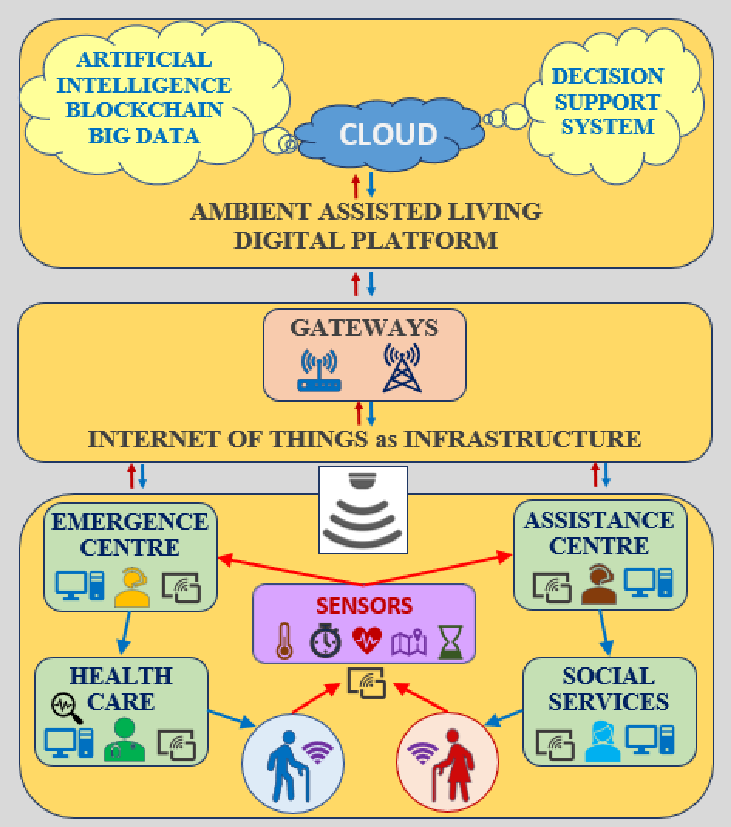 Fig 1: Proposed AAL Digital Platform for monitoring frail older adults through continuous data loops between the home and community services.
Methodology: The Multidisciplinary Research Agenda
The paper emphasizes that a "Smart Home" is a Cyber-Physical System (CPS). To make it work, it must incorporate:
- Wearable and Ambient Sensors: Real-time monitoring of vital signs and activities of daily living (ADL).
- Machine Learning: To establish "Personalized Behavior Models" and detect anomalies before a crisis occurs.
- Spatial Logistics: Using GIS (Geographic Information Systems) to ensure that the density of smart homes matches the location of response centers to minimize service delays.
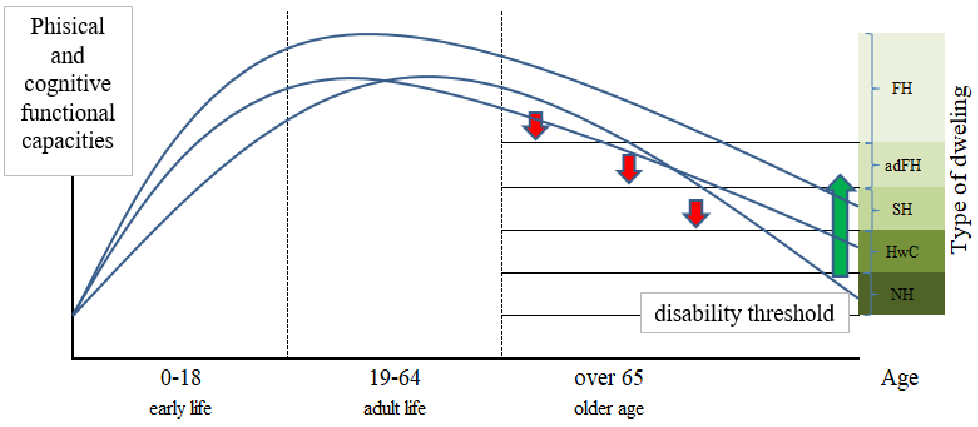 Fig 2: Growth in publications related to Smart Homes and Older Adults, showing an increasing focus but still representing a small fraction of general smart home research.
The Identified Research Gaps (The "Five Gaps")
The authors conclude with five critical areas for future researchers:
- Modeling Care Networks: We need to understand how technology characteristics influence independence.
- Risk Mitigation Models: Quantitative proof that real-time control preserves health.
- Legal Frameworks: Addressing the privacy paradox—older adults are fragile and need monitoring, but they also have a right to data protection.
- Holistic Environment Understanding: How smart homes change the social fabric of a neighborhood.
- Systematic Embedding: Moving from pilot projects to regional health system integration.
Critical Insight & Conclusion
The true value of this paper lies in its "systems approach." It moves the conversation away from Human-Computer Interaction (HCI) and toward Systems Engineering. For AAL to succeed, the smart home cannot be an island. It must be a node in a community-wide digital transformation of care.
Future Outlook: We should expect to see more integration of "Industrial Engineering" and "GIS" into geriatric research, focusing on the logistics of care delivery rather than just the hardware of the sensor itself.