
Beyond Automation: The Convergence of Smart Homes, Social Networks, and Big Data
Enrichment of Smart Home Services by Integrating Social Network Services and Big Data Analytics
This paper explores the intersection of Smart Home technology, Social Network Services (SNS), and Big Data Analytics. It proposes a conceptual framework to transition smart homes from isolated automation hubs into interconnected, socially-aware environments that leverage predictive analytics for enhanced resident support.
TL;DR
While the "Smart Home" has been a research staple for decades, most implementations remain siloed islands of automation. This paper argues for a paradigm shift: integrating Social Network Services (SNS) and Big Data Analytics to create "Attentive Homes." By leveraging social context and massive data processing, smart homes can evolve from simple remote controls to predictive environments that enhance assisted living, energy management, and healthcare.
Contextual Positioning
This work acts as a high-level architectural roadmap and literature synthesis. It moves past the "what" of smart home devices (sensors/actuators) to the "why" and "how" of the data-driven ecosystem. In the academic coordinate system, it bridges the gap between Ubiquitous Computing and Social Informatics, proposing a path toward higher Ambient Intelligence (AmI).
The Core Challenge: The Isolation Paradox
The authors identify a significant bottleneck in current Smart Home evolution:
- Isolation: Systems support tasks in a single home but ignore the social nature of living (neighborhood interaction, peer recommendations).
- The "Vs" of Data: Smart homes generate high Volume, Variety, and Velocity of data (sensor logs, video, health metrics), yet traditional local controllers cannot extract "Value" without Big Data techniques.
- The Cold Start Problem: Learning a resident's habits takes time. The authors suggest that social data (peer trends) can accelerate this learning.
Methodology & Architecture
The paper proposes a Big Data reference architecture adapted for the Smart Home context, focusing on the pipeline from heterogeneous data sources to Prescriptive Analytics.
The Intelligence Hierarchy
The paper classifies smart homes into five levels of evolution:
- Level 1-2: Isolated or communicating intelligent objects (e.g., smart thermostats).
- Level 3: Connected homes (remote access).
- Level 4-5: Learning and Attentive Homes—systems that use data patterns to anticipate needs before the resident acts.
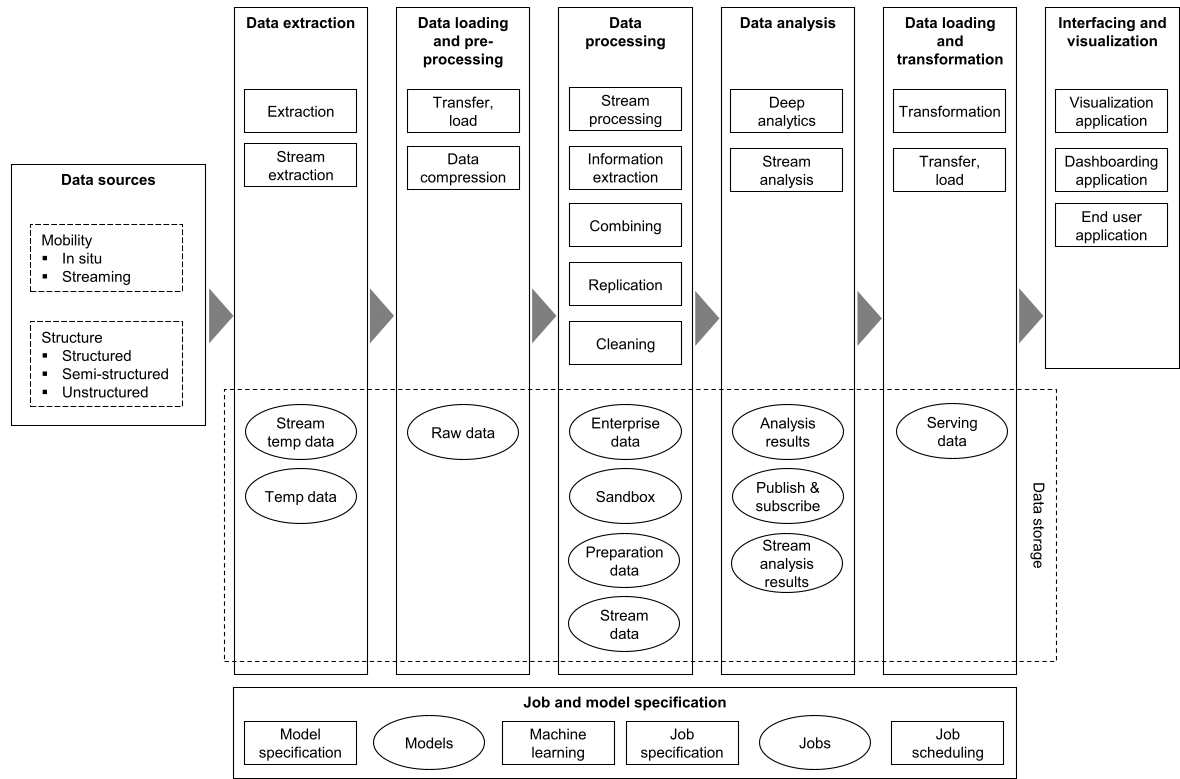 Figure 1: The proposed Big Data pipeline, transitioning from raw data sources (sensing/social) to analytical modeling and visualization.
Five Pillars of Research Opportunity
The authors categorize the future of this field into five strategic perspectives:
- Business: Transitioning from selling "smart bulbs" to "as-a-service" models (e.g., insurance companies co-financing smart elderly care to avoid nursing home costs).
- Behavioral: Using the UTAUT (Unified Theory of Acceptance and Use of Technology) model to understand how social integration affects user trust and adoption.
- Interaction: Designing interfaces that handle complex social/analytical data without overwhelming the user (Human-Computer Interaction).
- Technological: Solving the privacy-utility trade-off via methods like k-anonymization before data leaves the home for cloud processing.
- Analytical: Moving from Descriptive (what happened) to Prescriptive (what should be done) analytics.
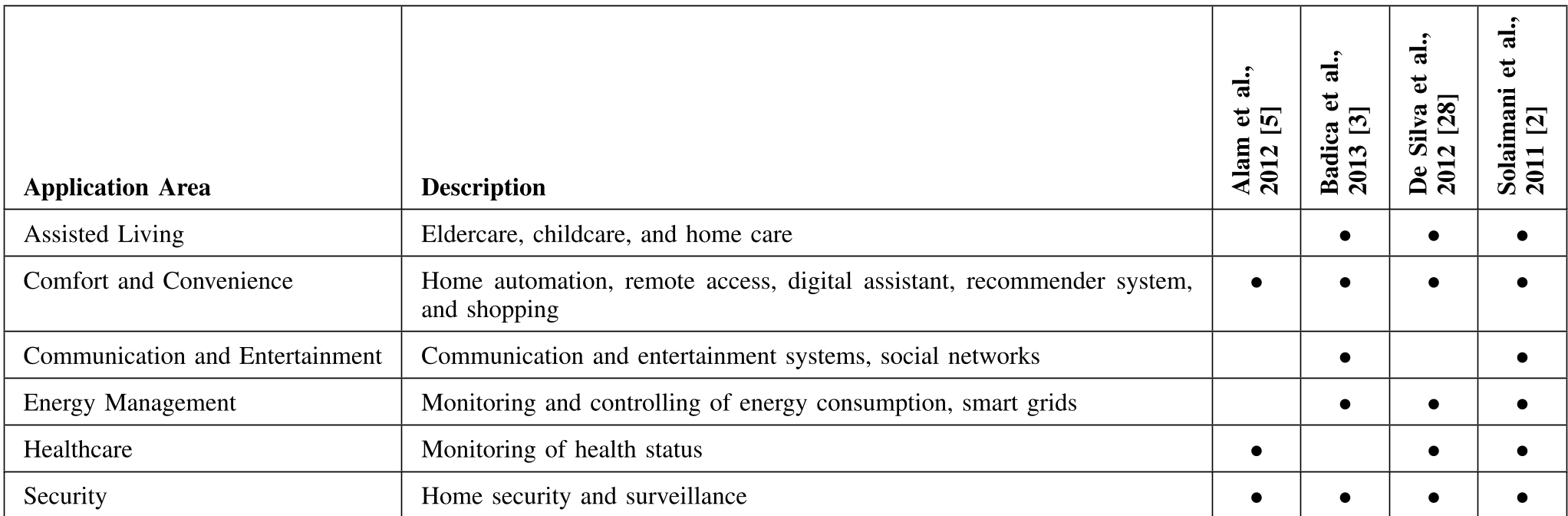 Table 1: A cross-comparison of application areas (Assisted Living, Energy, Healthcare) across existing state-of-the-art literature.
Critical Insights: Why This Matters
The most profound insight is the application of SNS to Assisted Living. In an aging society, a smart home that notifies "close peers" (family/caregivers) of unusual behavioral patterns via a social layer provides a safety net that local automation cannot. Furthermore, the "Social Energy Network" concept—where thousands of households coordinate energy loads via social-driven simulations—represents a massive leap in Smart Grid efficiency.
Conclusion & Limitations
The primary hurdle remains Privacy. Integrating social networks into the most private sphere of human life (the home) creates a high "creepiness factor." While the paper suggests technical solutions like anonymization, the social barrier is higher than the technical one.
Takeaway: Future smart home SOTA will not be defined by better sensors, but by better inter-home data synthesis and the ability to turn social context into actionable intelligence.