
Why Your Morning Jog Might Break Your Insulin Pump: A Deep Dive into Dynamic Context Analysis for Medical Apps
Analysis of Smart Mobile Applications for Healthcare under Dynamic Context Changes
This paper introduces a novel Model-Based Engineering (MBE) framework and a polynomial-time randomized analysis algorithm to evaluate Smart Mobile Medical Computing Systems (SMDCSes). The core method utilizes "ContextFSM" to model dynamic environmental changes and their impact on physiological control loops, specifically demonstrating how human mobility affects insulin infusion safety.
TL;DR
Researchers have developed a formalized method to predict when smart mobile medical apps will fail due to environmental changes. By modeling the "context" (like moving from indoors to outdoors) as a state machine coupled with physiological differential equations, they've proven that human mobility patterns directly impact the safety of life-critical systems like automated drug infusion.
The "Context" Crisis in Mobile Health
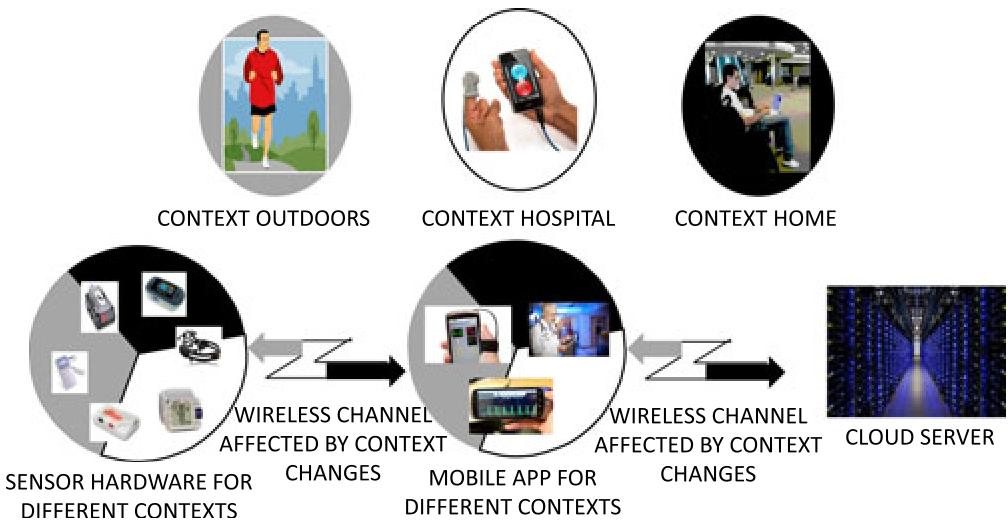
We treat smart health apps like standard software, but for a Cyber-Physical System (CPS), the boundary between the "app" and the "world" is dangerously blurred. Prior work often verified software code in isolation or used static laboratory settings. However, in the real world, a user shifts contexts—moving from a stable Wi-Fi zone (Home) to a high-interference street (Outdoor).
The authors argue that these random transitions create an intractable state space. If a wireless insulin pump loses packets because you walked behind a wall, the resulting "oscillation" in drug delivery isn't just a software bug; it's a physiological hazard.
Methodology: Bridging Discrete Logic and Continuous Biology
The researchers introduced ContextFSM, a mathematical construct where each state is a "Context" (a set of environmental variables) and transitions are governed by random human behavior (mobility, seizures, etc.).
The Analytical Core
The methodology integrates two disparate worlds:
- Discrete Control Algorithms (CA): The software logic.
- Cyber-Physical Interaction Functions (CPF): Spatio-temporal differential equations modeling how drugs diffuse in human tissue.
The breakthrough is a Randomized Analysis Algorithm. Instead of checking every possible sequence of events (which is exponentially impossible), they use the physics of "hitting times" in Markov chains to find the most probable sequences that lead to failure in polynomial time.
Experiments: The Levy Walk Danger
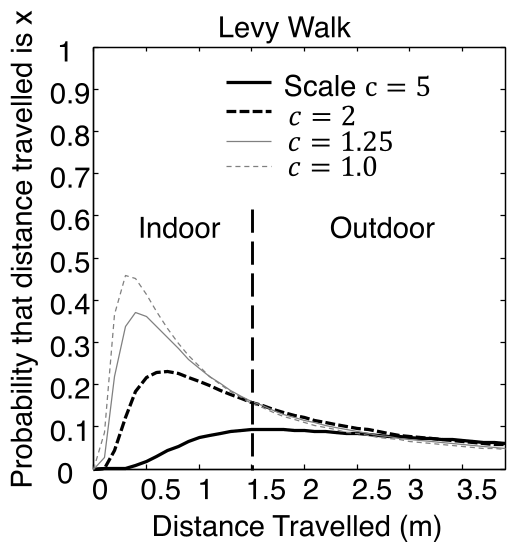
One of the most striking findings involves human mobility models. The paper compares Random Walk (short, local movements) with Levy Walk (bursty, long-distance movements characteristic of real humans).
- Finding: Levy walks cause more frequent "Outdoor" visits where wireless signals are weaker (PDR = 0.4).
- Impact: In the insulin pump simulation, these frequent outdoor excursions led to significant drug overshoots because the controller couldn't receive timely feedback to stop the pump.
Sustainability vs. Safety
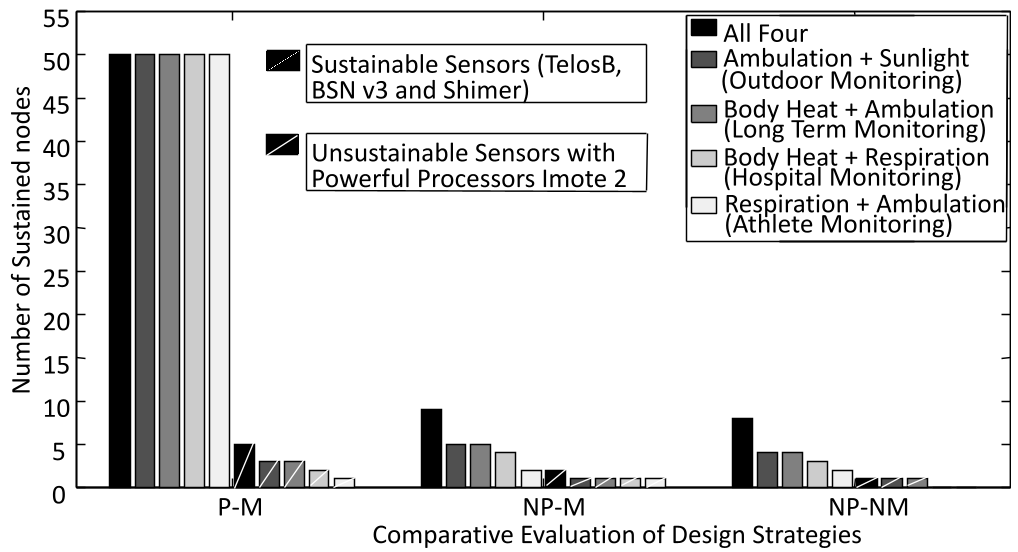
The paper also explores the "Ayushman" system, highlighting a classic engineering trade-off. Energy scavenging (from body heat or sunlight) is intermittent. By simulating these contexts, the authors could calculate exactly how much "Radio Duty Cycling" (sleeping) a sensor needs to survive 30 days while still meeting the safety requirement of detecting a heart arrhythmia within 5 seconds.
Critical Insight: From Testing to Modeling
The industry current standard is "Static Software Testing," but this paper suggests the FDA and developers must move toward Integrated Modeling. By using AADL to specify how software interacts with the human body before writing a single line of production code, developers can identify unsafe mobility-related failures that no amount of code-linting would ever find.
Conclusion
This work transforms "user context" from a vague concept into a rigorous mathematical variable. The move toward polynomial-time randomized analysis allows us to verify complex healthcare apps without waiting for an infinite simulation to finish. As we move toward autonomous "Closed-Loop" medical devices, treating the user's walk to the park as a system input is no longer optional—it's a requirement for survival.