
Decoding the Sydney Commute: A Machine Learning Approach to Traveler Satisfaction
Smart Mobility Improvement: Classifying Commuter Satisfaction in Sydney, Australia
This paper presents a machine learning-based approach to classify commuter satisfaction in Sydney, Australia, specifically focusing on the Macquarie Park business corridor. By evaluating Decision Trees, Support Vector Machines (SVM), and Neural Networks, the study identifies that different models specialize in different sentiment polarities, with SVM excelling at identifying satisfied commuters and Neural Networks better at detecting unsatisfied ones.
TL;DR
This research tackles the "human element" of smart cities by applying machine learning to classify commuter satisfaction in Sydney's Macquarie Park. By comparing Decision Trees, SVMs, and Neural Networks, the study reveals a specialized performance landscape: SVMs are most accurate at identifying happy commuters, while Neural Networks are superior at detecting frustration.
Background: The Human Dimension of Smart Mobility
Most "Smart City" projects focus on the infrastructure—sensors, GPS tracking, and traffic flow algorithms. However, a city is only as "smart" as its residents are satisfied. This paper shifts the focus toward Smart Mobility, aiming to understand why travelers in "Australia’s Silicon Valley" (Macquarie Park) choose specific transport modes and how those choices impact their daily experience.
Problem: The Blind Spot in Urban Analytics
Prior research has been excellent at predicting where a bus is, but poor at predicting how the person on that bus feels. The difficulty lies in the high variance of subjective feedback and the lack of structured labels in historical transportation data.
Methodology: A Multi-Model Comparison
The author analyzed 19,000 observations using nine key features, including demographic data, departure/arrival times, and geographic postcodes.
1. Decision Trees (The Interpretability King)
Using an entropy-based induction process, the author generated a pruned tree to extract "Rules of Thumb" for satisfaction.
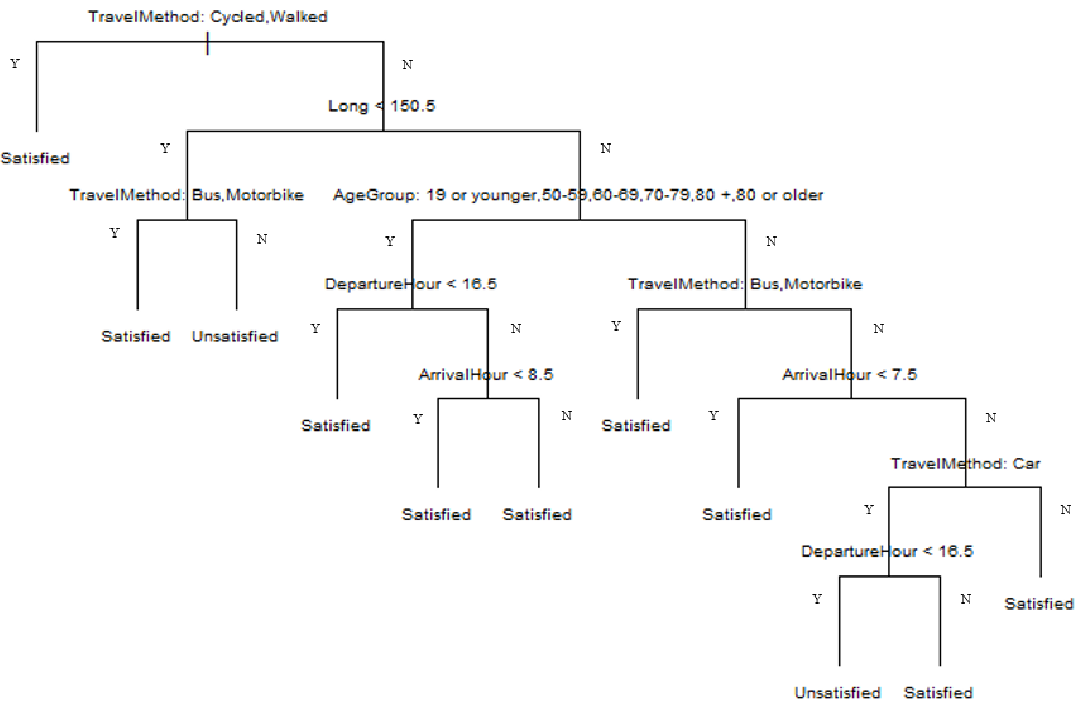 Insight: The tree suggests that Travel Method, Age Group, and Departure Time are the three pillars of a commuter's mood.
2. Support Vector Machine (The Precision Specialist)
By utilizing a Radial Basis Function (RBF) kernel, the researcher mapped the data into high-dimensional space to find the optimal separating hyperplane.
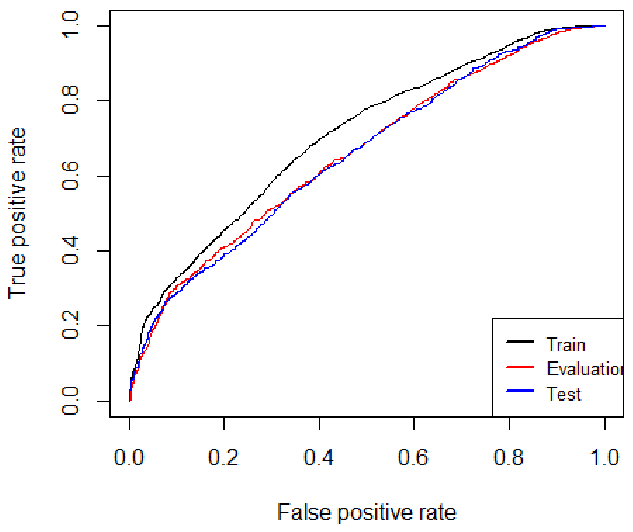
3. Neural Networks (The Complexity Capture)
A two-hidden-layer architecture was found to be the sweet spot for capturing the nuanced reasons behind traveler dissatisfaction.
Experimental Analysis: No "One Size Fits All"
The results present a fascinating trade-off in model selection.
| Model | Accuracy (Satisfied) | Accuracy (Unsatisfied) | Performance (Training Speed) |
|---|---|---|---|
| SVM | ~90% (Winner) | ~30% | Moderate |
| Neural Network | ~13% | ~88% (Winner) | Fast |
| Decision Tree | ~85% | ~30% | Instantly (Winner) |
Key Findings:
- SVM is the go-to for identifying what makes a commute "good."
- Neural Networks are highly sensitive to the features that define a "bad" commute, making them essential for identifying pain points in urban infrastructure.
- Decision Trees offer the best "Bang for the Buck," providing nearly instant results with human-readable logic.
Critical Insights & Future Outlook
This work demonstrates that "Smart Mobility" improvement is not just about faster buses, but about targeted interventions.
The Limitation: The models currenty run as "Black Boxes" (specifically SVM and NN), which makes it difficult for urban planners to know exactly what to change in the infrastructure to flip an "Unsatisfied" label to "Satisfied."
Future Directions: Integrating Real-time GPS data with this satisfaction classification could allow for "Dynamic Sentiment Routing," where commuters are warned of routes that are currently causing high levels of traveler frustration.
Conclusion
The study concludes that improving city life requires a hybrid approach. By leveraging the specific strengths of multiple ML architectures, Sydney and other global cities can move beyond simple traffic management into the era of truly intelligent, citizen-centric smart mobility.