
ODIN: Moving Beyond "Thin" Social Science with High-Dimensional Trajectories
Towards a Smart(er) Social Science Using High-Dimensional Continuous-Time Trajectories from the Open Dynamic Interaction Networks (ODIN) Platform
This paper introduces Open Dynamic Interaction Networks (ODIN), a comprehensive software platform designed for high-dimensional social science research. ODIN combines passive mobile sensing with context-aware dynamic surveys to capture continuous-time trajectories of human behavior and interpersonal interaction, successfully enabling "thick description" of social phenomena.
TL;DR
The Open Dynamic Interaction Networks (ODIN) platform is a breakthrough in behavioral science that replaces static "freeze-frame" social network snapshots with high-dimensional, continuous-time trajectories. By integrating passive sensor data (GPS, Bluetooth, Accelerometer, ECG) with adaptive, context-triggered surveys, ODIN allows researchers to capture not just what people are doing, but the subjective meaning behind their interactions in real-time.
Beyond Social Physics: The Need for "Thick Description"
For decades, Social Network Analysis (SNA) has relied on the metaphor of a graph—nodes and edges that are largely assumed to be stable. While models like ERGM and SIENA have advanced our understanding of network evolution, they still simplify complex human relationships into discrete links.
The authors argue that this "social physics" approach results in thin description. It misses the nuances of a "conspiratorial wink" versus an "involuntary blink." To achieve thick description, we need data that reflects the reflective and contextual nature of human life. ODIN provides the missing link: a way to ask the right question at exactly the right time (e.g., asking about social anxiety only when the sensors detect the participant is in a crowded bar).
The Technical Core: How ODIN Works
ODIN’s innovation lies in its ability to bridge the gap between raw data and human meaning through three components:
1. The Mobile Platform & Rule-Based Triggering
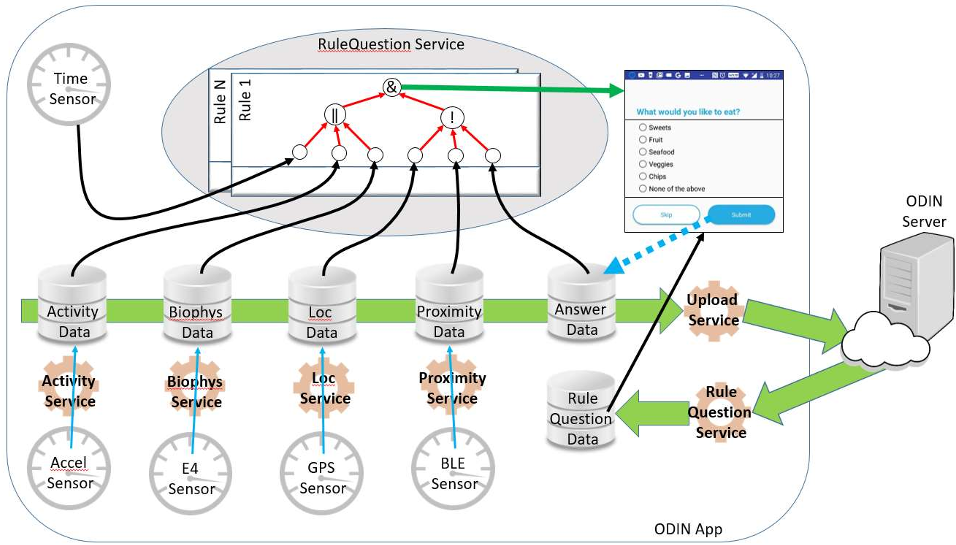
The mobile app doesn't just record data; it thinks about context. The RuleQuestion Service monitors sensor signatures to fire questions.
- OnArrival/OnDeparture: Triggers questions when entering specific Geofences.
- OnInteractionEnd: Detects via Bluetooth (BLE) when a social interaction has concluded and queries the participant about the nature of that interaction.
- OnPhysiologyChange: Can prompt a user if their heart rate or skin temperature spikes unexpectedly.
2. From Discrete Samples to Continuous Trajectories
Sensors sample data at intervals (e.g., every 5 minutes), creating "gaps." ODIN’s Analytics Library solves this using sophisticated imputation:
- Linear Interpolation: For smooth signals like heart rate.
- Categorical-Nearest-Value: For states like "at home" vs. "at work."
- Copy-Last-With-Decay: Essential for survey responses, where a "yes" to a craving question might remain valid for an hour before reverting to a default state.
Evaluating Reliability: The Reality of Mobile Hardware
The researchers rigorously tested ODIN on various Android devices (Motorola, Huawei). While the sensors themselves were highly reliable (missing data < 5%), the complex rules faced challenges from the Android OS.
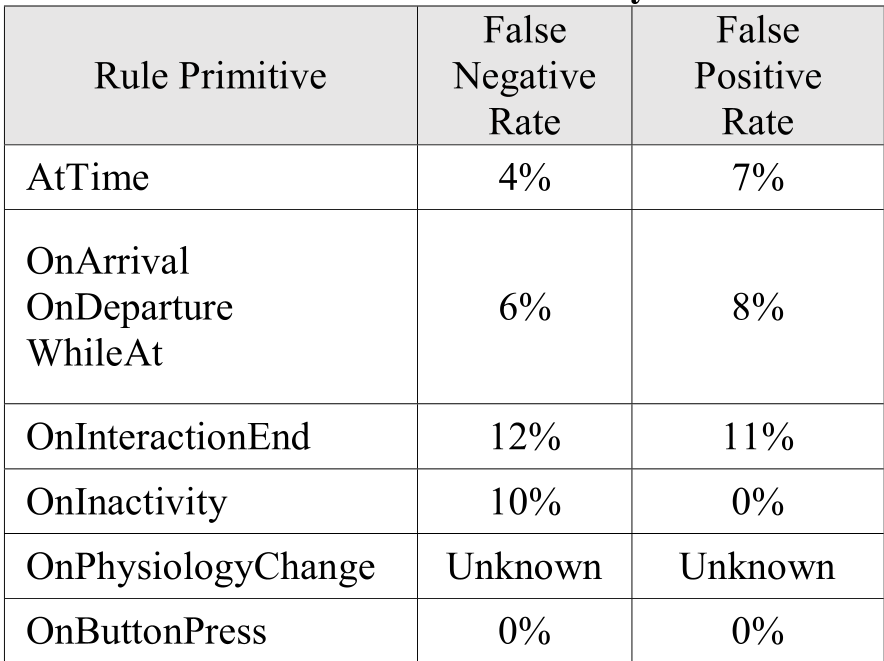
- Key Insight: The false negative rates (up to 12% for interactions) are primarily due to aggressive battery-saving "sleep" policies implemented by hardware vendors, rather than sensor failure.
Real-World Application: Class Interactions
A pilot study of 19 students illustrated the power of the platform. By projecting high-dimensional data into a single dimension (interaction count), researchers could visualize the "rhythm" of a student's day.
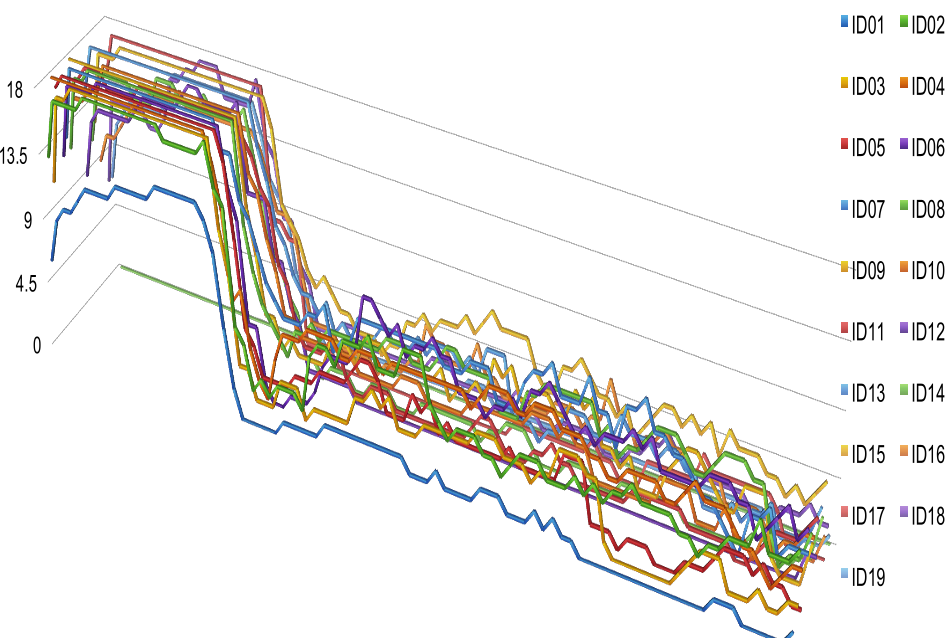 Figure: The spikes represent students in a 9 am lecture, followed by the diverse social patterns of lunchtime and afternoon hours.
Future Outlook
ODIN represents a shift toward a "smarter" social science. By moving away from static networks and toward continuous-time trajectories, researchers can finally disentangle homophily (we are friends because we are similar) from diffusion (I became like you because we are friends). Future iterations aim to integrate EEG headsets and refine power management to reduce the impact of OS sleep cycles on real-time rule firing.
Takeaway: In an era of "Big Data," ODIN reminds us that the quality and timing of data are just as important as the quantity.