
SmartCrowd: Bridging the Gap Between Rigid Workflows and Creative Crowdsourcing
SmartCrowd: A Workflow Framework for Complex Crowdsourcing Tasks
This paper introduces SmartCrowd, a workflow framework designed for complex and creative crowdsourcing tasks. It utilizes a state machine-based modeling approach that translates visual designs into executable SCXML code, enabling dynamic task decomposition and runtime flexibility.
TL;DR
Crowdsourcing has long been synonymous with simple data entry (Micro-tasks). However, creative work—like writing an article or designing software—is interdependent and non-linear. SmartCrowd is a new framework that uses State Machines and SCXML to allow "crowd-workers" to not just do the work, but also decide how to decompose the tasks at runtime. It transforms the crowd from a manual labor force into a collaborative engineering team.
The Problem: The "Rigid Workflow" Trap
Most existing crowdsourcing platforms (like Amazon Mechanical Turk) or technical frameworks (like CrowdForge) treat workflows as static directed graphs.
- The Limitation: Requesters must define every step in advance.
- The Creative Conflict: In creative tasks, you don't know the next step until you've finished the current one. If a writer realizes a section needs a photo, a subtask for "photography" must be created dynamically—something static workflows cannot handle.
- Human Intelligence Gap: Workers are usually excluded from the "planning" phase, forcing the requester to act as a bottleneck for every decomposition decision.
Methodology: State Machines as the Engine of Creativity
The authors propose that creative tasks aren't just series of steps; they are states of a system. By using Statecharts, SmartCrowd provides three critical features:
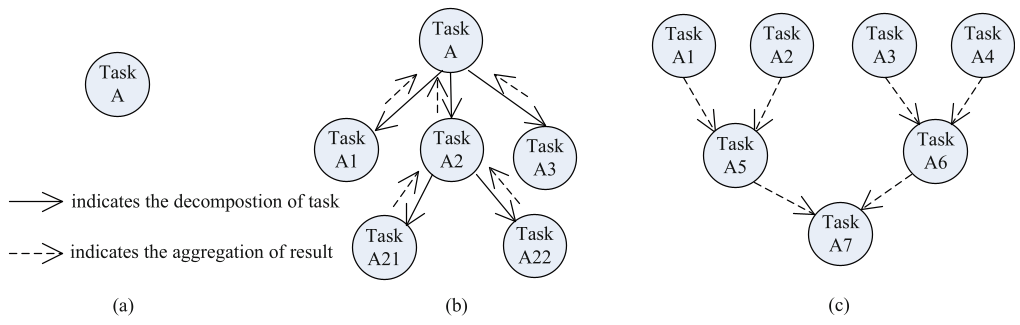
- Hierarchy and Recursion: A "Parent Task" state can spawn "Child Task" state machines. This allows for infinite nesting (e.g., an article task spawns a chapter task, which spawns a paragraph task).
- Event-Driven Communication: Tasks communicate via internal events. A "Finished" event from a child can trigger a "Review" state in the parent.
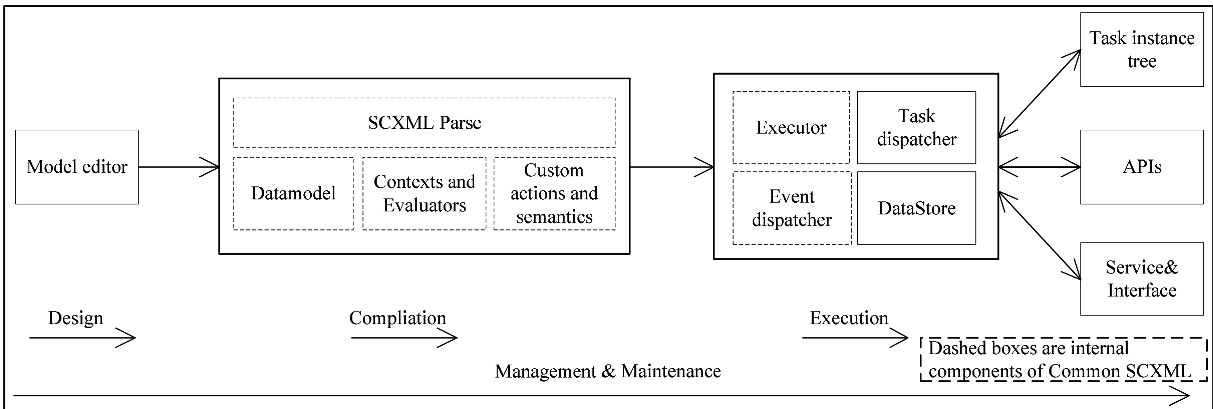
- SCXML Execution: By using the W3C standard SCXML, the framework interprets visual models into executable Java code via the Apache Commons SCXML engine, eliminating the need for hard-coding complex logic.
The Task Instance Tree
To keep track of this dynamic complexity, SmartCrowd introduces the Task Instance Tree. As workers vote to decompose an outline into three parts, the tree grows three new nodes. If one of those nodes is found to be too complex, it spawns its own children.
Real-World Application: Crowdsourced Writing
The researchers tested SmartCrowd on a MapReduce writing task. Unlike previous attempts where the "Map" (Decomposition) and "Reduce" (Merging) stages were fixed, SmartCrowd allowed the crowd to:
- Vote on whether a section was "Too Complex."
- If "Yes," the state transitioned to a
Decomposingstate where workers proposed sub-structures. - The best sub-structure was selected via a
DecomposeVotingstate.
This ensures that the workflow adapts to the difficulty of the content, rather than following a blind, pre-set path.

Key Design Patterns for Crowdsourcing
One of the paper's most valuable contributions is the categorization of crowdsourcing into four executable patterns:
- Collection: Fixed number of independent subtasks.
- Contest: Parallel work followed by a selection of the "best" answer (Tournament style).
- Collaboration: Dynamic decomposition where subtasks are unknown until runtime.
- Interaction: Concurrent subtasks that exchange data (events) mid-execution.
Critical Insight & Conclusion
SmartCrowd's use of State Machines is a brilliant application of a classic computer science concept to a modern human-computation problem. By moving away from Task A -> Task B logic to a State + Event -> New State logic, the framework captures the "chaos" of human creativity within a manageable, auditable technical structure.
Future Outlook: The ability to dynamically orchestrate human intelligence at scale is the key to creating higher-quality datasets for AI and solving problems that still evade LLMs. SmartCrowd sets the stage for "Crowd-AI" hybrids where humans manage the architecture and AI handles the micro-tasks.
Disclaimer: This research was supported by the National Natural Science Foundation of China.