
SmartGW: Slashing Cloud Costs for the Social TV Era
SmartGW: Enabling Bandwidth-Efficient Group Watching in Cloud Social TV Systems
SmartGW is a group-aware bandwidth management scheme designed for Cloud Social TV systems to enable efficient Group Watching. It utilizes a group coordinator and P2P data exchange within clusters of virtual machines (cloud clones) to reduce redundant video downloads, achieving SOTA-level cost reduction and QoE stability.
Executive Summary
As television shifts from a "laid-back" experience to an interactive social paradigm, Group Watching (GW)—the ability to watch synchronized content with remote friends—has become a killer feature. However, for service providers, this feature is a "bandwidth monster."
This post explores SmartGW, a research work that tackles the prohibitive operational costs of Cloud Social TV. By intelligently exploiting the social and geographical locality of users, SmartGW reduces bandwidth costs by 15% while simultaneously improving the Quality of Experience (QoE). It positions itself as a critical bridge between stochastic network optimization theory and practical cloud multimedia deployment.
The Bottleneck: The "Cloud Clone" Redundancy
In current cloud-centric social TV systems, every user is represented by a Cloud Clone (a Virtual Machine). When a group of 100 friends watches a football game together, 100 separate VMs traditionally download 100 identical video streams from the source.
The Problem:
- Redundancy: Extreme bandwidth wastage on the link between the Content Source and the Cloud Data Center.
- Cost: Bandwidth is the primary operational expense in cloud services (e.g., Azure or AWS egress fees).
- QoE Volatility: Without a group-aware strategy, bandwidth is often shared unfairly, leaving large groups or premium users with sub-par bitrates.
Methodology: The SmartGW Framework
Instead of treating every stream as independent, SmartGW introduces social-awareness into the network layer.
1. Group-Aware Architecture
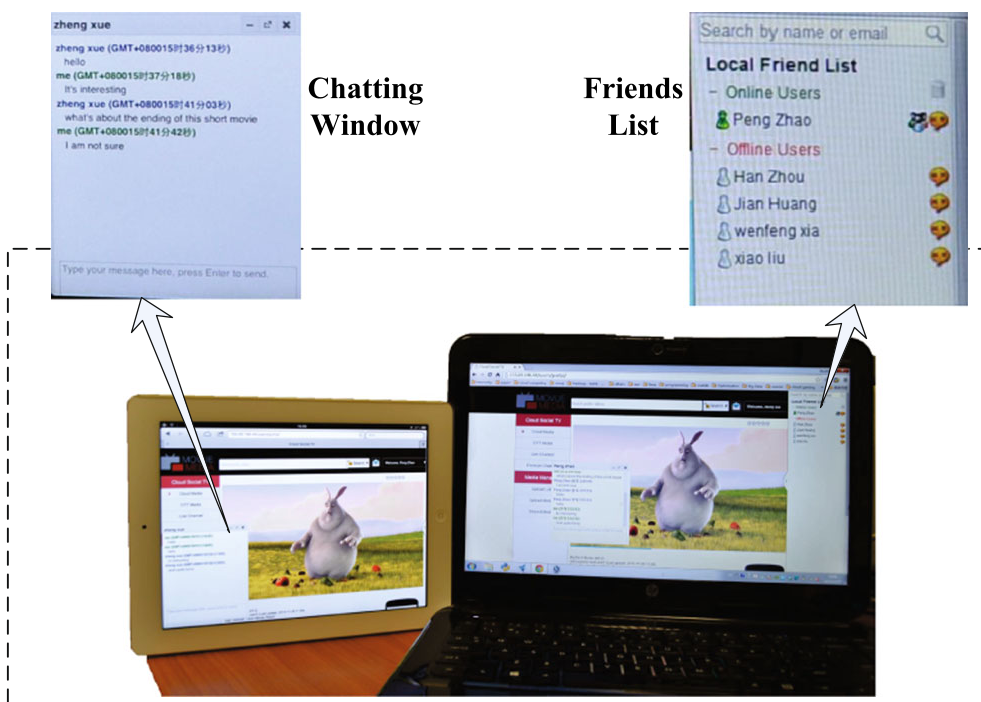
As shown in the architecture below, SmartGW designates a Group Coordinator. This coordinator downloads a single stream and uses P2P-style data exchange to distribute chunks to other clones within the same datacenter.
2. Operational Brain: Lyapunov Optimization
The core of the paper is the formulation of a Constrained Stochastic Optimization problem. The goal is to minimize cost subject to a minimum average QoE .
The authors use Lyapunov Drift-Plus-Penalty theory to turn this "long-term average" problem into an "instantaneous" decision problem. It creates a Virtual Queue that tracks how much the current QoE has deviated from the target. If grows too large, the system prioritizes QoE; if is small, it prioritizes saving money.
Experiments and Performance
The researchers validated SmartGW using a real-world trace from Sina Weibo, simulating 3.18 requests per time slot with an average group size of 53 users.
Key Breakthroughs:
- Cost Efficiency: SmartGW consistently outperformed LPFA (Load-aware Fair Allocation) and LPWFA (Weighted Fair). While the baselines focused only on current load, SmartGW's dynamic provisioning reduced costs by over 15%.
- Stable QoE: As seen in the results, SmartGW is the only algorithm that manages to keep the "QoE Queue" stable, ensuring users receive a consistent Mean Opinion Score (MOS).
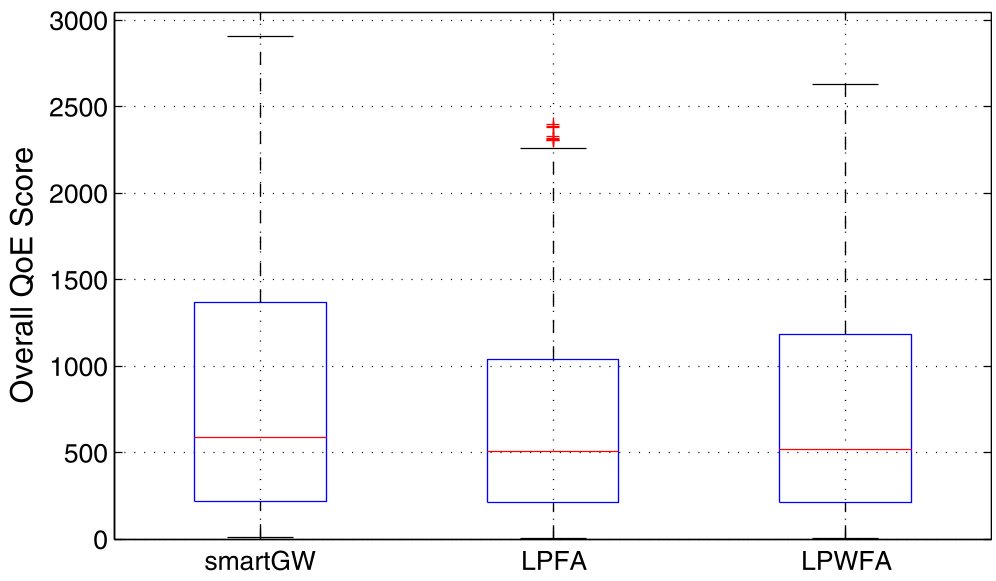 Figure: Cumulative bandwidth cost over 1000 time slots.
The Premium User Advantage
SmartGW includes a "bonus weight" () for premium users. The optimization naturally prioritizes high-value users when bandwidth is tight, ensuring that the service provider meets its Service Level Agreements (SLAs) without over-provisioning for the entire group.
Critical Analysis & Conclusion
SmartGW is a masterclass in applying control theory to cloud resource management.
The Takeaway: The "physics" of social networks (locality) can be used to optimize the "math" of cloud infrastructure. By moving the distribution burden from the content source to intra-datacenter P2P, we can make social TV economically viable.
Limitations: The paper assumes most group members are in the same datacenter due to geographical locality. If a group is globally dispersed, the "intra-datacenter" traffic benefit vanishes. Future work integrating Software-Defined Networking (SDN) or Edge Computing could further refine these results by optimizing the physical network paths between different cloud regions.
Main Reference: Xue et al., "SmartGW: Enabling Bandwidth-Efficient Group Watching in Cloud Social TV Systems," Springer Science+Business Media, 2015.