
Portolan: Turning the Global Smartphone Fleet into a Network Microscope
15218_Smartphone-based crowdsourcing for network monitoring Opportunities, challenges, and a case study.
This paper introduces Portolan, a modular smartphone-based crowdsourcing framework designed for large-scale network monitoring. It leverages the ubiquity and mobility of smartphones to perform tasks like Internet AS-level topology mapping and cellular signal strength fingerprinting, achieving fine-grained data collection at the network edge.
TL;DR
The ever-expanding complexity of the Internet has outpaced our ability to monitor it using traditional, centralized methods. This paper proposes a crowdsourcing paradigm using smartphones as "micro-monitors." By deploying a system called Portolan, the researchers demonstrated they could discover network paths—specifically 21.8% of AS-level links—that professional global entities like CAIDA had completely missed.
Background: The Centrifugal Force of Monitoring
For decades, we measured the Internet from the backbone. But today’s Internet is "user-centric." The most critical performance metrics and structural changes happen at the edge—in WiFi hotspots, cellular cells, and behind private NATs. The authors argue that monitoring must follow this "centrifugal force" toward the periphery. Smartphones are the perfect vehicle for this because they are always-on, geolocalized, and vastly distributed.
Challenges: The Price of Crowdsourcing
While the "power of the masses" is great, managing a fleet of unmanaged, battery-dependent devices is a technical nightmare:
- Resource Scarcity: Unlike PCs, smartphones have strict energy budgets. Tasks must be "parcelable" into micro-tasks that consume less than 1% of battery.
- Connectivity Barriers: Most mobile devices are behind NATs or firewalls. Portolan solves this by using a polling-based interaction where the client initiates the connection to a Proxy server.
- Control Loss: The central authority cannot force a device to stay on. The system must handle duplicate tasks and asynchronous results to ensure data integrity.
Methodology: The Portolan Architecture
The core of the system is a modular task-distribution engine. It uses XML-defined campaigns that are broken down into microtasks.
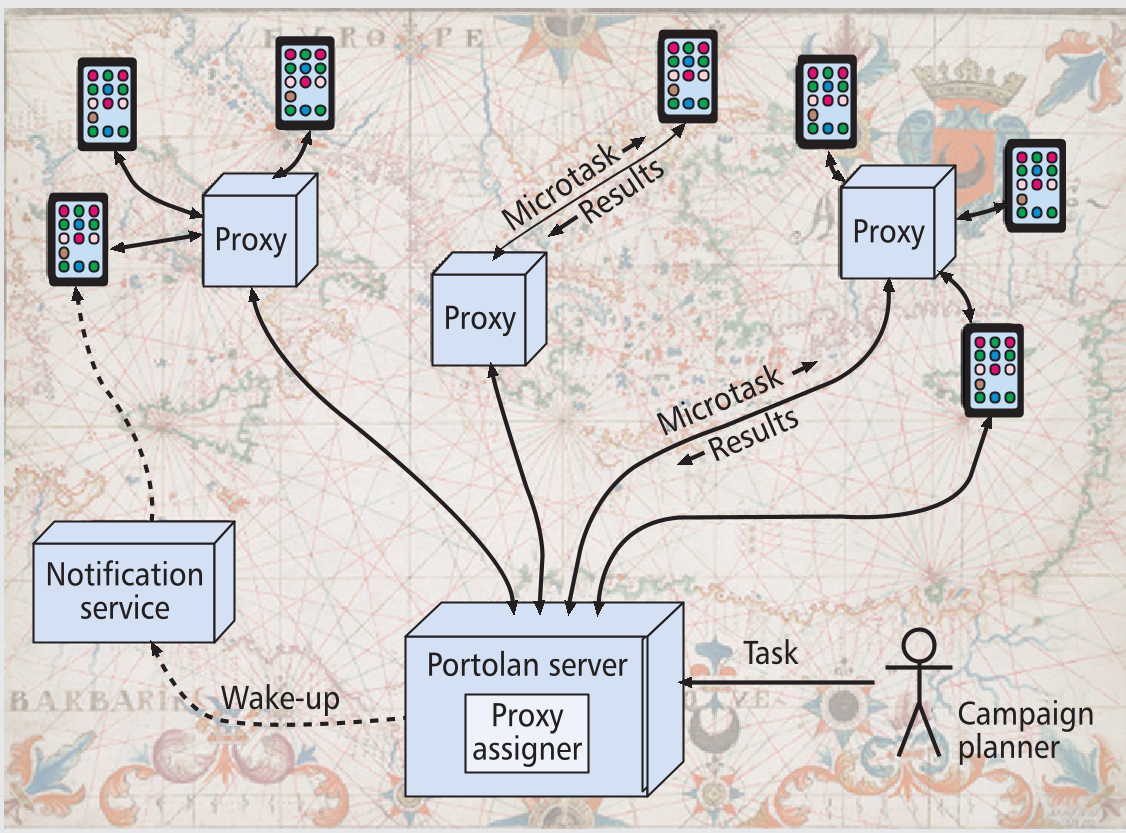
Key features include:
- Geographical Proxies: To ensure scalability, proxies are distributed (e.g., at the country level) to handle subsets of the crowd.
- Active vs. Passive Sensing: The system can trigger "Active" probes like
tracerouteor "Passive" tasks like logging Signal Strength (RSS) via the Android location provider without waking up the GPS unnecessarily. - Privacy via Pseudo-IDs: Devices are identified by random IDs to decouple physical users from their measurement data.
Experimental Results: Beating the SOTA
The most striking evidence of Portolan’s value came from its Internet Mapping Campaign. By running 435,000 traceroute operations from just ~100 users in Italy, the system mapped the Autonomous System (AS) graph.
- The Discovery Gap: Out of 1,117 links discovered, 21.8% were unknown to CAIDA (a world-leading Internet research project).
- Why? Because CAIDA depends on fixed vantage points. Portolan’s monitors are mobile; they access the web through different ISPs and cell towers as users move, providing a "multi-view" perspective that fixed monitors can't replicate.
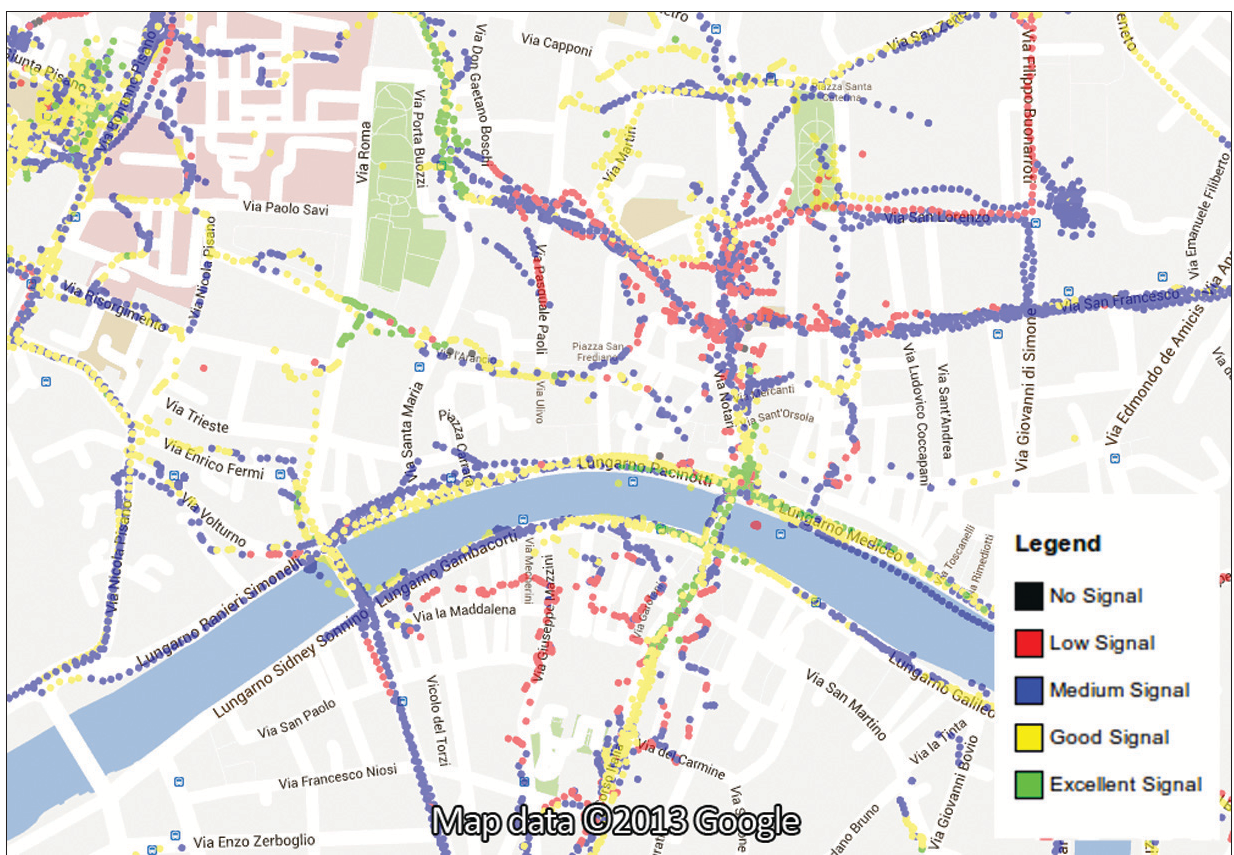
Critical Insight & Conclusion
This work validates that diversity of location is more valuable than raw compute power in network sensing. Even with cheap smartphone hardware, the sheer Variety of entry points into the network allows us to see "behind the curtain" of ISPs and carriers.
Future Outlook: While Portolan proved the concept, the future of such systems lies in Net Neutrality monitoring. As ISPs increasingly differentiate traffic (e.g., throttling YouTube or BitTorrent), a crowdsourced fleet of smartphones is arguably the only way to hold carriers accountable by detecting these violations directly at the end-user interface.
Takeaway: If you want to see the whole world, don't use a few massive telescopes; use a billion tiny mirrors.