
SNAP: Bridging the Gap Between Implicit Digital Footprints and Ground-Truth Social Networks
SNAP: Towards a Validation of the Social Network Assembly Pipeline
This paper introduces and validates SNAP (Social Network Assembly Pipeline), a framework for large-scale actor identification and tie inference from non-relational electronic data. Using an airline passenger dataset, the authors demonstrate SOTA-level precision (87.72%) in relationship prediction by combining automated heuristics with human-verified ground truths.
TL;DR
Researchers have developed SNAP (Social Network Assembly Pipeline), an automated framework designed to transform noisy, non-relational electronic data (like airline bookings) into verified social graphs. By validating automated predictions against a targeted user study, the team achieved nearly 90% precision, proving that machines can not only reconstruct our social circles but also "remind" us of connections we have personally forgotten.
Background: The Ground-Truth Crisis
In the world of Social Network Analysis (SNA), we often build complex models on "shaky ground." Most community-finding algorithms are judged by internal metrics like modularity rather than whether the "community" actually exists in the real world. This paper addresses the fundamental lack of ground-truth by creating a feedback loop between automated data mining and human verification.
Problem & Motivation: The Noise in the Machine
Unlike Facebook or LinkedIn, where relationships are explicitly defined, most "big data" sources (emails, phone logs, travel bookings) contain only implicit traces.
- Prior Work Limitations: Most studies focus on either manual surveys (accurate but small-scale) or automated mining (large-scale but unvalidated).
- The Challenge: Noise is rampant. A corporate travel agent booking flights for 50 employees makes them look like a "clique" on paper, even if they have never spoken.
- Insight: The authors argue that while humans are bad at recalling everyone they know (Recall), they are excellent at recognizing names from a list (Recognition). SNAP leverages this cognitive quirk to validate its pipeline.
Methodology: The SNAP Architecture
The SNAP framework decomposes the problem into three logical stages, each influencing the next:
- Actor Identification: Using SVM classifiers to determine if "John Doe" in booking A is the same as "J. Doe" in booking B.
- Tie Inference: Utilizing six specific rules (e.g., booked together, same home address, shared email domain) to hypothesize a link.
- Tie Strength: Weighting these rules based on domain expertise (e.g., traveling multiple times together is a stronger signal than a shared email domain).
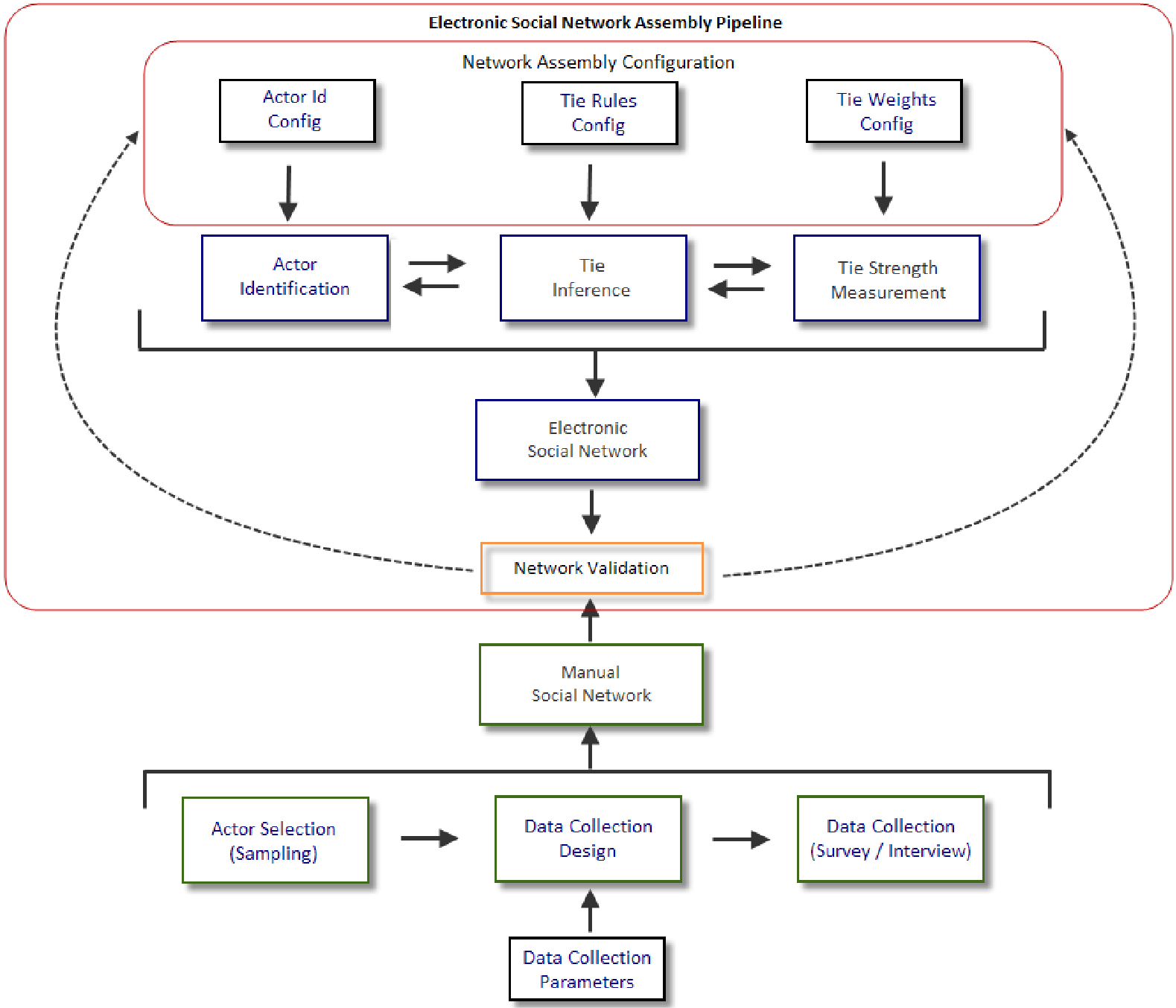
The genius of this approach lies in the feedback loop. Errors in actor identification (treating one person as two) propagate through the network. By using a C4.5 decision tree on manual validation data, the authors "fine-tuned" these rules to filter out accidental "commuter acquaintances" from genuine social ties.
Experiments & Results: Better Than Human Memory?
The study used an airline dataset spanning 18 months, resulting in a graph of 21,674 nodes and over 635,000 edges.
Key Findings:
- High Precision: 87.72% of predicted top-tier links were confirmed as real by participants.
- The Recall Gap: Participants failed to recall an average of 2.26 travel partners that SNAP correctly identified. This highlights the "Recall vs. Recognition" advantage of electronic logs.
- Optimization: Integrating a decision tree improved precision to 89.33%, showing that ground-truth samples can be used to re-calibrate the entire large-scale network.
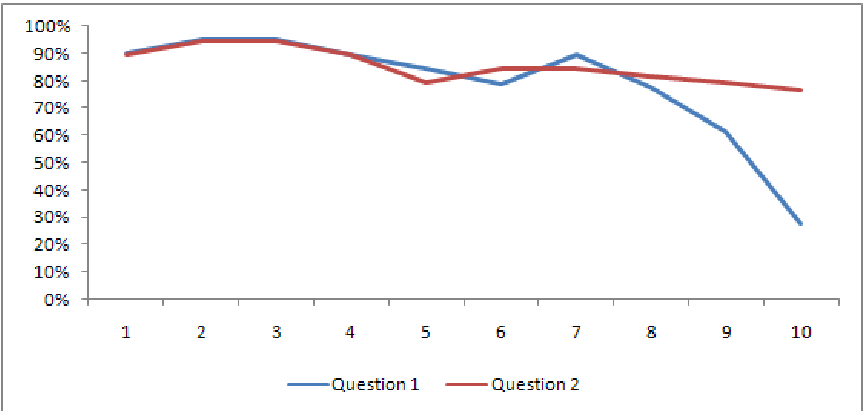 The chart above illustrates the expected decay: as predicted link strength decreases (higher rank number), the precision drops, highlighting the need for a "strength threshold" in social graph assembly.
Critical Insight: The Propagation of Error
One of the paper's most salient observations is how a single failure in Actor Identification (e.g., failing to merge a user's business and leisure profiles) creates "ghost" nodes. These ghosts then weaken the overall network structure.
The authors also touch on Privacy and Ethics. Surprisingly, most participants were "excited" rather than "scared" by the network's accuracy, particularly when it highlighted high-value customers for the airline—a testament to the double-edged sword of modern data transparency.
Conclusion & Future Outlook
SNAP proves that implicit data is a goldmine for social structure, provided we account for the reliability of predicted links. Future work needs to explore how these "assembled" networks affect high-level analysis like information diffusion—if we only keep the "top n" most certain links, do we lose the "weak ties" that often drive viral growth?
For technical leads and data architects, the takeaway is clear: Never trust your implicit links without a validation pipeline. The future of SNA isn't just bigger data; it's better-calibrated data.