
SNSaPP: Restoring Truth to Social Media by Neutralizing Paid Posters
SNSaPP: Unbiased Social Media Analysis Against Paid Posters
The paper introduces SNSaPP, a comprehensive social media analysis system designed to detect "paid posters" (internet water armies) and generate unbiased celebrity rankings and event influence estimates. It utilizes a hybrid LSTM-rule detection engine and Inverse Propensity Weighting (IPW) to filter manipulation and restore data veracity.
TL;DR
SNSaPP is an end-to-end analytical system developed to detoxify social media data. By identifying "internet water armies" through deep learning and applying causal inference (IPW) to ranking algorithms, it extracts the genuine "signal" of public opinion from the "noise" of paid manipulation.
Context: The Invisible Hand on Your Feed
The digital town square is under siege by Paid Posters—entities hired by PR teams and political actors to shepherd public awareness. Whether it’s burying a corporate scandal or artificially boosting a movie’s box office through "social proof," these actors exploit the core mechanics of social platforms: engagement-based ranking.
The authors argue that existing systems are vulnerable because they treat all "likes" and "comments" as equal. SNSaPP moves the needle from simple detection to correction, providing a transparent, unbiased view of what people actually think.
Methodology: Detection Meets De-biasing
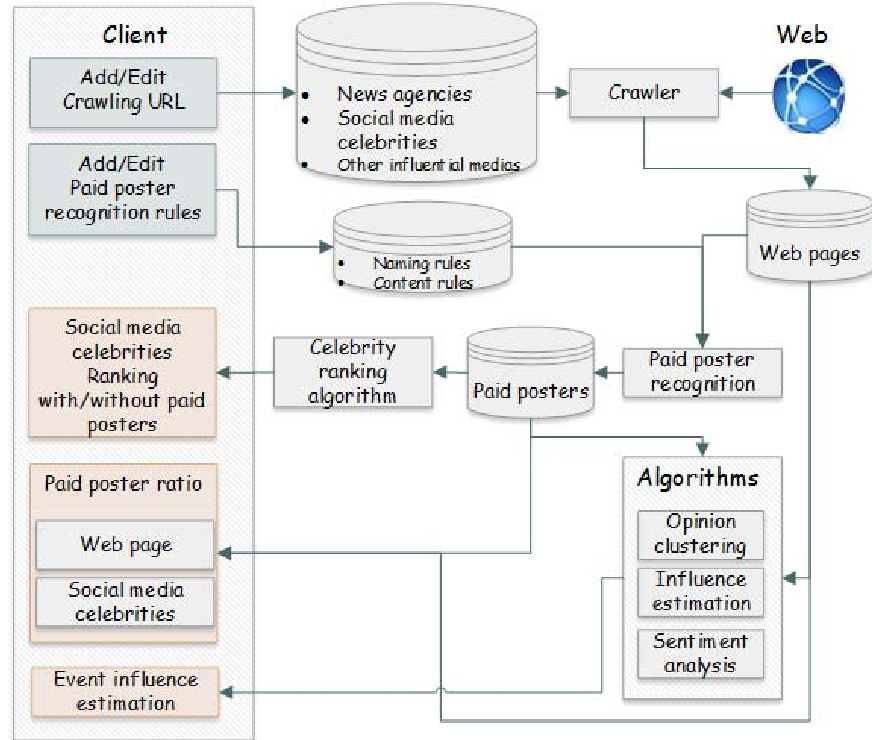
SNSaPP’s architecture is built on a four-stage pipeline: Crawling, Management, Influence Estimation, and Unbiased Ranking.
1. The Two-Stage Scalable Detection
Detecting 20 million accounts requires a balance of speed and precision.
- Step 1 (Rules): High-quality heuristic rules filter out obvious bots based on account names and homepage patterns.
- Step 2 (Deep Learning): An LSTM-based classifier processes the remaining suspicious accounts to identify more sophisticated human-operated or AI-generated paid content.
2. Causal Correction with IPW
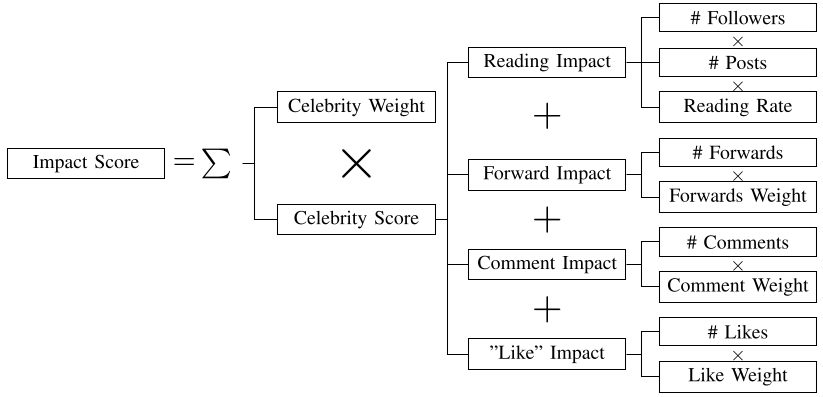
The most technical innovation is the use of Inverse Propensity Weighting (IPW). Instead of just deleting suspected paid posters—which might lead to data loss—the system calculates an "impact score" that penalizes actions likely to be inorganic.
The score for a celebrity on event is weighted by the probability that a specific interaction was not performed by a paid poster. This ensures that a celebrity’s rank is determined by real human resonance rather than a purchased bot farm.
Analyzing "The Wandering Earth" Case Study
The system's utility is showcased using the Chinese blockbuster The Wandering Earth.
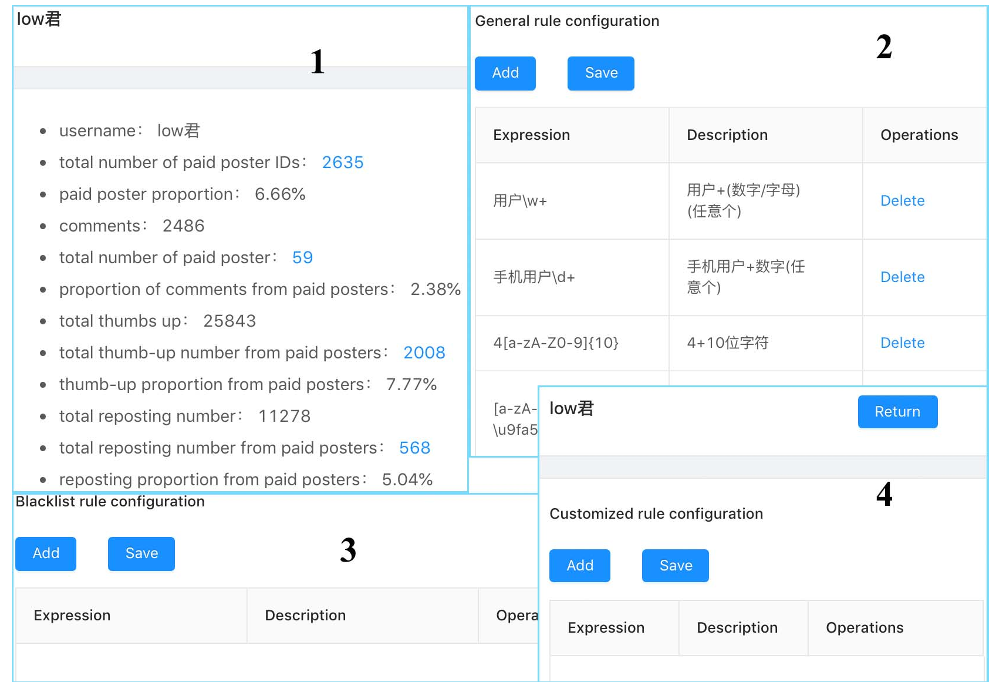
The results were revealing:
- Quantified Distortion: The total event impact (78) was nearly 40% driven by paid posters (33).
- Sentiment Divergence: Paid posters utilized extreme polarized language (e.g., calling the film "the best ever" or criticizing it based on "political correctness"), while organic users concentrated on director performance and Hollywood comparisons.
- Volume vs. Veracity: 9.97% of users were identified as paid posters, yet they contributed a disproportionate amount of the "noise" that shaped the trending list.
Deep Insight & Conclusion
SNSaPP shifts the perspective of social media moderation from content removal to algorithmic accountability. By providing users with both the "raw" and "unbiased" rankings, it empowers decision-makers—corporate managers and the public alike—to see through PR smokescreens.
Limitations & Reality Check: While the system is robust, the "Water Army" is evolving. As paid posters begin using LLMs to mimic organic human writing styles more closely, the LSTM classifiers will need continuous retraining on adversarial datasets. However, the integration of causal weighting (IPW) remains a powerful, mathematically sound foundation for future-proofing our information ecosystems.