
SoCaST: Mastering the Multi-Dimensional Canvas of Event Recommendations
SoCaST: Exploiting Social, Categorical and Spatio-Temporal Preferences for Personalized Event Recommendations
The paper introduces SoCaST, a personalized event recommendation framework for Event-Based Social Networks (EBSNs). It integrates geographical, categorical, social, and temporal influences using an adaptive Kernel Density Estimation (KDE) and TF-IDF weighting to deliver Context-Aware recommendations.
TL;DR
Recommending a "perfect" event is harder than recommending a movie. It's not just about what you like, but where you are, when it happens, and who else is going. SoCaST (Social, Categorical, and Spatio-Temporal) is a new framework that achieves SOTA results on Meetup.com data by moving beyond simple 1D distances to a sophisticated 2D adaptive spatial model combined with deep categorical and social insights.
Problem & Motivation: Beyond 1D Distance
Most existing recommenders suffer from "Contextual Blindness." They treat location as a simple distance from home, ignoring that users might have specific "activity zones." Furthermore, while the content of an event (titles and descriptions) is often used, the broader Category (e.g., "Tech" vs. "Hiking") is a much stronger indicator of intent but is frequently under-utilized.
The authors observed that:
- Geographical Intuition: Users don't just care about distance; they have spatial preferences tied to specific coordinates.
- Categorical Loyalty: Users often stick to a few niche categories regardless of social pressure.
- Cold-Start Failure: Standard social-based recommenders fail when a new user joins because there is no history to build "friendship" links.
Methodology: The Four Pillars of SoCaST
SoCaST models user preference as a product of four distinct scores:
1. Adaptive 2D Geographical Modeling
Instead of using the standard Gaussian formula for distance, SoCaST employs Adaptive Kernel Density Estimation (KDE).
- The Intuition: In areas where a user attends many events (high density), the model uses a "fine-grained" bandwidth to capture details. In sparse areas, it uses a "broad" bandwidth to reduce noise.
- 2D Advantage: By using (Latitude, Longitude) coordinates directly, it learns the specific shape of a user's "geographic footprint."
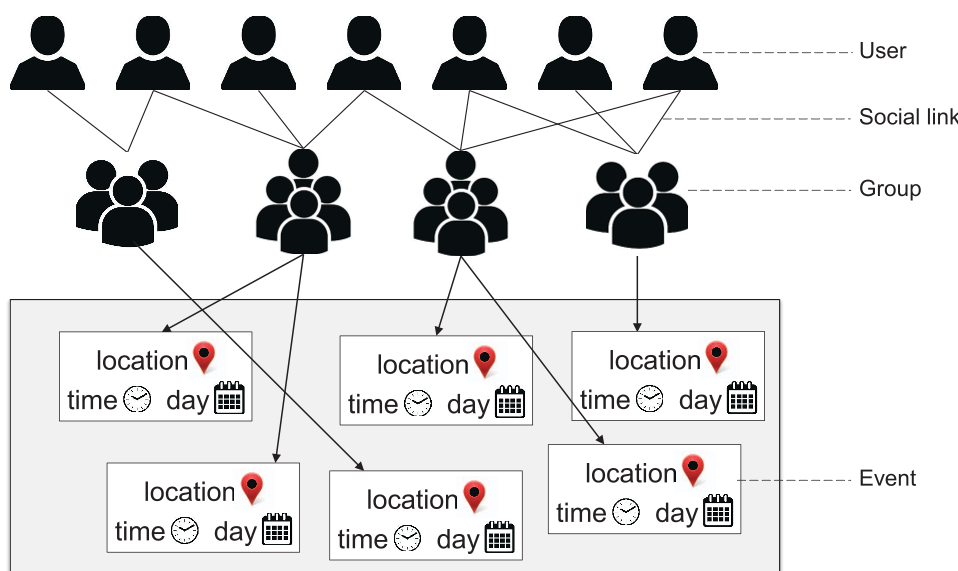 Fig 1: The standard EBSN structure involving users, groups, and events.
2. Categorical Influence (TF-IDF)
The model treats each user as a "document" and event categories as "terms." By using TF-IDF, SoCaST identifies how unique a category is to a user compared to the general population. It also calculates Category Popularity within a group to reflect social trends.
3. Social Synergy
Social influence is modeled not just by who you know, but by the Relevance of the Group. It calculates how active a user is in a group and cross-references this with the attendance patterns of other members (social group relevance).
4. Temporal Probability
Time is treated as a continuous variable. Using KDE, the system estimates the time probability density of a user's past attendance, effectively learning if a user is a "weekend warrior" or a "weekday after-work" event attendee.
Experiments & Results: Setting a New Standard
The authors tested SoCaST against four major baselines (SRE, CFM, CAER, PAAT) using datasets from New York and San Francisco.
- Consistency: SoCaST dominated across all values for Precision and Recall.
- Cold-Start Resilience: Even for users with minimal history, SoCaST provided superior recommendations because its Categorical and Geographical models can generalize faster than Social Friendship models.
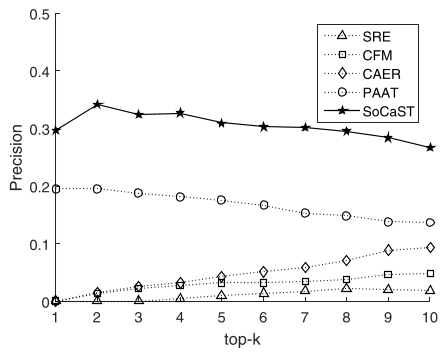 Fig 2: Performance metrics in NY and SF show SoCaST outperforming competitive baselines like PAAT.
Ablation Study: What Matters Most?
The study revealed a fascinating hierarchy of influence: Geographical > Categorical > Social > Temporal This suggests that in EBSNs like Meetup, where an event is and what it is labeled as are the primary gatekeepers of attendance.
Critical Analysis & Conclusion
SoCaST successfully proves that adaptive modeling of location and category is significantly more effective than static distance formulas.
Limitations: The current model uses a "Product Rule" for fusion, assuming all influences are equally weighted for everyone. In reality, some users may be "Location-Sensitive" while others are "Category-Driven."
Future Outlook: The next frontier for this work is Personalized Weighting—dynamically learning through an attention mechanism or similar architecture which of the four pillars (Social, Categorical, Spatial, or Temporal) should dominate for a specific individual.
Takeaway: If you are building a recommendation engine for offline events, stop looking at "who users know" and start looking at "where they go" and "how they categorize their interests."