
Beyond Game Theory: Why Social Context is the "Final Boss" for Negotiation Support Systems
Social acceptance of negotiation support systems: scenario-based exploration with focus groups and online survey
This paper investigates the social acceptance and functional requirements of mobile Negotiation Support Systems (NSS), specifically focusing on the "Pocket Negotiator." Through focus groups and an online survey (N=120), the study identifies that social context and subjective norms are the primary determinants of a user's intention to adopt such assistive technology.
TL;DR
Most Negotiation Support Systems (NSS) fail in the real world because they are "socially tone-deaf." This paper bridges the gap between algorithmic bidding and social reality, revealing that our willingness to use a digital "negotiation coach" depends less on its intelligence and more on whether our friends approve and whether our opponent can see us using it.
The "Rationality" Trap
For decades, researchers in AI and Management Science have built NSS based on strict economic rationality. These systems are great at calculating the Pareto frontier but terrible at navigating a room's atmosphere. The authors argue that the lack of adoption in real-world negotiations stems from a "technical focus" that ignores human factors—specifically, how a device might disrupt the social flow of a conversation or make a user look incompetent.
Methodology: The Scenario-Based Approach
To capture the nuance of social interaction, the researchers used filmed scenarios (The "Pocket Negotiator" concept) involving diverse contexts:
- The Secret Weapon: Using an NSS hidden from a boss.
- The Transparent Partner: Using an NSS openly at a car dealership.
- The Remote Advisor: Using an NSS during a phone negotiation.
 Figure 1: Visualizing different social contexts: from mobile preparation on a train to face-to-face evaluation talks.
Key Insights: Subjective Norms Rule
The most striking finding is the dominance of the Subjective Norm. In traditional tech adoption models (TAM), "Perceived Usefulness" is usually king. However, in negotiation—an inherently social act—the intention to use the system is driven primarily by the perceived expectations of people important to the user.
Results Breakdown
- Context-Dependent Acceptance: People are happy to use an NSS on a train or the phone (where the opponent is "blind" to the support), but feel embarrassed or "impolite" using it face-to-face.
- The "Weakness" Paradox: Users fear that using a support system makes them look like they "cannot think for themselves," potentially shifting the power dynamic in favor of the opponent.
- The Power of Stealth: Secret use was preferred, but carried high "nervousness" costs for the user.
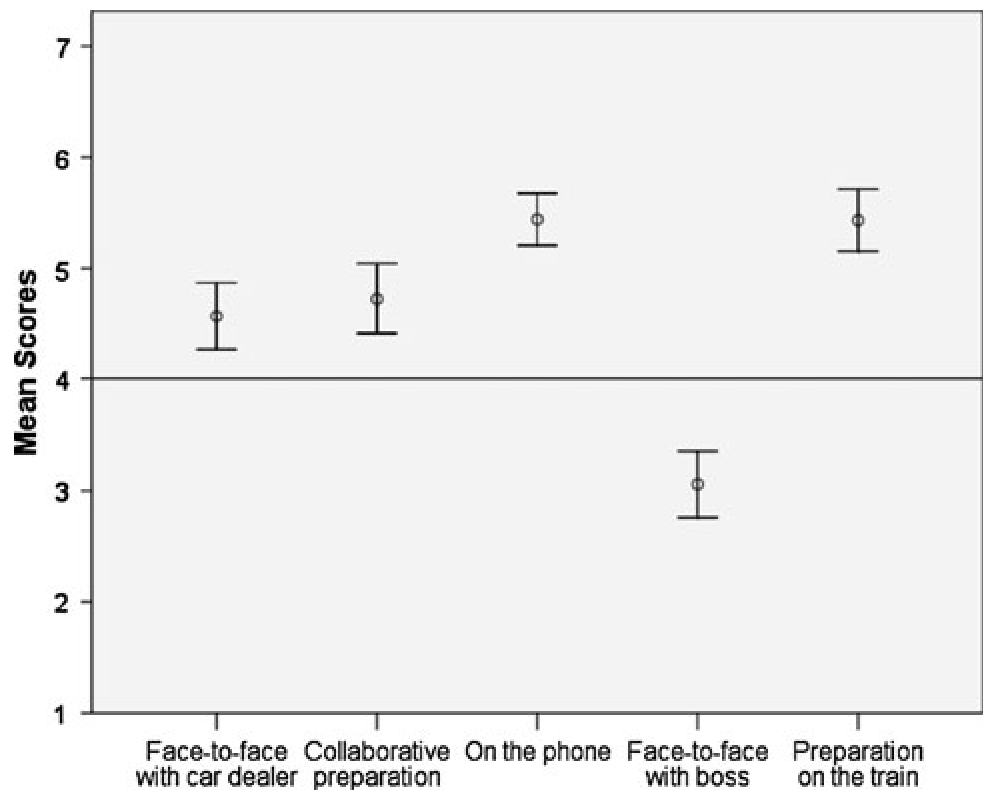 Figure 2: Mean social acceptance ratings across different scenarios, highlighting the sharp drop in face-to-face (F-2-F) professional settings.
12 Design Guidelines for the Future
The authors distilled their findings into 12 core guidelines. Notable highlights include:
- Interactive Preparation: Use virtual agents for role-play training before the real deal.
- Cognitive Load Minimization: Representation must be dead-simple during live meetings to avoid "distracted negotiator" syndrome.
- NSS as a Social Device: Systems should leverage social networks, allowing users to tap into the "collective wisdom" of friends or previous successful negotiations.
Critical Analysis & Future Outlook
This work marks a pivotal shift from NSS as a Calculator to NSS as a Social Companion. While written in 2011, its conclusions are even more relevant today with the rise of LLMs and wearable AI.
The limitation is the "age-tech" gap; today's "digital natives" might be far more comfortable with visible AI assistance than the 2011 cohort. However, the core psychological barrier—the fear of appearing socially incompetent—remains a universal hurdle for any "human-in-the-loop" AI system. Future products must prioritize social invisibility or socially endorsed transparency to move from the research lab to the bargaining table.