
Multi-Network Social Activeness: A Game Theoretic Breakthrough in D2D Relay Selection
Social activeness based relay selection: A game theoretic approach
The paper introduces a social activeness-based relay selection scheme for D2D cooperative communications. By leveraging multi-platform social network data (e.g., Facebook, Line) and physical channel characteristics, it models relay selection as a non-cooperative game to maximize information dispersion.
TL;DR
In the era of 5G, Device-to-Device (D2D) communication is the backbone of proximity services. This paper argues that choosing a relay shouldn't just be about signal strength; it should be about how "socially active" a user is across multiple platforms. By combining physical channel metrics with a multi-layered social utility function and applying Game Theory, the authors achieve a significant boost in network throughput and information dispersion.
The Problem: Beyond Signal Strength and Simple Social Ties
Traditional D2D relay selection focuses on the Physical Layer (SINR, bandwidth) or simplified Social Layers (trust between two people). However, these approaches fail to capture the "Information Dispersion" potential.
In the real world:
- Multi-Platform Interaction: A user might be quiet on LinkedIn but a "super-spreader" on Facebook or Line.
- Network Heterogeneity: Not all social networks are created equal; some have more influence or larger group sizes.
- The Tension: A node with a great signal might be socially isolated (selfish), while a social butterfly might be physically congested.
The challenge lies in finding the Nash Equilibrium where nodes select relays that are both socially "loud" and physically "available."
Methodology: Fusing the Social and Physical Worlds
The authors propose a dual-layer system model.
1. The Utility Function
The core of the paper is the utility function , which balances Social Gain () and Physical Gain ():
- Social Gain (): This isn't just a binary link. It aggregates the number of shared social networks, the weight (popularity) of each platform (), and the number of friends () a potential relay has, multiplied by the contact duration ().
- Physical Gain (): This uses Shannon's theorem but introduces a penalty for Congestion (the sum of data loads from other nodes directed at that relay).
2. The Relay Selection Game
The authors model this as a non-cooperative game where each node is a "player" trying to maximize its own utility. They prove that this is an Exact Potential Game, which is a crucial mathematical property. It guarantees that the system will always converge to a Nash Equilibrium (NE) in finite steps, meaning no user can improve their utility by unilaterally changing their relay.
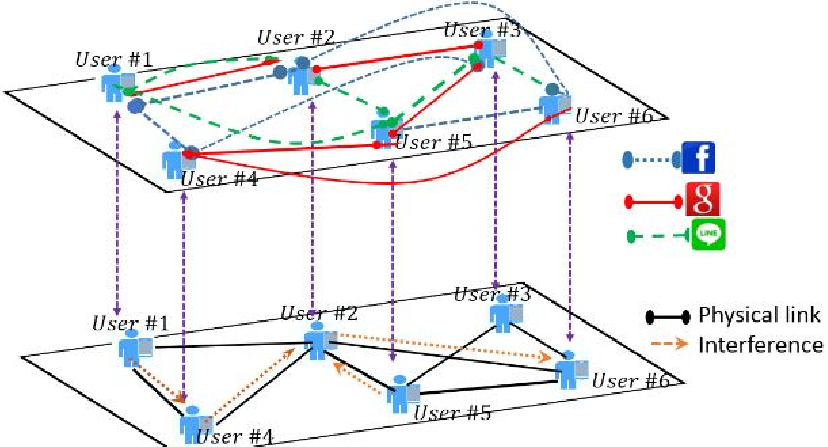 Figure 1: The dual-layer architecture separating Social Connectivity from Physical Interference.
Experimental Analysis: Results that Matter
The authors used MATLAB to simulate 40 D2D users with varying social densities.
Throughput Superiority
The proposed method shows a steep increase in throughput compared to:
- Random Selection: Higher failure rates/lower efficiency.
- Purely Social: Ignores physical interference, leading to "traffic jams" at popular nodes.
- Purely Physical: Ignores the willingness or reach of the relay.
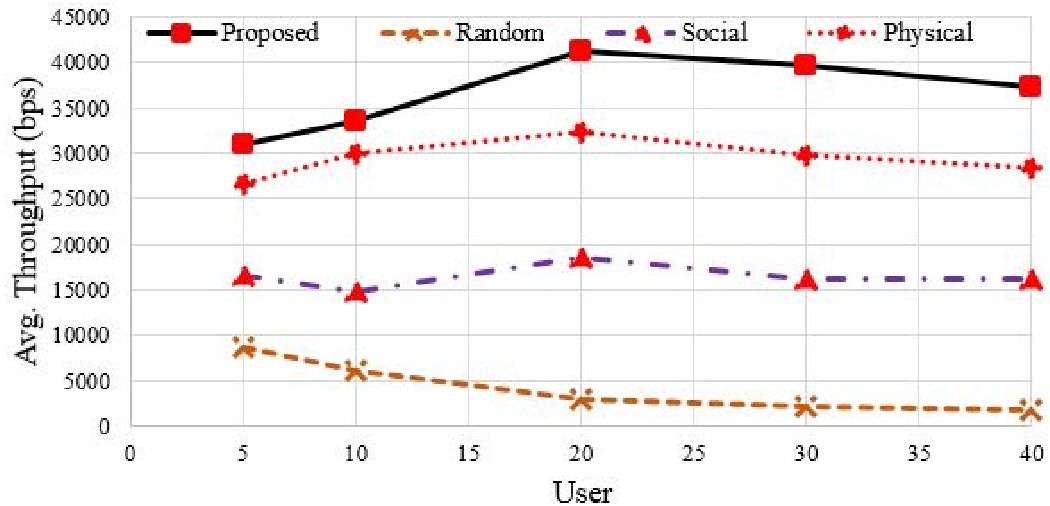 Figure 2: Throughput peak around 20 nodes, demonstrating the balance between connectivity gains and rising interference.
The Weight of Social Platforms
One of the most interesting findings (Fig. 8 in the paper) is that assigning different weights to different social networks leads to higher overall system utility than treating all platforms as equal. This reflects the real-world intuition that information spreads differently on "Broadcast" apps versus "Messaging" apps.
Critical Analysis & Conclusion
The paper successfully bridges the gap between social science metrics and hard communication engineering. By proving the game as an Exact Potential Game, they provide a robust algorithmic foundation that guarantees stability—a must-have for real-world network protocols.
Limitations:
- Privacy: The model assumes nodes can "see" the friend counts and contact durations of others, which raises significant privacy concerns in a real D2D deployment.
- Static Weights: The social network weights () are fixed; in reality, these fluctuate based on trending topics or time of day.
Future Outlook: This research paves the way for "Socially-Aware 5G." Future iterations could integrate reinforcement learning to allow nodes to learn social weights dynamically, or use zero-knowledge proofs to calculate social gain without compromising user privacy.
Takeaway: Effective D2D communication isn't just about the strongest antenna; it's about finding the most influential "social hub" that isn't currently overwhelmed by traffic.