
Social Capital vs. Code: The Hidden Signal for OSS Developer Initiation
Social Activities Rival Patch Submission for Prediction of Developer Initiation in OSS Projects
This study investigates the predictors of developer initiation in Open Source Software (OSS) projects, specifically comparing technical contributions (patches) against social interactions (email communication). Using data from six Apache Software Foundation projects, the research demonstrates that social network metrics—specifically "two-way" communications—are superior predictors of becoming a developer compared to traditional patch submission metrics.
TL;DR
Is the "ticket to entry" for becoming a core developer in Open Source a mountain of code, or a web of conversations? This study reveals that social activity is a more powerful predictor of developer initiation than patch submissions. By analyzing the first three months of a contributor's "social footprint," researchers can accurately predict who will join the inner "circle of trust."
The "Circle of Trust" Problem
In Open Source Software (OSS), the transition from a casual contributor to a "Committer" or "Developer" is the ultimate evolution. Traditionally, we assume that the more code (patches) you submit, the more the community trusts you. However, this study identifies two major flaws in that logic:
- Data Fragmentation: Tracking technical contributions requires mining disparate, messy sources (Jira, Bugzilla, Git logs).
- The "Non-Dev" Noise: Many users submit technical patches but never integrate into the core team. Conversely, some developers maintain the "engine" through coordination and mentorship rather than just raw code volume.
The researchers asked a provocative question: Can we ignore code entirely and predict the next core developer just by looking at who they talk to?
Methodology: Mapping the Social Genome
The team analyzed six major Apache projects (including Ant, Lucene, and Solr). To filter the noise of automated notifications and "shouting into the void," they focused specifically on two-way social links: messages that received a reply or were replies themselves.
Key Metrics:
- Number of Messages: Total incoming/outgoing replies.
- Number of Threads: New discussions initiated.
- Neighbor Developers: How many current "inner circle" members do you talk to?
- Project Age: How mature is the project when you join?
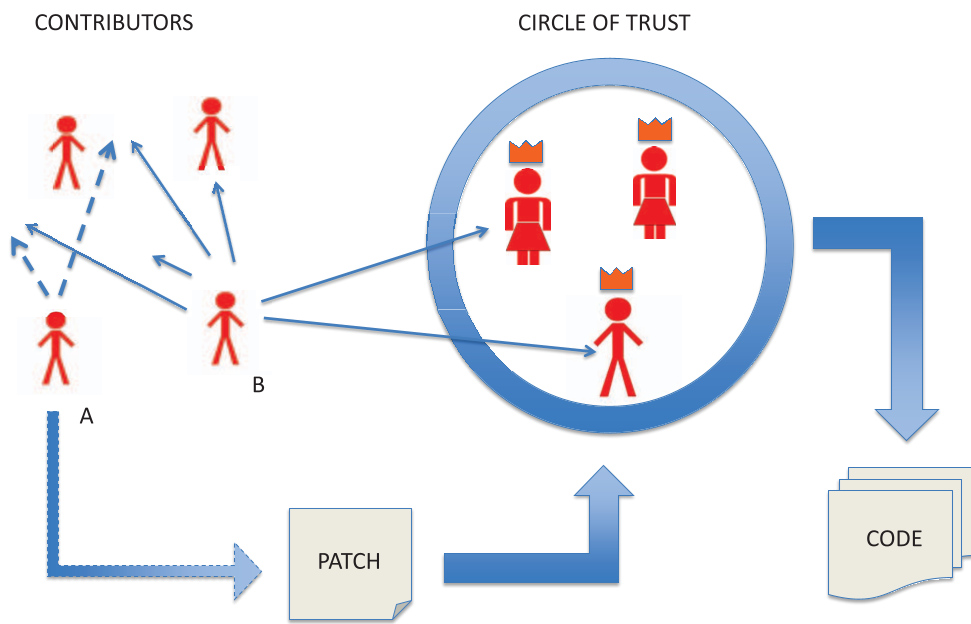 In the figure above, Contributor B (high social, no patches) is actually more likely to become a developer than Contributor A (low social, high patches).
Results: Talk is Cheap, but Extremely Predictive
The findings challenge the "code-only" meritocracy myth.
1. Social Trumps Technical
When "Number of Messages" was added to predictive models, the statistical significance of "Number of Patches" often vanished. The social network metrics consistently delivered higher AUROC (Area Under the Receiver Operating Characteristic) values, often exceeding 0.85. In projects like Log4j and Solr, the social-only models were significantly more accurate.
2. The "First Month" Phenomenon
How long do you have to be in a project before your future is written?
- 3 Months: The "sweet spot" for high-fidelity prediction.
- 1 Month: Surprisingly, even just 30 days of social interaction data provided predictions within 10% accuracy of the three-month models.
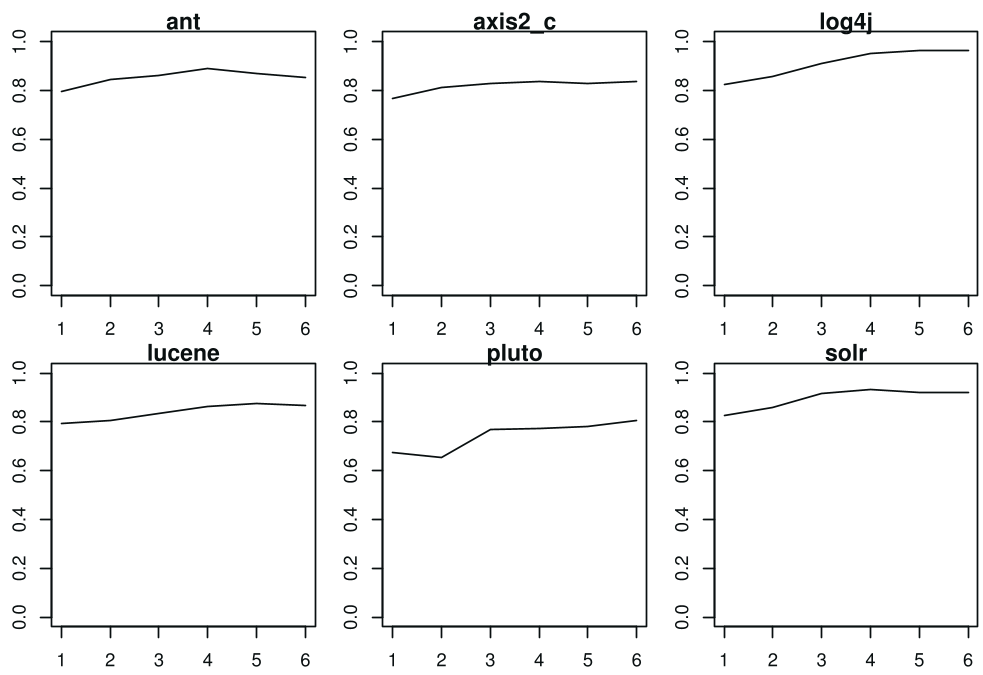 This chart demonstrates that AUROC scores remain robust even when reducing the observation window, proving that social 'vibe' is established almost immediately.
3. The "Maturing Project" Barrier
The study found a consistent negative correlation with Project Age. It is significantly easier to become a developer in the early stages of a project's life. As a project matures, the "circle of trust" hardens, and new entrants must display significantly higher social and technical effort to earn the same status.
Deep Insight: Why Social Matters More
Why does chatting in a mailing list predict a developer better than a bug fix?
- Socio-technical Congruence: Software development is a coordination problem. A developer who communicates effectively reduces the "friction" of code reviews and architectural alignment.
- Trust Encoding: Within the Apache ecosystem, "Committer" status is granted by a vote of existing developers. These votes are based on perceived reliability and cultural fit—traits that are demonstrated through communication, not just the logic in a
.difffile.
Conclusion & Limitations
This research provides a "social-first" lens for OSS health. If you want to identify the next generation of leadership in an Open Source community, don't just look at the commit heatmaps—look at who is answering questions and sustaining threads.
Limitations: The study was conducted on Apache projects using mailing lists. In the modern era of GitHub Discussions and Slack, the medium has changed, but the fundamental human metric—the two-way interaction—remains the most reliable signal of an emerging leader.
Final Takeaway: To join the circle of trust, your social footprint is your strongest resume.