
From Big Data to Personas: Algorithmic Customer Segmentation via Social Analytics
Leveraging Social Analytics Data for Identifying Customer Segments for Online News Media
The paper presents a methodology for identifying customer segments for online news media by leveraging large-scale social analytics data. Using Non-negative Matrix Factorization (NMF) on aggregated YouTube interaction data from AJ+ Arabic, the authors isolate distinct behavioral patterns and map them to specific demographic profiles to automatically generate data-driven personas.
TL;DR
In the era of privacy-first data, understanding your audience is harder than ever. This paper introduces a robust methodology to transform aggregated social media interactions (like YouTube view counts) into rich, actionable customer personas. By applying matrix decomposition to tens of millions of data points from AJ+ Arabic, the authors bridge the gap between "what" people watch and "who" those people actually are, in near real-time.
Problem & Motivation: The Aggregate Data Wall
Modern news organizations and digital marketers face a paradox: they have more data than ever, yet less visibility into the individual. Most social media platforms provide aggregated analytics to preserve user privacy—you know that 10,000 people watched a video, but you don't know the exact overlap between age groups and countries for specific content clusters.
The authors' core insight is that while the data is bucketed, the underlying patterns of consumption are not random. There exist "latent" behaviors that define specific audience segments. If a news outlet can mathematically "disaggregate" these buckets, they can move away from guesswork and toward precision marketing.
Methodology: The Power of Matrix Decomposition
The heart of this research lies in moving beyond simple clustering (like K-Means) which often fails on aggregated data. Instead, the authors use Non-negative Matrix Factorization (NMF).
The Logic of Disaggregation:
- The Interaction Matrix (): Imagine a massive spreadsheet where rows are demographic groups (e.g., "Males, 18-24, Iraq") and columns are specific videos. Each cell contains the
viewCount. - The Decomposition ():
- Matrix (Demographic Weights): This tells us how much each demographic group contributes to a specific behavioral pattern.
- Matrix (Behavioral Segments): This represents the "latent" content preference patterns.
By breaking the big matrix down, the system can identify that "Pattern A" consists of heavy interest in political satire and is predominantly driven by young males in Saudi Arabia.
(Note: The process involves transforming raw API data into a structured matrix for NMF processing.)
Experiments & Results: Real-World Validation
The researchers tested this on AJ+ Arabic, a digital-only news channel. With data spanning 30 months and 214 countries, the findings were stark:
- Demographic Skew: Despite a global reach, the audience was highly concentrated (e.g., Saudi Arabia, Iraq, Morocco).
- The Power Law: Video popularity followed a classic power-law distribution—a few "hits" drove the majority of engagement.
- Segment Identification: The NMF approach successfully isolated five distinct behavioral segments. For instance, Segment 1 was dominated by males aged 18-34 from Saudi Arabia, while Segment 2 showed a unique cross-border cluster of users from Jordan and Palestine.
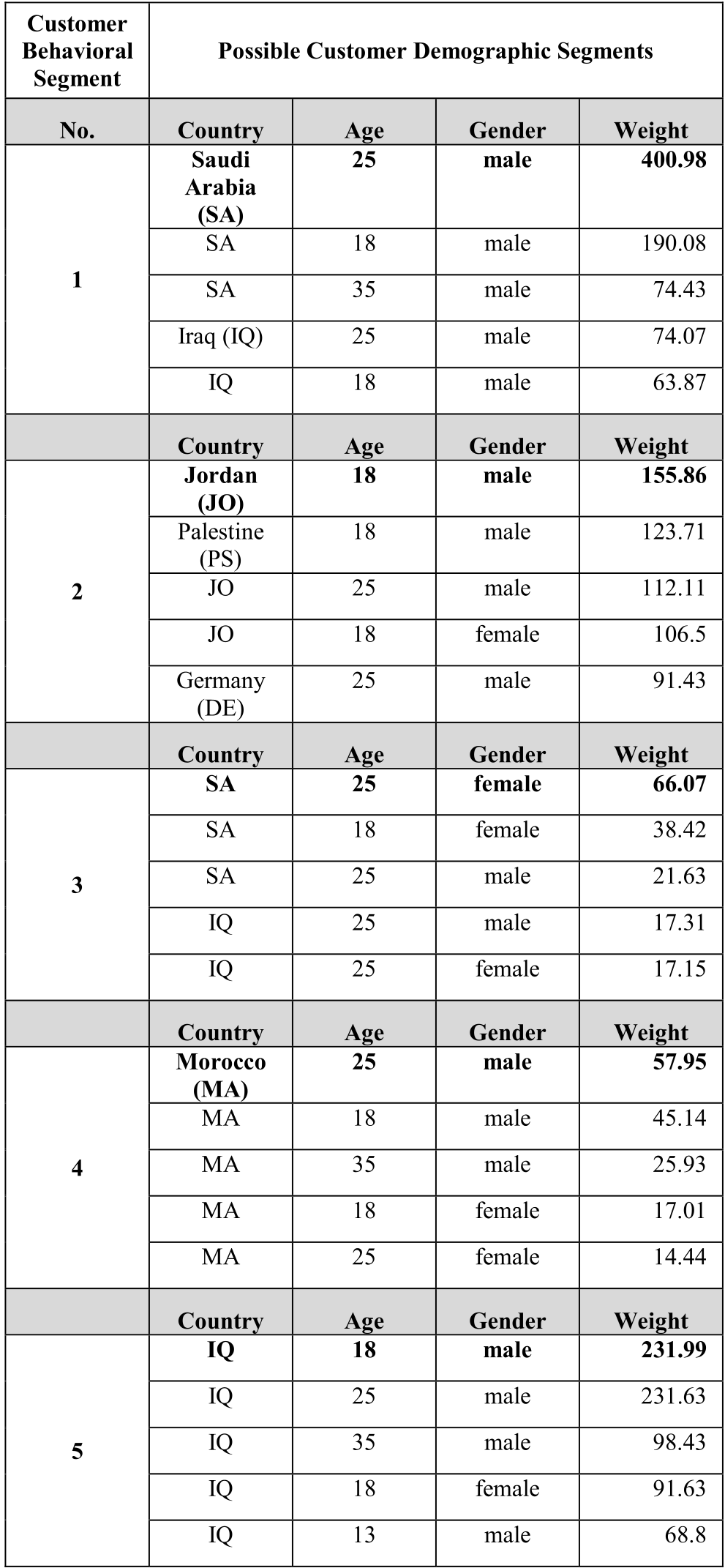 Table: Top demographic groups associated with distinct behavioral segments. Higher weights indicate stronger association.
Application: Automated Persona Generation (APG)
The most "product-ready" output of this research is the Automated Persona Generation system. Instead of a dry spreadsheet, the system outputs "fictional" characters (Personas) that embody the data segments. This allows journalists and marketers to ask: "What would 'Omar from Riyadh' want to watch today?" rather than looking at a viewCount of 500,000.
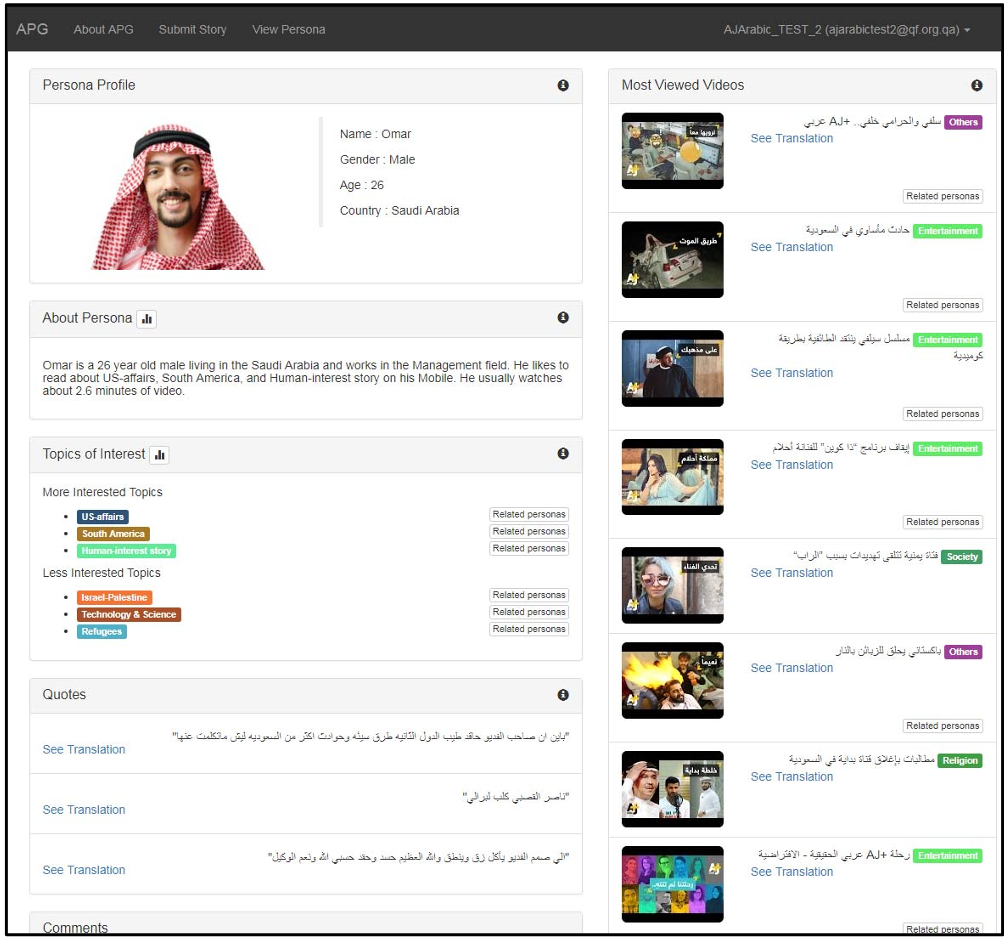 The APG system provides names, images, and demographic stats based on the NMF-derived segments.
Critical Insight & Future Outlook
While this methodology is powerful, it currently relies heavily on viewCount as the primary behavior. The authors admit that adding "sentiment" (comments/likes) or "socio-economic status" (derived from shared links) would significantly enrich the results.
The Takeaway: For any organization operating on social platforms, this research offers a blueprint for turning "anonymous" platform data into a deep, human-centric understanding of their audience. It's a significant step toward making digital marketing both data-driven and empathetic.