
Decoding the Silhouette of a Bot: Structural Differences in Social and Communication Networks
Analyzing Social and Communication Network Structures of Social Bots and Humans
This study presents a comparative analysis of the social and communication network structures of social bots and humans across two distinct real-world datasets: 2017 natural disasters and the 2018 Winter Olympics. Utilizing state-of-the-art bot detection (BotOrNot) and community detection algorithms, the researchers identified structural "fingerprints" that distinguish automated entities from organic human behavior.
TL;DR
Researchers from the University of Arkansas at Little Rock and Creighton University have mapped the "social DNA" of bots versus humans. Analyzing over 2.6 million tweets from natural disasters and the 2018 Winter Olympics, the study reveals that bots favor large, sparse, and core-periphery network structures, while humans form dense, niche-focused clusters. This structural signature remains consistent regardless of whether the topic is a crisis or a sporting event.
Problem & Motivation: Beyond Simple Detection
In an era of digital "bellwethers," social bots have evolved from simple spam scripts to sophisticated agents capable of altering public opinion. While we know they exist, the how of their coordination remains a black box. Current research often focuses on whether an account is a bot, but not how these bots organize themselves as a collective.
The authors argue that by understanding the unique "communication styles" and "network architectures" of bots, we can better predict their evolution and impact on public discourse during high-stakes events like Hurricane Harvey or the Olympics.
Methodology: Mapping the Digital Ecosystem
The researchers built a robust pipeline to compare bot and human behavior:
- Data Acquisition: Using Google TAGS to harvest millions of tweets.
- Classification: Applying the BotOrNot score to isolate the top 100 most likely bots and humans.
- Network Reconstruction: Building social networks (friends/followers) and communication networks (interactions).
- Clustering: Utilizing modularity-based algorithms to find communities.
Methodology Detail: The Three Pillars of Analysis
The study doesn't just look at followers; it looks at three layers of digital existence:
- Social Network: Who follows whom? (Structural/Static)
- Communication Network: Who retweets or mentions whom? (Behavioral/Dynamic)
- Hashtag Co-occurrence: How is information categorized? (Content-driven)
Results: The "Core-Periphery" vs. "Close-Knit" Divide
The findings offer a striking visual contrast between human and machine behavior.
1. Social & Communication Structures
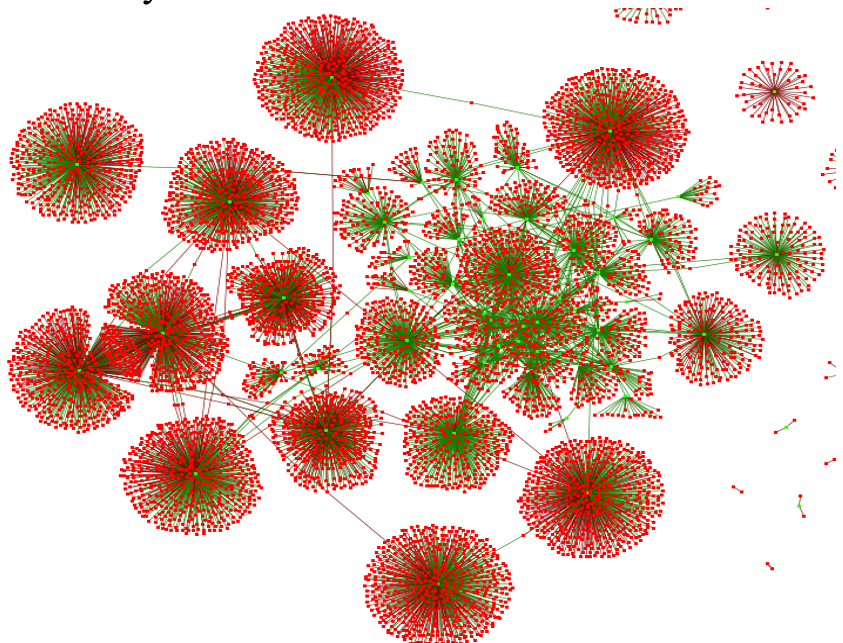
Bots tend to form a strongly connected core with smaller botnets at the periphery. Their communities are larger but more sparse. In contrast, humans form many small, dense, and "close-knit" communities.
- Natural Disasters: Humans formed 57 communities; bots formed only 43.
- Density: Human interactions are significantly more concentrated within their specific groups.
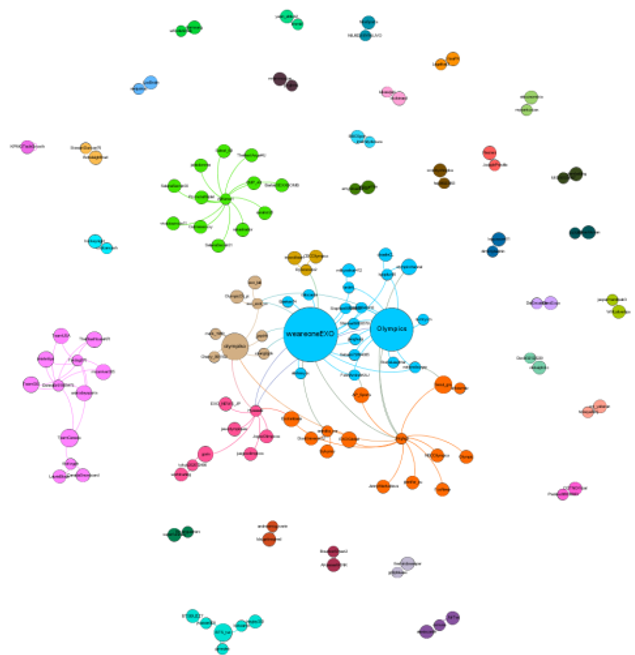 In Fig. 4, the bot network displays a sparse distribution across clusters, indicating a lack of the specialized focus seen in human groups.
2. Hashtag Usage: Niche vs. Generic
The content analysis revealed a "specialization gap."
- Humans: Used specific, niche hashtags. During the Olympics, human communities were divided by specific sports (ice hockey, snowboarding). In disasters, they focused on relief or specific affected areas.
- Bots: Used generic, broad hashtags. Bot communities were often divided by language rather than subject matter, acting as "bridges" that spread generalized information across the network.
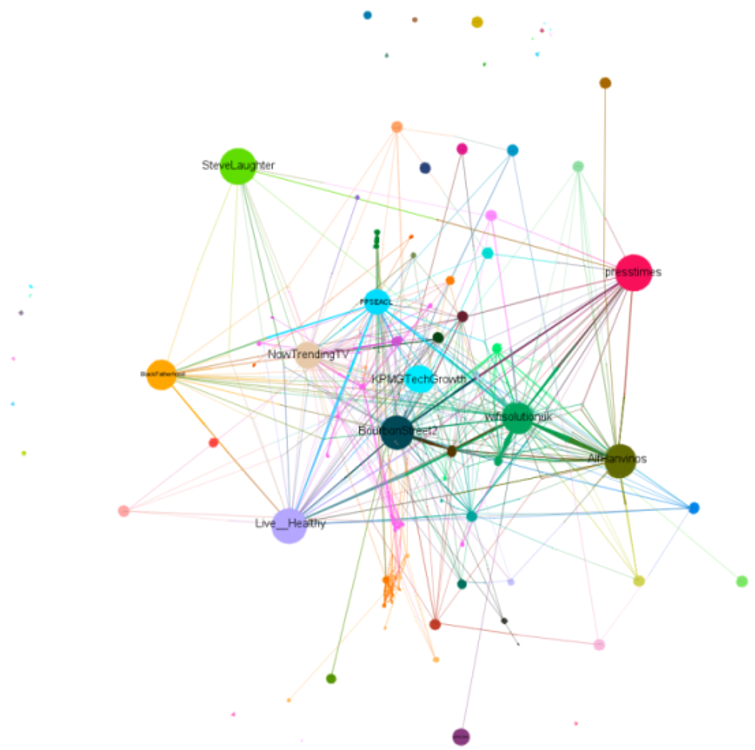 In Fig. 8, the hashtags in the bot network serve to bridge disparate topics rather than deepening a single specialized discussion.
Critical Insight & Conclusion
Takeaway
The most valuable discovery is the Consistency of Pattern. Whether the context is the chaos of a Mexico Earthquake or the spectacle of the PyeongChang Olympics, bots maintain the same sparse, large-scale structural footprint. This suggests that bot "architects" use standardized templates for coordination that differ fundamentally from organic human sociability.
Limitations & Future Work
The study acknowledges it did not create a new detector but rather illuminated the features that detectors should use. A limitation is the reliance on the top 100 accounts—future work could scale this to thousands to see if these structural patterns hold at a "macro" bot-army scale. As bots become more "human-like" (cyborgs), detecting these subtle structural shifts in how they cluster will be the next frontier in digital forensic research.