
The Home Gateway as a Social Guardian: Bridging IoT and Social Networks
Social applications in the home network
This paper proposes a specialized home gateway architecture comprising two core components: the "Social Enabler" and the "Social Watchdog." It aims to bridge the gap between home consumer electronics (like set-top boxes) and social networks, enabling secure content sharing and automated adaptation.
TL;DR
As our homes become smarter, our devices—from set-top boxes to media gateways—become repositories of our most intimate habits. This paper introduces a robust architecture featuring a Social Enabler for content adaptation and a Social Watchdog for privacy enforcement, allowing legacy home devices to participate in social networks without compromising user security or requiring complex manual setup.
Problem & Motivation: The Gap Between Leisure and Privacy
Modern social networks and multimedia delivery are converging, yet the hardware we use to consume media (TVs, set-top boxes) remains largely disconnected from our social identities. Why? Because integrating these devices poses two massive hurdles:
- Interface Constraints: Most home devices lack keyboards, making credential entry and social interaction cumbersome.
- Privacy Risks: Indiscriminate sharing by "dumb" smart devices can leak sensitive daily routines, a risk factor particularly high for children and non-technical users.
Current solutions often focus on mobile or web interfaces, leaving the home network as a "black box" that either stays isolated or becomes a privacy liability.
Methodology: The Social Enabler & The Social Watchdog
The authors propose a middleware layer residing in the Home Gateway (HG). This placement is strategic: the HG acts as the "chokepoint" through which all external and internal traffic must flow.
1. The Social Enabler (SE)
The SE handles the "How" of social interaction. It acts as a semantic bridge:
- Content Adaptation: Since a set-top box cannot render a complex Facebook React page, the SE transforms social feeds into DVB-HTML or XML formats suitable for JavaTV or OCAP environments.
- Share Services: It allows a Hi-Fi system or game console to post updates (e.g., "Now listening to...") by acting as a proxy agent.
2. The Social Watchdog (SW)
The SW is the "Why" and "Whether" of the system—the security brain.
- Credential Management: It maps complex social media passwords to simple Numeric PINs, allowing users to authenticate via standard TV remote controls.
- Policy Enforcement: Using a neutral policy form, it evaluates whether a device (e.g., a child's game console) is authorized to post a specific type of content to a specific sub-network.
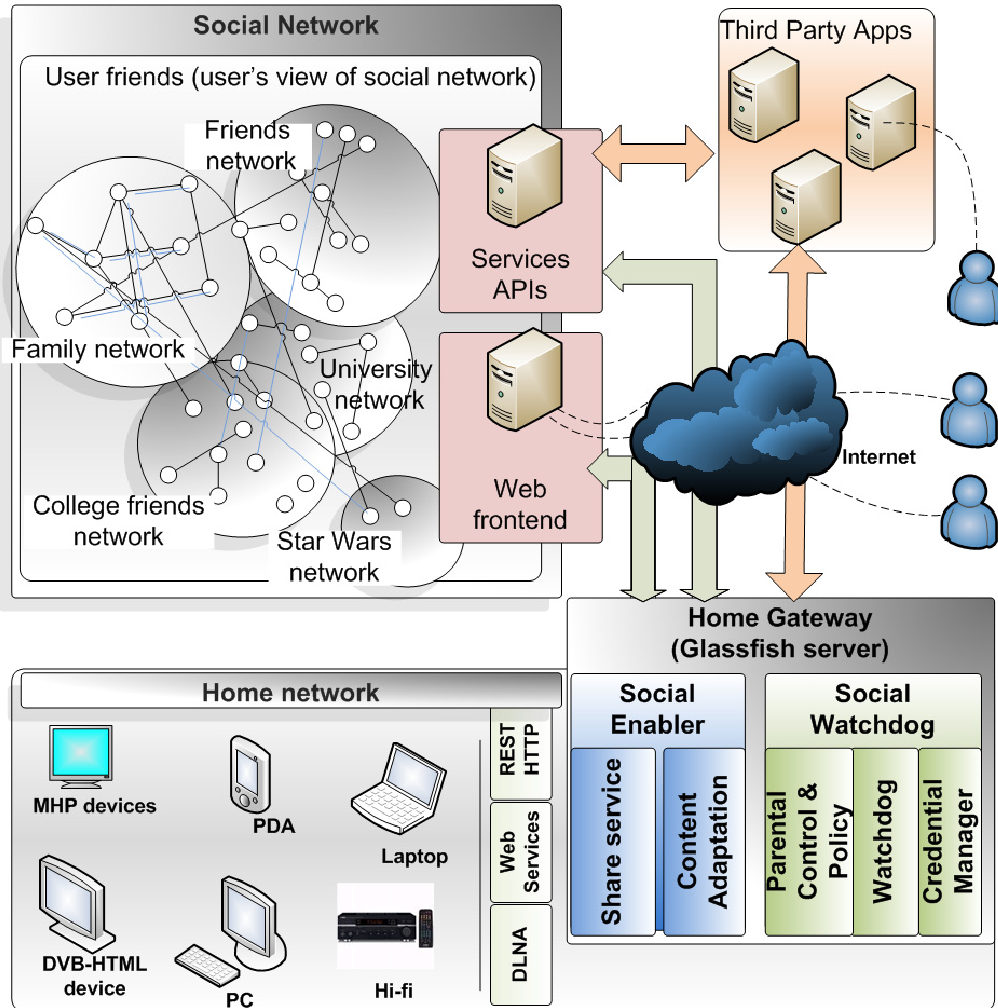 Figure 1: The architecture demonstrates how the Social Enabler and Watchdog mediate between the local devices and external Social APIs.
Experiments & Results: The "Film Board" Use Case
To validate the architecture, the authors developed the Film Board application.
- The DVB receiver identifies a movie tag from a broadcast stream.
- The Social Enabler fetches friend recommendations regarding that specific movie.
- The Social Watchdog verifies permissions and handles OAuth-like flows in the background.
The implementation proves that even devices with limited input capabilities can participate in rich social interactions. The "Watchdog" function also introduces a Relation Strength Graph, which calculates which social contacts' posts are most relevant to the user, optimizing the frequency of background "privacy sweeps."
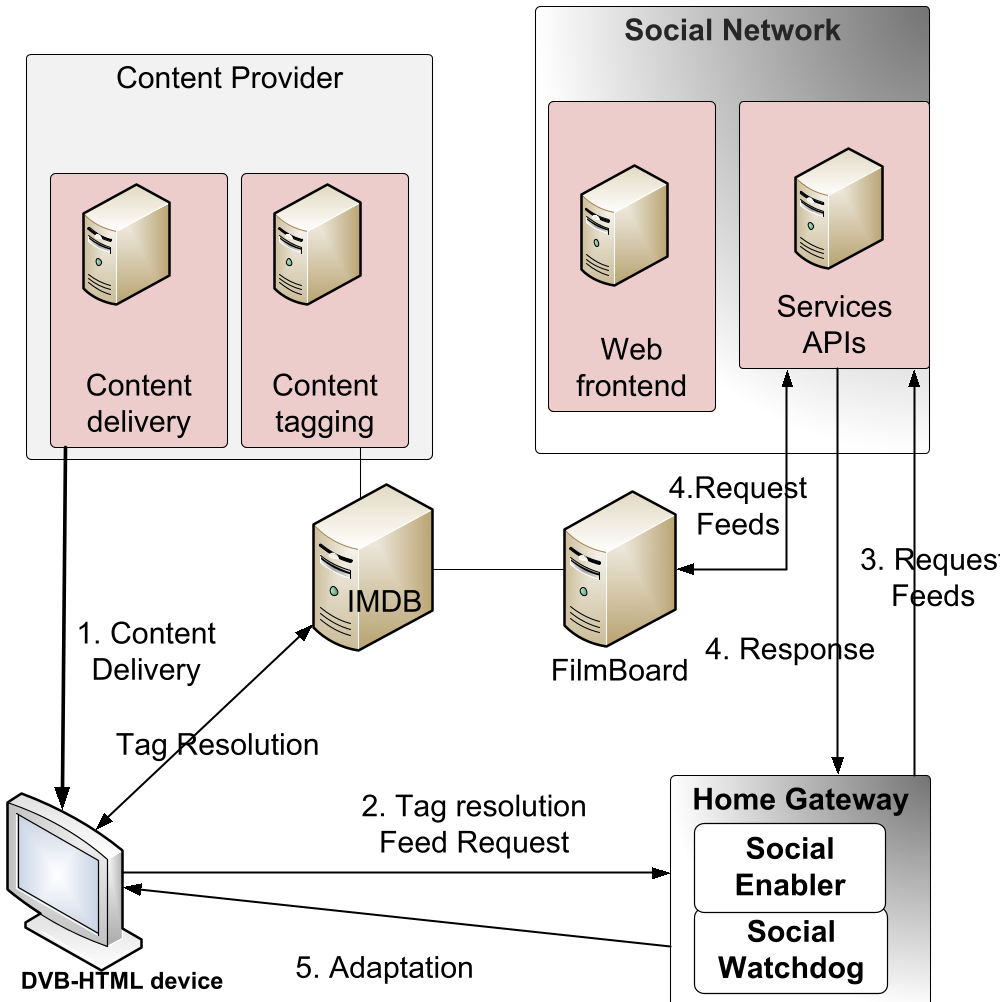 Figure 2: Sequence of content resolution and feed requests in the Film Board prototype.
Critical Analysis & Conclusion
Takeaway
The genius of this work lies in centralizing intelligence. Instead of making every lightbulb or TV "social-aware," the authors turn the Home Gateway into a sophisticated agent that speaks "Social Network" on one side and "Legacy Device" on the other.
Limitations & Future Work
While the architecture is sound, the reliance on DVB-HTML and XML reflects the era of its conception. Modern iterations would likely replace these with JSON-LD and containerized microservices. Furthermore, as the authors suggest, the next frontier is Risk Modeling—using machine learning to predict if a specific social post might constitute a long-term privacy leak before the user even hits "send."
In conclusion, this work provides a foundational blueprint for a Privacy-First Smart Home, where the gateway serves not just as a router, but as a digital guardian.