
Social Authentication: Is "Who You Know" More Secure Than "What You Know"?
Social Authentication Applications, Attacks, Defense Strategies and Future Research Directions: A Systematic Review
This paper provides the first systematic review of Social Authentication (SA), establishing a taxonomy that categorizes schemes into knowledge-based and trust-based mechanisms. It introduces a comprehensive evaluation framework to assess the security, usability, and deployability of SOTA schemes like Facebook's "Trusted Contacts" and photo-based challenges.
TL;DR
Social Authentication (SA) leverages our natural ability to recognize friends and trust relationships to replace or augment passwords. This systematic review by Alomar et al. provides the first academic roadmap for SA, categorizing it into Knowledge-Based (answering questions about friends) and Trust-Based (friends vouching for you) systems. While it solves the "forgotten password" crisis, it introduces a terrifying new reality: your security is only as strong as your most gullible friend's account.
The Motivation: The Memory Crisis
We are living in an era of "password fatigue." Traditional multi-factor authentication (MFA) relies on something you know (password), have (token), or are (biometrics). This paper explores the Fourth Factor: Somebody You Know.
The logic is intuitive: humans are evolved to recognize faces and shared experiences. Why not use the massive social graphs of Facebook, Twitter, or LinkedIn to verify identity? However, the transition from physical recognition to digital verification is fraught with "hidden" technical traps.
Methodology: The Social Authentication Taxonomy
The authors break down SA into two primary technical lineages:
1. Knowledge-Based Techniques (Recall & Recognition)
These systems generate challenges based on your social graph.
- Node Attributes: "Who is the person in this photo?" or "What is Bob's birthday?"
- Edge Attributes: "Who liked your last post?" or "With whom did you exchange this message?"
- Pseudo-Edge Attributes: "Who attended this seminar with you?"
2. Trust-Based Techniques (Vouching)
- Explicit Vouching: You ask 3-5 "Trusted Contacts" to receive a code and give it to you.
- Implicit Vouching: The system monitors physical proximity (Bluetooth/Wi-Fi) or social interactions to "silently" verify you.
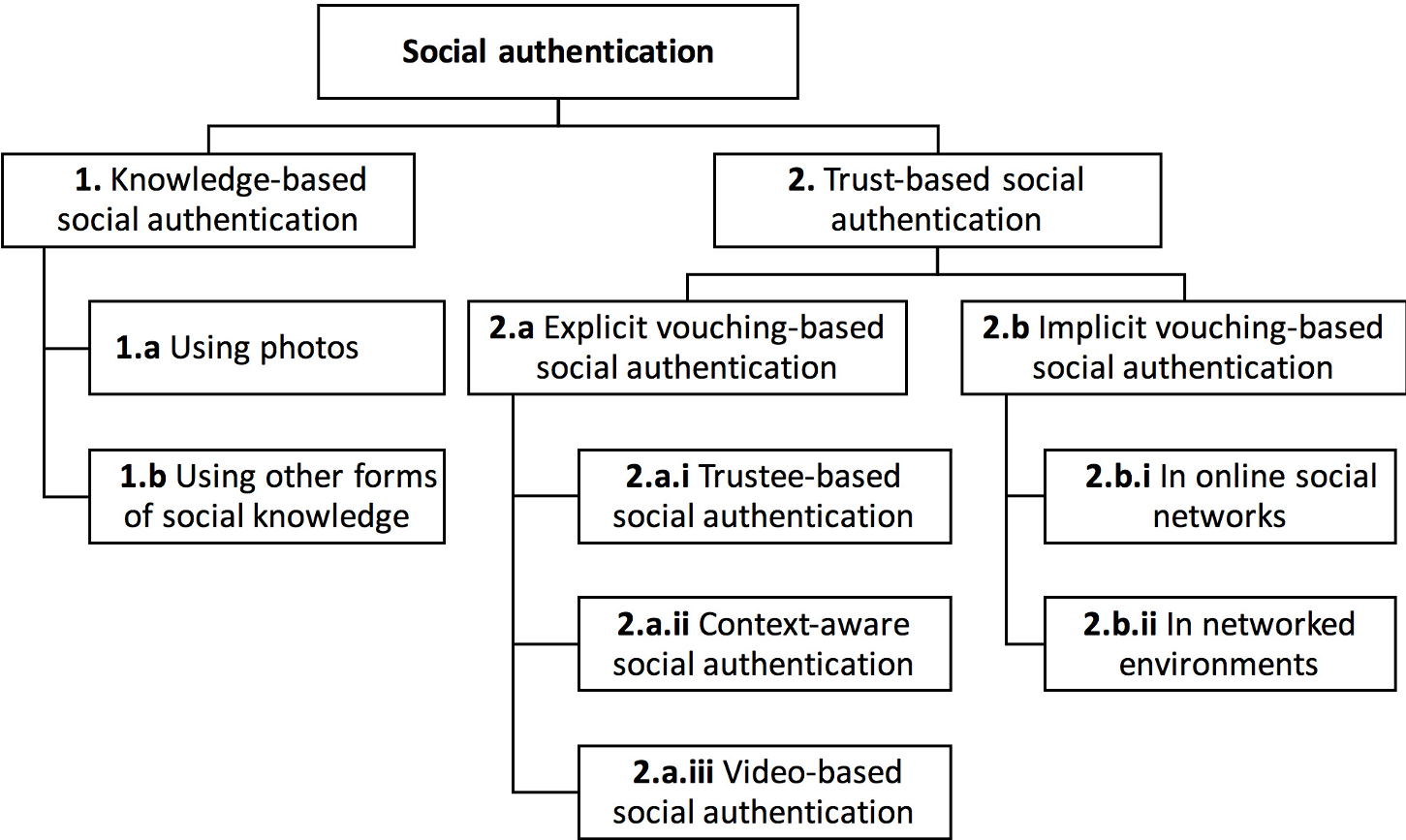 The proposed taxonomy categorizing the landscape of socially-aware security.
The Anatomy of an Attack: Why "Friends" are Security Holes
The paper’s most vital contribution is the analysis of Forest-Fire Attacks.
In a traditional system, if Bob’s password is leaked, only Bob is at risk. In Social Authentication, if an attacker compromises 3 or 4 of Bob's friends, they can utilize the "Trusted Contacts" feature to hijack Bob's account. This leads to a chain reaction—a "Forest Fire"—where compromising a few central nodes allows an attacker to incinerate the security of an entire community.
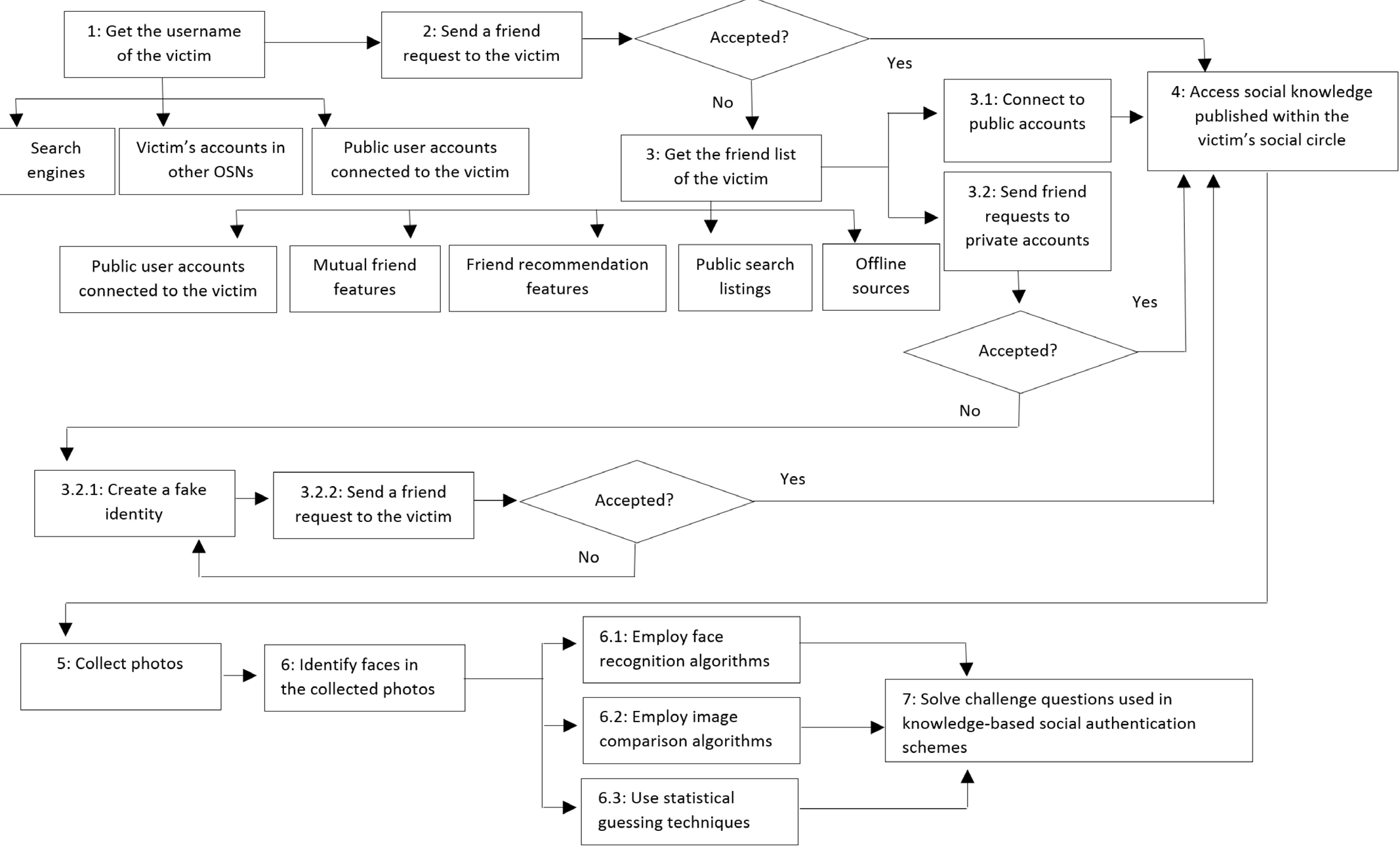 A workflow demonstrating how automated scrapers and face recognition can solve social challenges.
Critical Results: The "Four Friend" Rule
The authors compared various SOTA implementations, including Facebook's "Trusted Contacts" and "Lineup."
Key findings include:
- Face Recognition Vulnerability: Automated bots can now solve "Who is this friend?" challenges with over 80% accuracy using publicly scraped photos, rendering simple photo-CAPTCHAs obsolete.
- The Threshold Fix: Most systems use a recovery threshold of 3. The authors' data suggests moving to 4 trustees significantly increases the computational cost for an attacker while maintaining "usable" difficulty for the legitimate user.
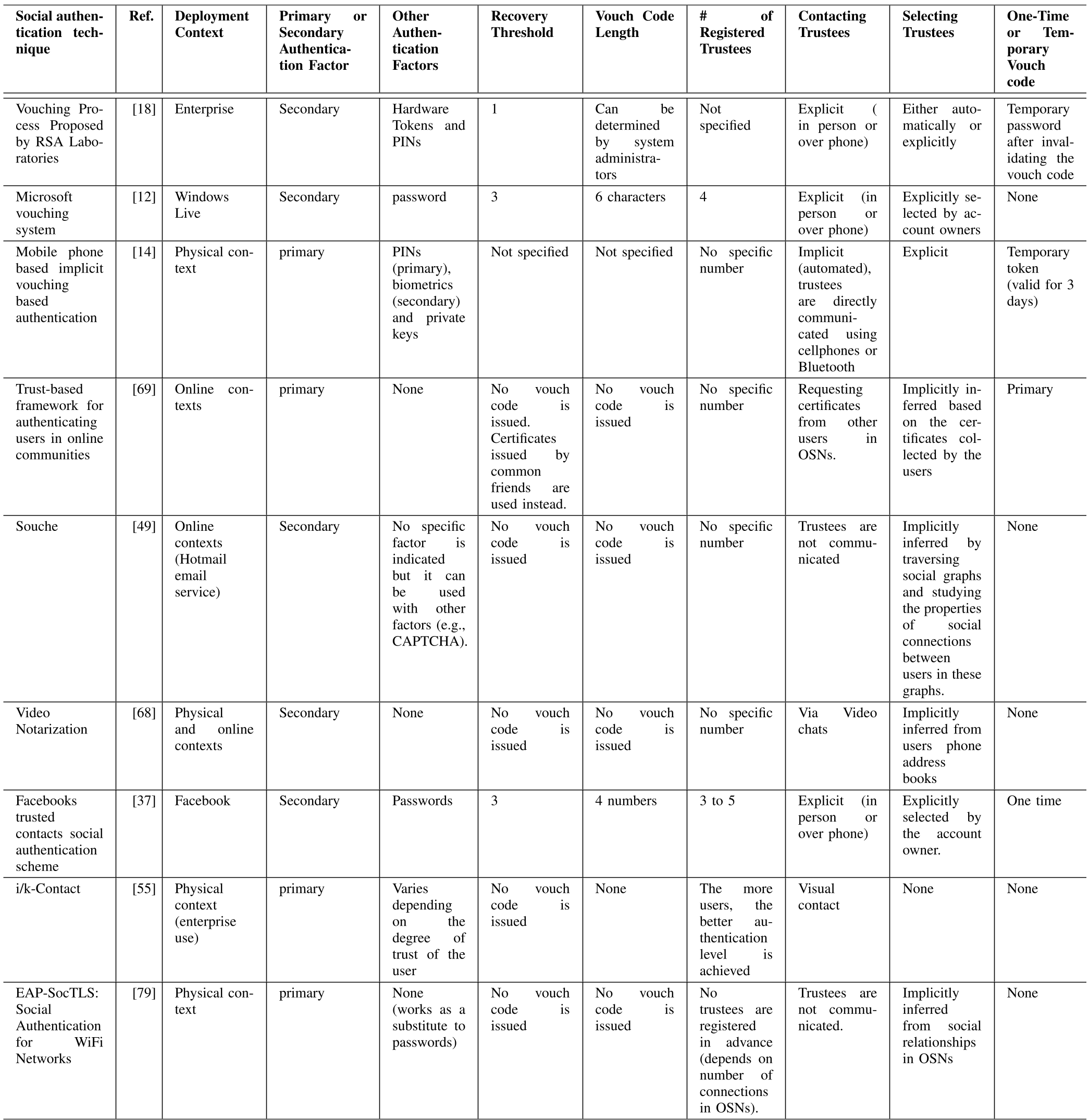 Comparison of trust-based schemes: Note the varying recovery thresholds and contact methods.
Critical Insight & Future Outlook
The "Social Side" of authentication is both its greatest strength and its terminal flaw. The paper highlights a massive gap: Offline Social Factors. Most current systems only look at online clicks. A "friend" on Facebook might be a stranger in real life.
The Future of SA:
- Disjoint Community Selection: Systems should force users to pick trustees from different social circles (e.g., one from family, one from work, one from high school). This ensures an attacker can't compromise all trustees by simply infiltrating one social clique.
- Hybrid Implicit Models: Combining Wi-Fi proximity, Bluetooth heartbeats, and social graph "Trust Scores" to creates a frictionless, continuous authentication experience.
Conclusion
Social authentication is not yet ready to be a "Primary" factor in high-stakes environments. However, as an account recovery tool, it is vastly superior to the "What was your first pet's name?" questions that anyone can find on Google. The secret to the future of SA lies in Context: knowing not just that two people are connected, but how and why they trust each other.