
SACC: Revolutionizing Content Sharing in MSNs via Social-Aware Cooperative Caching
Social-aware cooperative caching mechanism in mobile social networks
The paper introduces SACC (Social-aware Cooperative Caching), a mechanism designed for Mobile Social Networks (MSNs) that optimizes content sharing by leveraging social tie strength, trustworthiness, and encountering probability. It achieves state-of-the-art performance by integrating a community-based content popularity model with a differentiated four-region cache management strategy.
TL;DR
Mobile Social Networks (MSNs) face a persistent crisis of inefficient content dissemination due to unpredictable node mobility and "selfish" resource constraints. This paper proposes SACC (Social-aware Cooperative Caching), a framework that treats social relationships—trust, intimacy, and encounter probability—as first-class citizens in the caching decision process. By aligning cache management with human social behavior, SACC boosts delivery success rates by up to 41.9% while slashing network overhead.
Problem & Motivation: The Mobility vs. Buffer Conflict
In the world of MSNs, contents are shared via a "store-carry-forward" paradigm. When node A wants to send a file to node B, it must rely on intermediate relay nodes. The pain point is twofold:
- Cache Exhaustion: Relay nodes have finite memory. Once full, they stop helping others, leading to congestion.
- Social Blindness: Prior works like Drop-Oldest or UBM treat all relay encounters equally, ignoring that people are more likely to share data with "friends" or "trusted contacts" within specific communities.
The authors' core Insight is that content popularity is not universal; it is community-specific. A video may be trending in a "Tech Enthusiast" community but irrelevant to a "Sports Fans" group.
Methodology: The SACC Framework
The SACC mechanism operates across three distinct layers of intelligence:
1. Quantifying User Sharing Ability
SACC defines a user's ability to serve others based on three metrics:
- Social Tie Strength: Derived from interest similarity and the duration of past interactions.
- Trustworthiness: A dual-layer model evaluating both direct interactions and indirect "friend-of-a-friend" trust.
- Encountering Probability: Modeled as a Power-Law Distribution, predicting how likely two users will meet before a content's TTL expires.
2. Multi-Region Cache Division
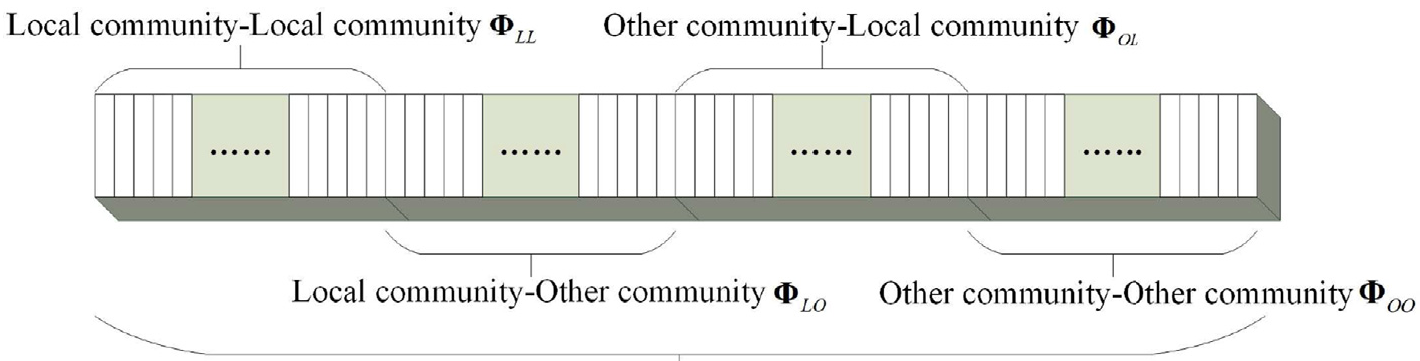
To handle inter-community and intra-community traffic effectively, SACC partitions the node's buffer into four zones based on the source and destination's community membership:
- (Local-Local): High priority for internal community sharing.
- : Various tiers for cross-community bridging.
3. Popularity-Based Replacement
When the cache hits capacity, SACC doesn't just drop the oldest packet. It calculates a dynamic Content Popularity score (Eq. 20) and uses a 0-1 knapsack optimization to keep only the most valuable data.
Experiments & Results
The authors used the ONE (Opportunistic Network Environment) simulator to bench SACC against three major baselines: Drop-Oldest, HCCS, and UBM.
Performance Gains
- Success Ratio: SACC outperformed Drop-Oldest by 41.9% and UBM by 10.1%, proving that social awareness leads to smarter relay selection.
- Overhead Reduction: SACC reduced useless data packet transmissions by 40.1% compared to HCCS.
- Resilience: As shown in the result graphs, SACC maintains a higher success ratio even as cache resources become increasingly scarce (down to 100MB).
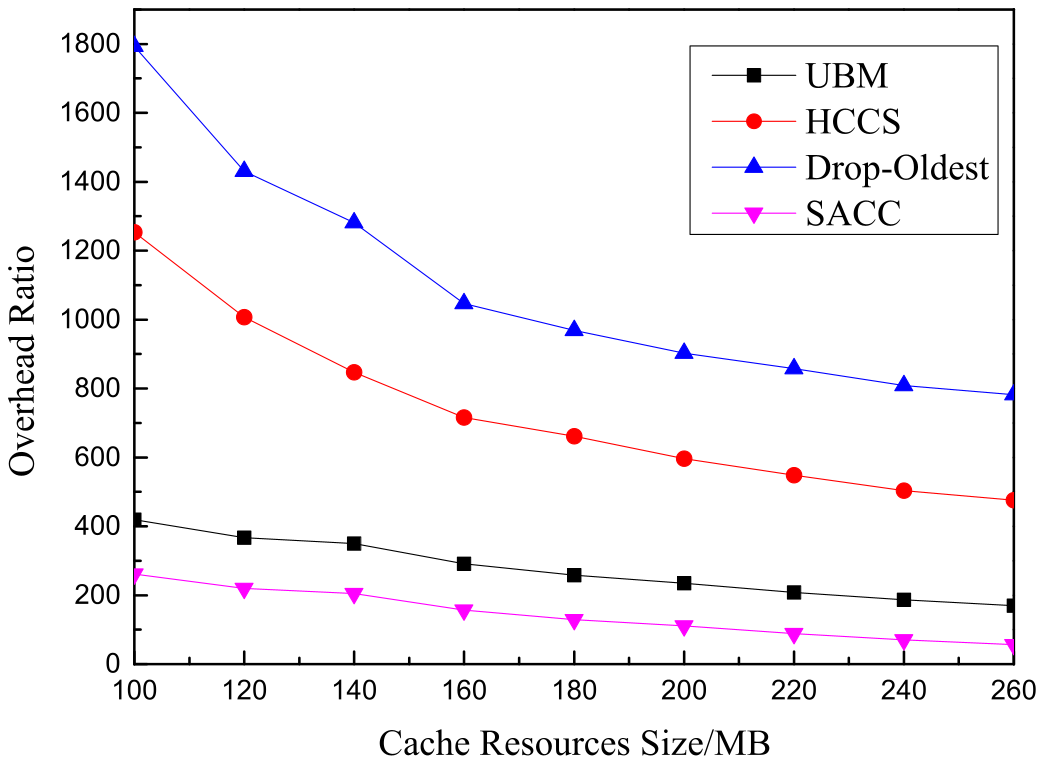
In the figure above, SACC (red line) consistently stays above its peers across all cache sizes.
Critical Analysis & Conclusion
Takeaway
SACC's primary contribution is the mathematical formalization of "trust" and "social ties" into a cache replacement policy. By using the Power-Law distribution for encounters, it moves beyond the unrealistic "Random Waypoint" mobility models often seen in older literature.
Limitations
- Evolutionary Dynamics: The paper assumes communities are relatively stable. In real-world MSNs, users change interests and social circles frequently.
- Computational Overhead: Solving a 0-1 knapsack problem on a low-power mobile device for every encounter might introduce battery drain, which wasn't fully addressed.
Future Outlook
The SACC framework sets the stage for "Content Centric Networking" in the 5G era. Integrating this with Machine Learning to predict community evolution could make the system even more robust against high-velocity mobility.