
SDUS: Bridging Social Trust and D2D Data Uploading in Cellular Networks
On social-aware data uploading study of D2D-enabled cellular networks
This paper introduces a Social-Aware Data Uploading Scheme (SDUS) for D2D-enabled cellular networks that incorporates human social relationships and incentives to facilitate multi-hop data relaying. By modeling the interactions as a non-transferable utility (NTU) coalitional game and applying a merge-and-split algorithm, it optimizes uploading success rates and decreases latency in realistic social network scenarios.
TL;DR
The paper introduces SDUS (Social-aware Data Uploading Scheme), a framework that leverages human social relationships and a tailored incentive mechanism to optimize multi-hop Device-to-Device (D2D) data uploading. By utilizing Coalitional Game Theory, the authors provide a stable algorithm for devices to form "relay chains" that reduce latency and improve reliability over traditional non-cooperative or trust-blind methods.
Problem & Motivation: The "Social Gap" in D2D
Most prior works on D2D-enabled cellular networks operate on two extremes:
- Full Trust: Assuming every device is a selfless altruist willing to burn its own battery for others.
- No Trust: Assuming every device is an island, leading to massive inefficiencies in crowded or disaster-stricken areas.
In reality, human behavior is driven by social ties (friends, colleagues) and self-interest. Users are reluctant to consume their memory and energy to relay data for strangers without a reward. This paper bridges this gap by incorporating social graphs—where "trustworthiness" is a measurable metric—and an incentive mechanism that pays users for their "effort."
Methodology: Gaming the Relay Chain
The core of the SDUS framework resides in the intersection of the Physical Domain (communication range) and the Social Domain (trust relationships).
1. The Incentive Mechanism
The system offers rewards () to devices based on two critical factors:
- Latency (): Rewards are inversely proportional to the time taken to deliver data.
- Reliability (): Rewards are directly proportional to the product of "trustworthy relationship" scores () along the D2D chain.
2. Coalitional Game Formulation
To prevent the Base Station (BS) from suffering massive computational overhead, the authors adopt a Non-Transferable Utility (NTU) Coalitional Game.
- Players: The mobile devices.
- Merge-and-Split Rules: The algorithm allows coalitions to merge if it benefits at least one member without hurting others, and split if the current group is no longer optimal.
 In the figure above, active devices (ADs) and idle devices (IDs) form a multi-hop path to the Base Station.
Experiments & Performance
The authors compared SDUS against several baselines, including CCFS (Constrained Coalition Formation) and NCUS (Non-Cooperative).
Key Findings:
- Incentive Sensitivity: The ratio of reward scaling factors ( for latency vs. for reliability) has a "sweet spot" (around 4 or 5) where the number of cooperating devices peaks.
- Scalability: Unlike non-cooperative methods where performance plateaus or drops as users find the network congested, SDUS maintains a high Successful Uploading Ratio by dynamically forming relay paths.
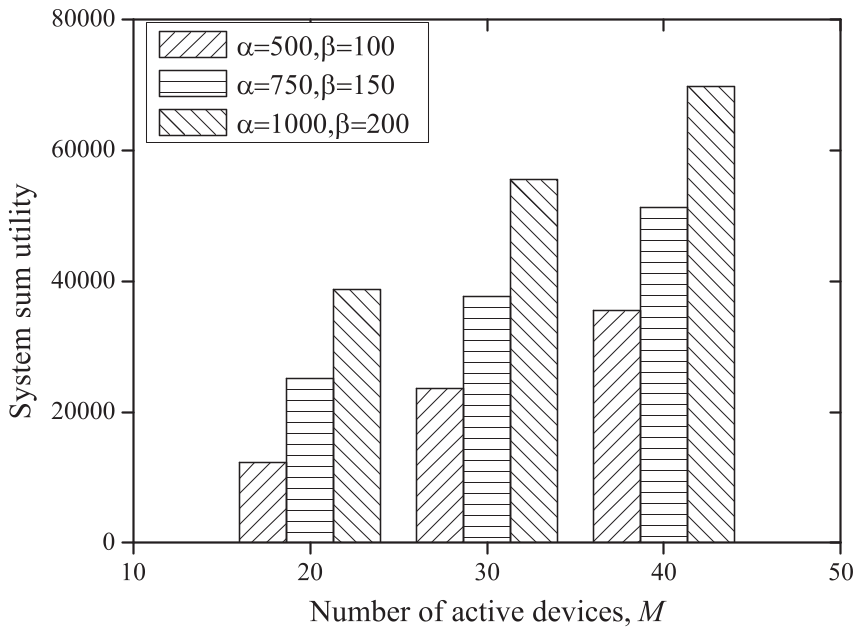 The graph shows that as the complexity of the network grows, the social-aware incentive keeps the cooperation rate significantly higher than baseline methods.
Critical Insight & Conclusion
The true value of this work lies in its Inductive Bias toward human-centric connectivity. By recognizing that a digital network is often a reflection of a social network, the authors demonstrate that Social Centrality can be used as a routing metric just as effectively as signal strength.
Limitations: The model assumes the BS can collect CQI and social metrics accurately, which might be a bottleneck in privacy-sensitive or high-mobility scenarios. Future work should likely explore decentralized ledger technology (like Blockchain) to manage these incentives without a central BS.
Takeaway: For 5G/6G deployments in high-density urban areas or emergency scenarios, "social-awareness" isn't just a feature—it's the backbone of a reliable network.