
SERS: Why Your Next Mobile Relay Should Be a "Friend," Not a Stranger
SERS: Social-Aware Energy-Efficient Relay Selection in D2D Communications
The paper proposes SERS, a social-aware energy-efficient relay selection mechanism for cooperative Device-to-Device (D2D) communications. It leverages social trust (direct, indirect, and triadic closure) and physical encounter history to select optimal relay nodes and employs a game-theoretic approach to optimize transmission power.
TL;DR
The paper introduces SERS (Social-aware Energy-efficient Relay Selection), a framework that moves beyond the "selfish node" assumption in D2D communications. By blending social trust metrics—like who your friends are and how often you meet them—with a game-theoretic power control model, SERS achieves higher throughput and better energy efficiency than traditional physical-layer-only methods.
The Problem: The "Altruism Myth" in Wireless Networks
Most traditional D2D (Device-to-Device) protocols assume a digital utopia where every device is a willing volunteer. In the real world, however, devices are tied to humans. Humans are protective of their battery life and data plans.
Current SOTA (State Of The Art) methods often fail because:
- Lack of Incentives: Strangers have no reason to relay your data.
- Security & Privacy: Users are hesitant to route sensitive data through unknown nodes.
- Interference Chaos: Without a coordination mechanism, D2D links using the same spectrum create massive "electronic noise" for each other.
Methodology: Bridging the Social and Physical Divide
The SERS framework operates on a dual-layer logic: the Social Layer and the Physical Layer.
1. The Social Trust Engine
Instead of just checking for signal strength, SERS evaluates three types of trust:
- Direct Trust: Derived from social distance in a friendship graph.
- Similarity Trust: Calculated using Cosine Similarity of user profiles (interests).
- Triadic Closure: The "friend-of-a-friend" logic. If Node A and B are friends, and B and C are friends, the system uncovers the hidden trust between A and C.
2. The Physical Reality Check
Trust is useless if the friend is on the other side of the city. SERS uses Pareto Distribution to model encounter history, ensuring that the chosen relay is someone you frequently cross paths with.
3. The Power Control Game
Once a relay is selected, SERS solves the interference problem using Game Theory. It treats each D2D link as a "player" in a non-cooperative game. Crucially, it uses social distance as a penalty coefficient. If you are socially close to your destination, the "price" of interference is adjusted, forcing the node to optimize its power output.
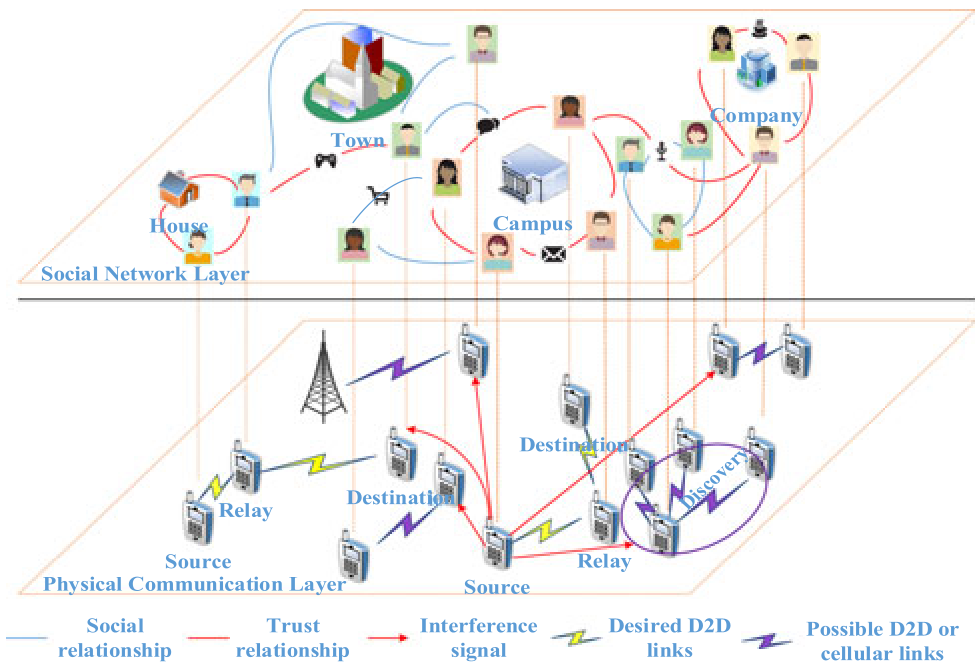 Figure 1: The dual-layer model mapping social connections to physical D2D links.
Experiments & Results: Real-World Validation
The authors tested SERS using the Infocom06 dataset, which tracks 98 conference attendees' physical encounters.
- Throughput Gains: SERS achieved performance remarkably close to the "Theoretical Upper Bound," significantly outperforming random selection.
- Discovering Connections: By using Triadic Closure, SERS identified nearly 2x the number of social links compared to initial direct distance models.
- Rapid Convergence: The distributed power game reached a stable Nash Equilibrium in just 5-6 iterations, proving it can work in real-time on mobile devices.
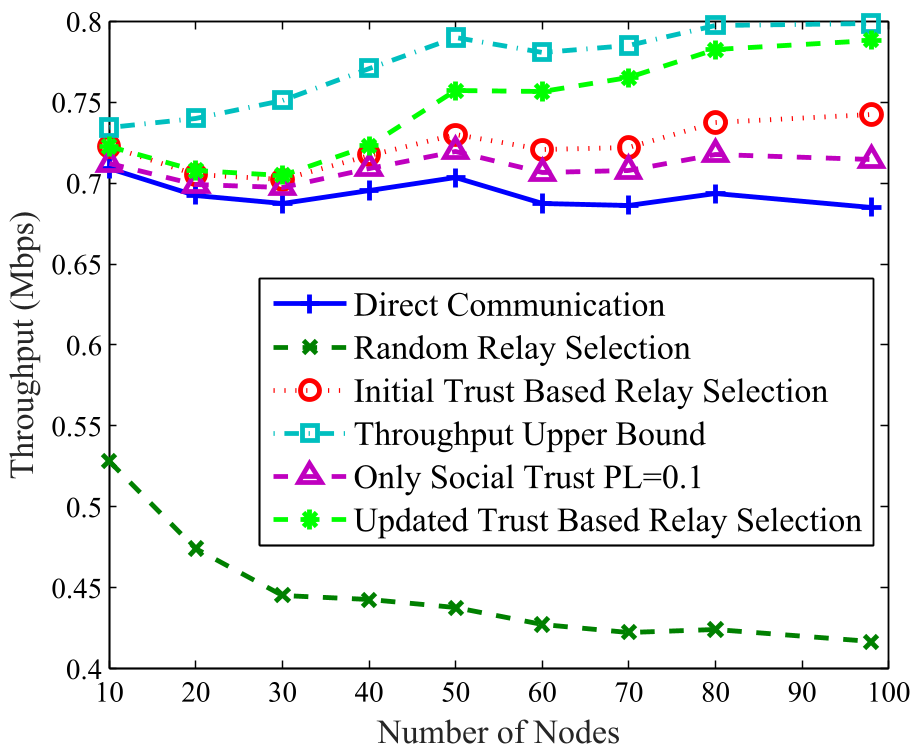 Figure 2: Throughput comparison showing SERS outperforming random and initial-trust-only models.
Deep Insight: Social Distance as a Physical Constraint
The most "academic" brilliance of this paper is the mathematical mapping of Social Distance into the Penalty Factor () of the power game. By doing this, the authors prove that social ties aren't just an "incentive"—they are a variable that can be used to mathematically minimize co-channel interference.
Conclusion & Future Outlook
SERS proves that the "human factor" is not a noise in the system but a solution to the coordination problem in 5G/6G networks.
Limitations: The model currently assumes a single-relay hop. In highly dense urban environments, multi-hop relay selection would introduce exponential complexity. The Takeaway: Future wireless protocols must be "social-ready." By understanding the human fabric, we can build more robust, energy-efficient, and cooperative digital networks.