
F-KNN: Beyond Nearest Neighbors — Leveraging the Wisdom of Friends in Spatial Search
Social-Aware KNN Search in Location-Based Social Networks
The paper introduces the Friend-based K-Nearest Neighbor (F-KNN) query, a novel task for Location-Based Social Networks (LBSNs) that finds points of interest (POIs) by balancing spatial proximity and friends' visiting evaluations. It proposes the F-Quadtree hybrid index and a region-based pruning algorithm, achieving significant speedups over baseline Threshold Algorithms (TA).
TL;DR
When searching for a restaurant, proximity is important, but a friend's recommendation is often the deciding factor. This paper formalizes the Friend-based K-Nearest Neighbor (F-KNN) query, which retrieves locations that are both nearby and highly rated by a user's social circle. To solve this at scale, the authors introduce the F-Quadtree, a hybrid index that prunes search space using both spatial and social bounds, making real-time personalized search possible across millions of records.
The "Social-Spatial" Dilemma
In modern LBSNs like Foursquare or Yelp, we face a data fusion problem. Traditional spatial indices (like R-trees or Quadtrees) are brilliant at finding the closest pizza slice, but they are "socially blind." Recommendation engines are "socially aware" but often spatially inefficient.
The challenge is efficiency. A naive approach would calculate a score for every nearby restaurant by aggregating all friends' ratings. However, with millions of users and check-ins, this brute-force aggregation becomes a latency nightmare for mobile apps.
Methodology: The F-Quadtree Architecture
The core innovation is the F-Quadtree. Unlike a standard Quadtree that only stores spatial boundaries, the F-Quadtree incorporates regional user scores.
1. Hybrid Indexing
The index splits the world into a hierarchy of regions. For each region, it stores:
- Spatial Bounds: Minimum distance to the query point.
- Regional User Scores: The minimum (best) score any friend has given to any object within that specific quadtree node.
2. Region-Based Pruning
The search utilizes a Best-First Traversal. By calculating a lower bound F-KNN score for an entire region—combining the spatial distance and the aggregated friend scores—the algorithm can discard entire geographic areas if their "best possible" score is worse than the current Top-K results.
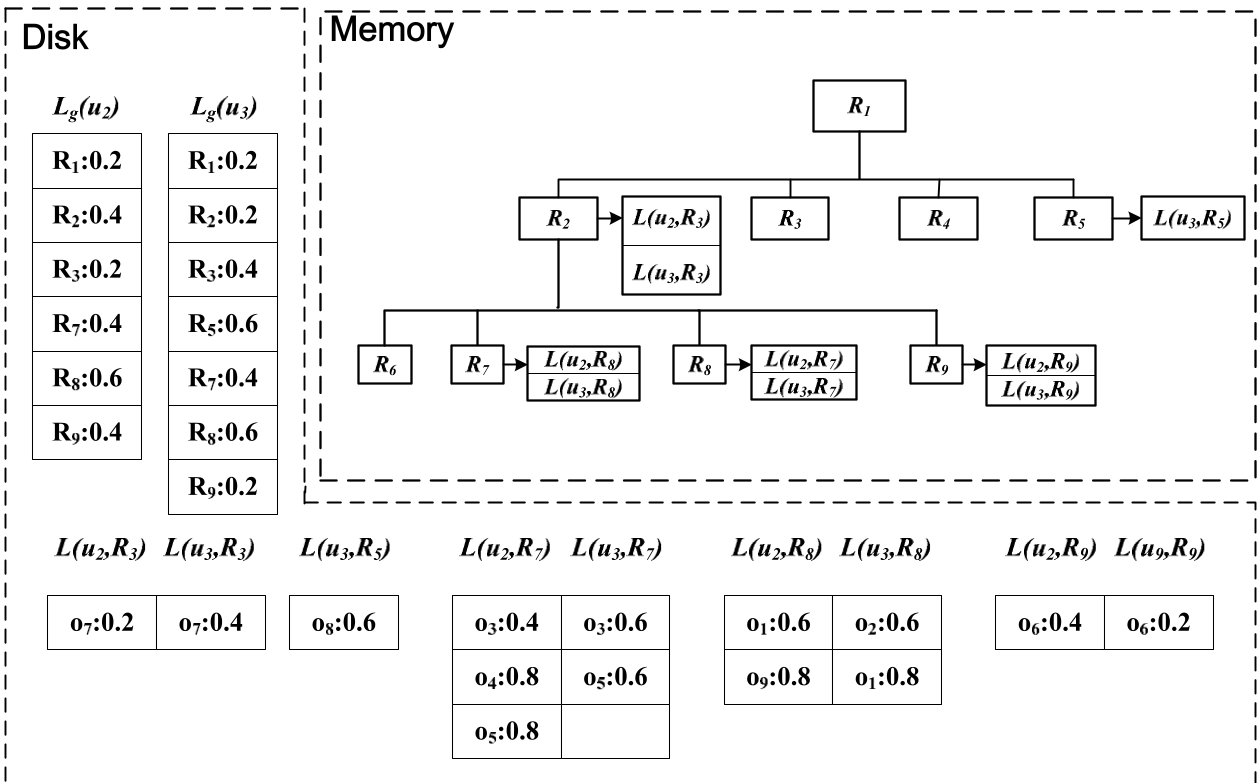 Figure 1: The F-Quadtree integrates inverted lists of user records into the spatial leaf nodes.
Advanced Refinements: Speeding Up the Search
To go beyond the basic index, the authors proposed two specialized optimizations:
- User Based Partitioning: Since friends often share similar tastes, the authors cluster users into "social circles" and partition objects within leaf nodes based on these circles. This allows the search to skip over POIs preferred by social groups completely unrelated to the query user.
- Memory Materialization: Loading data from disk is the bottleneck. By identifying "high-influence" users (those with many friends) and pre-loading their top-rated POIs into RAM, the system establishes a highly competitive "Threshold" very early in the search process, leading to much more effective pruning.
Experimental Results
Testing on the Gowalla and Twitter datasets (millions of users/objects), the results confirm the intuition: social signals drastically improve relevance.
- Effectiveness: F-KNN achieved significantly higher recall than Spatial-Only (SO) queries, proving that your friends' history is a strong predictor of your future check-ins.
- Computational Performance: The Refined F-Quadtree Algorithm (RFBA) outperformed the standard Threshold Algorithm (TA) by a massive margin, reducing processing time to microseconds.
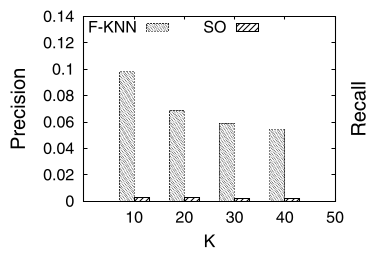 Figure 2: Efficiency comparison showing RFBA maintaining low latency even as K (the number of results) increases.
Critical Insight & Conclusion
The brilliance of this work lies in how it transforms a "Social Recommendation" problem into a "Spatial Pruning" problem. By pushing social scores into the spatial index itself (the F-Quadtree), the authors avoid the high cost of late-stage data aggregation.
Limitations: The current model assumes a static social graph during the query. In highly dynamic social environments, updating the regional user scores in the quadtree could become a maintenance overhead.
Future Outlook: As we move toward more personalized AI, the integration of heterogeneous data (social, temporal, and spatial) into unified index structures like the F-Quadtree will be essential for "Zero-Latency" personalization.