
SMR-MNRL: Bridging the Sparsity Gap in Movie Recommendations via Multimodal Network Learning
10985_Social-Aware Movie Recommendation via Multimodal Network Learning.
The paper introduces SMR-MNRL, a social-aware movie recommendation framework that learns a multimodal network representation. It integrates textual descriptions (via LSTM), visual posters (via VGG-Net), and social relationships into a heterogeneous information network to achieve SOTA ranking performance.
TL;DR
The paper "Social-Aware Movie Recommendation via Multimodal Network Learning" presents SMR-MNRL, a framework that treats recommendation as a multimodal network embedding problem. By fusing a movie's visual poster (CNN) and textual description (LSTM) with a user's social graph, the system overcomes the perennial "data sparsity" issue, setting a new SOTA on Chinese social media datasets (Douban).
Problem & Motivation: The Sparsity Wall
Modern movie recommenders face a fundamental paradox: while we have more data than ever (posters, trailers, reviews), the actual interaction matrix (user-movie ratings) remains incredibly sparse. Most users only rate a tiny fraction of available films.
The authors identify two fatal flaws in prior SOTA:
- Feature Silos: Text and images are often processed in isolation, failing to capture the "holistic" vibe of a movie.
- Structural Neglect: Traditional list-ranking models ignore the "social homophily" (the tendency of friends to share tastes) that is inherently present in platforms like Douban or IMDb.
Methodology: The Multimodal Fusion Engine
The core of SMR-MNRL lies in its Heterogeneous Information Network (HIN). Instead of just a user-item matrix, the authors build a graph where nodes are either users or movies, and edges represent ratings or social "following" relationships.
1. Dual-Path Feature Extraction
- Visual Path: Uses a 15-layer VGG-Net to extract high-level semantic features from movie posters.
- Textual Path: Employs an LSTM (Long Short-Term Memory) network to digest variable-length movie descriptions into a fixed semantic vector.
- Fusion Layer: These two paths are merged using a scaled hyperbolic tangent function to create a "shared representation" .
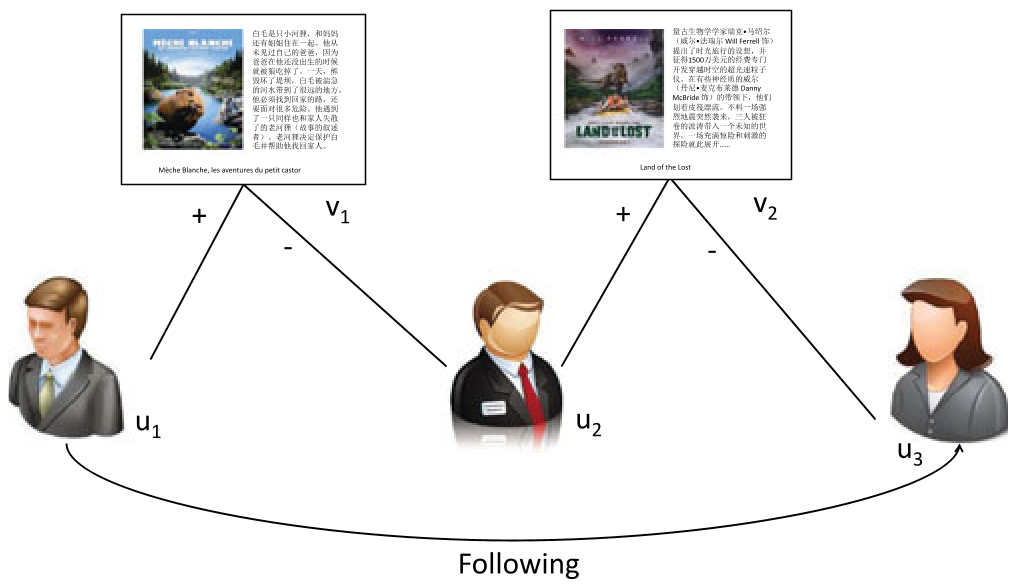 Figure 1: The Heterogeneous SMR Network construction combining user preference, social links, and multimodal content.
2. Random-Walk Based Learning
To learn the embeddings, the authors adapt DeepWalk. However, unlike standard unsupervised DeepWalk, they integrate a Ranking Metric Loss. They sample paths through the social graph and enforce a margin-based loss: This ensures that if user preferred movie over movie , their embeddings reflect this order in the latent space.
Experiments & Results: Dominating the Baseline
The model was tested on a real-world dataset from Douban, comprising over 59,000 movies and 4,200 users.
Key Findings:
- Performance: SMR-MNRL consistently outperformed traditional Collaborative Filtering (CF) and even deep models like CNNMSE.
- The Power of Posters: Interestingly, models using visual posters (like CNNMSE) often outperformed those using only text, proving that a poster is indeed a "visual summary" of the narrative.
- Social Gain: By walking through social "Follow" edges, the model successfully "borrowed" preferences from connected users to fill in the gaps for sparse user profiles.
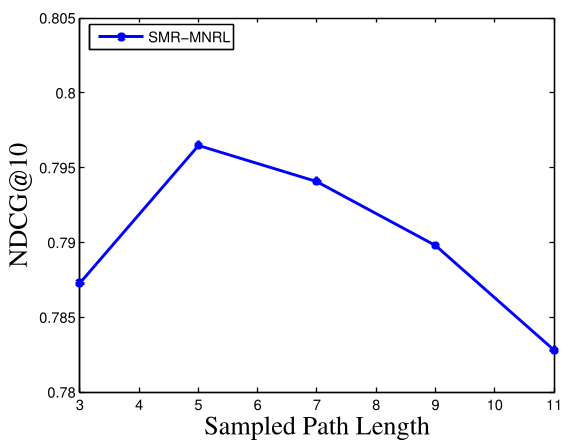 Figure 2: Impact of embedding dimensions on ranking accuracy (NDCG and MAP).
Critical Analysis & Conclusion
Takeaway: The success of SMR-MNRL proves that recommendation is no longer just about "matching" tags; it's about representation learning on graphs. By embedding multimodal content directly into the social network structure, the authors solve the cold-start/sparsity problem with architectural elegance.
Limitations:
- Dynamic Content: The model currently uses static posters. In the future, incorporating video trailers (Temporal CNNs/Transformers) could further improve results.
- Compute Intensity: Random-walk sampling on massive graphs can be computationally expensive as the social network scales to millions of nodes.
Future Outlook: This methodology is highly extensible. The same logic could be applied to "Social-Aware Song Recommendation" (Audio + Lyrics + Social) or even E-commerce (Product Image + Description + Social), making it a versatile blueprint for multimodal HIN learning.