
Social-Aware Multicast: Optimizing DTN Dissemination through Social Logic
Social-Aware Multicast in Disruption-Tolerant Networks
This paper introduces a probabilistic approach to social-aware multicast in Disruption-Tolerant Networks (DTNs), specifically addressing Single-Data Multicast (SDM) and Multiple-Data Multicast (MDM). By leveraging social metrics like Cumulative Contact Probability (CCP) and hierarchical community structures, the proposed method achieves delivery ratios comparable to Epidemic routing while significantly reducing forwarding costs.
TL;DR
In the world of Disruption-Tolerant Networks (DTNs), where end-to-end paths are rare and connections are opportunistic, standard multicast is a nightmare. This paper moves beyond simple "Spray-and-Wait" tactics by introducing a Social-Aware Multicast framework. By calculating a new centrality metric (CCP) and using hierarchical community structures, the authors achieve high delivery ratios with a fraction of the traditional "flooding" cost.
Problem & Motivation: Beyond Unicast and Blind Flooding
In DTNs, nodes (like smartphones carried by humans or vehicles) move unpredictably. Traditional routing often fails because it assumes connectivity. Existing "social-based" methods like BUBBLE Rap or SimBet are designed for unicast—sending a single message to one person.
When we need to multicast (e.g., sharing battlefield intelligence or traffic alerts), simply repeating unicast for every destination is incredibly wasteful. On the other hand, Epidemic routing (blindly flooding the network) kills battery life and clogs buffers. The authors identified a gap: we lacked an analytical model that selects the minimum number of relays needed to satisfy a specific delivery ratio () within a time constraint ().
Methodology: The Core Innovations
1. The CCP Metric: Why Betweenness Isn't Enough
Traditionally, researchers used Betweenness Centrality (how often a node lies on the shortest path). This paper argues that in DTNs, paths aren't fixed. They propose Cumulative Contact Probability (CCP):
eq i} e^{-\lambda_{ij}T}$$ This measures the expected probability that a node will contact a *random* destination. The beauty of CCP is that it accounts for the *rate* of contact ($\lambda$), not just the existence of a link. ### 2. Destination-Awareness in MDM For Multiple-Data Multicast (MDM), nodes must deal with buffer constraints. The authors introduce "Destination-Awareness." A node shouldn't just carry data; it should carry the *specific* data item it has the highest probability of delivering. * **Intracommunity**: Nodes exchange "Opportunistic Path" tables—fine-grained routing data for people they see often. * **Intercommunity**: For distant nodes, they use "Gateway Paths"—coarse-grained data showing which "social hubs" to pass the data through. 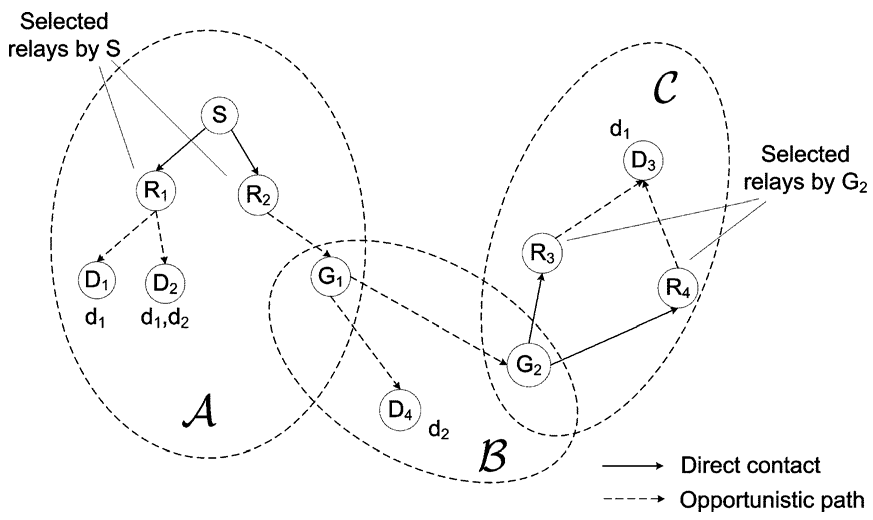 *Figure 1: Hierarchical multicasting across social communities via gateway nodes.* ### 3. The Edge Splitting Process A major mathematical hurdle in multicast is that paths from different relays to the same destination might overlap. You can't just multiply the probabilities because they aren't independent. The authors solve this with an **Edge Splitting Process**, creating a virtual lower bound that allows for efficient relay selection without overestimating delivery success. ## Experiments & Results: Efficiency Gains The authors tested their schemes against **Epidemic**, **PROPHET**, and **Spray-and-Wait** using real-world traces from MIT and Infocom. ### Key Performance Insights: * **Cost Savings**: In the Infocom trace, the proposed SDM scheme achieved a similar delivery ratio to Epidemic but with 75% less overhead. * **Buffer Resilience**: In MDM tests (MIT Reality trace), as the number of data items increased, the social-aware approach managed buffer competition far more gracefully than its competitors. 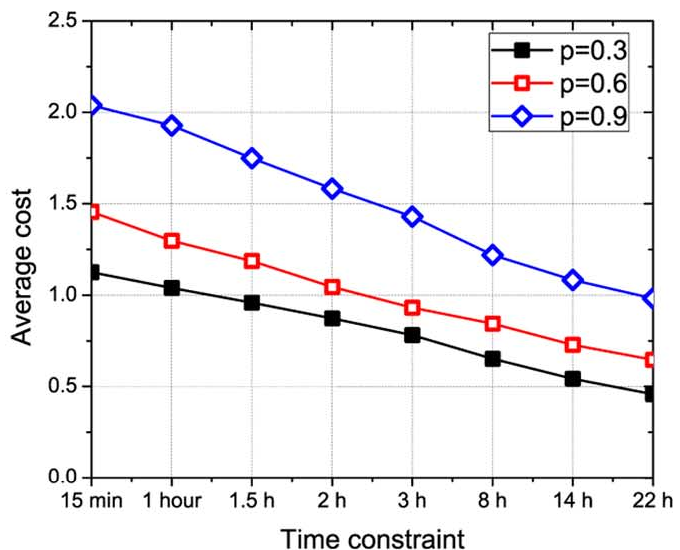 *Figure 2: Delivery ratio and cost comparison on the Infocom trace. Note the significant reduction in average cost (right graph).* ## Critical Analysis & Conclusion This paper is a masterclass in applying social network analysis (SNA) to hard engineering problems. By shifting from "topology-aware" to "social-aware" modeling, it acknowledges the reality of human mobility. **Takeaway**: The essential difference between multicast and unicast in DTNs is the requirement for **cumulative probability awareness**. **Limitations**: The model assumes Poisson contact processes (exponential inter-contact times). While the authors provided an ablation study using synthetic traces (Figs 15-16) showing limited impact, in highly structured environments (like a scheduled bus route), these stochastic assumptions might lose some edge. **Future Work**: This framework lays the groundwork for "Publish/Subscribe" systems in the edge computing era, where social links determine data value.