
RPBV: Revolutionizing Opportunistic Routing with Decentralized Node Embeddings
A Social-Aware Opportunistic Network Routing Protocol Based on the Node Embeddings
The paper introduces RPBV (Routing Protocol Based on Vector), a social-aware opportunistic routing protocol for Mobile Opportunistic Social Networks (MOSNs). It utilizes a novel decentralized embedding algorithm called "op2vec" to map discrete network nodes into numerical vectors, enabling multi-phase routing based on community detection and encounter probability.
TL;DR
Routing in Mobile Opportunistic Social Networks (MOSNs) is notoriously difficult due to the lack of consistent end-to-end paths. This paper introduces RPBV, a routing protocol that moves away from static social metrics. By implementing op2vec—a decentralized node embedding algorithm—it transforms the network's social structure into a vector space. This allows for precise community detection and encounter probability estimation, resulting in higher delivery ratios and lower overhead than established baselines like BubbleRap.
The Social Dilemma in MOSNs
In MOSNs, nodes are typically mobile devices carried by humans. Naturally, these nodes exhibit social patterns: they form communities and gravitate towards "popular" individuals. Existing protocols like BubbleRap or PeopleRank try to exploit this, but they have a fatal flaw: they treat social attributes as discrete, often static labels.
The authors argue that social mining is difficult because discrete nodes are hard to use in continuous mathematical optimizations. They ask: What if we could represent every person in the network as a high-dimensional vector, where the distance between vectors represents their social affinity?
Methodology: From Topology to Vectors
1. op2vec: Decentralized Embedding
The core innovation is op2vec, a distributed version of the popular node2vec algorithm. Since no central server knows the entire network topology, nodes exchange local adjacency matrices (Matrix A) during contacts.
Each node performs a second-order random walk on its local view of the "Contact Strength Graph" (CSG). These walks are used as training data for a Skip-gram model, which learns to embed nodes that appear in similar walk contexts (i.e., social neighborhoods) close together in a vector space.
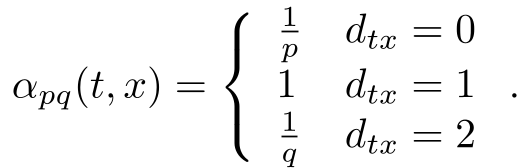 The transition probability formula used for biased random walks to capture both structural equivalence and community membership.
2. The RPBV Routing Logic
RPBV uses a clever two-phase strategy:
- Phase 1 (Global Search): If the destination is unknown or far away, the message is passed to nodes with higher Global Centrality (the "social butterflies" of the network).
- Phase 2 (Local Pursuit): Once the message reaches the destination's community (detected via K-means on the vectors), it uses the Encounter Probability—calculated using the dot product of node embeddings—to home in on the target.
Experimental Results
The authors tested RPBV against Epidemic (the upper bound for delivery), BubbleRap, and PeopleRank across three diverse datasets: Infocom 2006, Reality Mining, and Pmtr.
Higher Delivery, Lower Cost
As shown in the performance charts, RPBV consistently outperforms other social-aware protocols in Delivery Ratio. More impressively, it maintains the lowest Delivery Cost. This means RPBV is remarkably efficient, reaching the destination with fewer message copies (replicas) by making "smarter" forwarding decisions based on vector similarity.
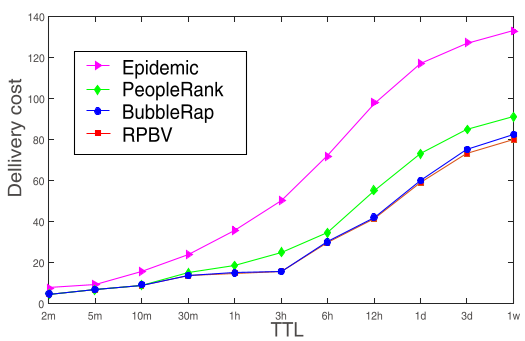 Relative performance showing RPBV (orange line) consistently outperforming BubbleRap and PeopleRank.
Delay Analysis
While the Epidemic protocol has the lowest delay (due to its brute-force flooding nature), it is impractical for real-world use due to congestion. Among the "controlled" protocols, RPBV shows the lowest normalized delay, reaching destinations significantly faster than its social-aware predecessors.
Critical Insight & Conclusion
The true value of this work lies in the Inductive Bias of embeddings. By moving from "centrality counts" to "latent vectors," RPBV captures higher-order relationships that simple contact-counting misses.
Limitations: The protocol requires nodes to maintain and exchange local matrices and perform periodic K-means clustering. In extremely resource-constrained IoT environments, the computational overhead of training a Skip-gram model locally might be a bottleneck.
Future Outlook: As mobile hardware becomes more capable of on-device AI, decentralized embedding-based protocols like RPBV will likely become the standard for resilient, infrastructure-less communication in smart cities and disaster recovery scenarios.