
Social-Aware D2D: Bridging Social Ties and Resource Allocation for Green 5G
Social-aware peer discovery and resource allocation for device-to-device communication
This paper presents a social-aware D2D communication scheme that integrates peer discovery and joint resource allocation (sub-carrier and power) by leveraging Mobile Social Networks (MSN). By utilizing a Quantum-behaved Particle Swarm Optimization (QPSO) algorithm, the framework achieves a significant improvement in system throughput and D2D pairing success rates.
TL;DR
This study introduces a holistic framework for Device-to-Device (D2D) communication that doesn't just look at signal strength, but also at who you know. By combining social network relationships (MSN) with a Quantum-behaved Particle Swarm Optimization (QPSO) for resource allocation, the authors increase D2D pairing by 50% and significantly boost overall network throughput while prioritizing device energy levels.
Background & Motivation: Why Social Matters
In the race to 5G and beyond, D2D communication is a "holy grail" for offloading traffic from congested Base Stations (BS). However, two major hurdles remain:
- User Selfishness: Why would a stranger use their battery to help transmit your data?
- Discovery Efficiency: How do devices find reliable partners in a sea of interference?
The authors argue that Social Ties provide the necessary incentive and trust. You are more likely to help a "friend" or a "friend-of-a-friend" than a complete stranger.
Methodology: The Two-Tier Strategy
1. Peer Discovery & The Fallback Mechanism
The discovery process isn't just a blind broadcast. It leverages a two-hop "friendship" logic in the social layer. When a user needs content, it queries its social circle. To ensure "Green Communication," the algorithm selects candidates based on Residual Energy: If multiple requesters target the same high-energy node, a Fallback Mechanism is triggered, using a timer based on energy weight to resolve conflicts and maximize the total pairs established.
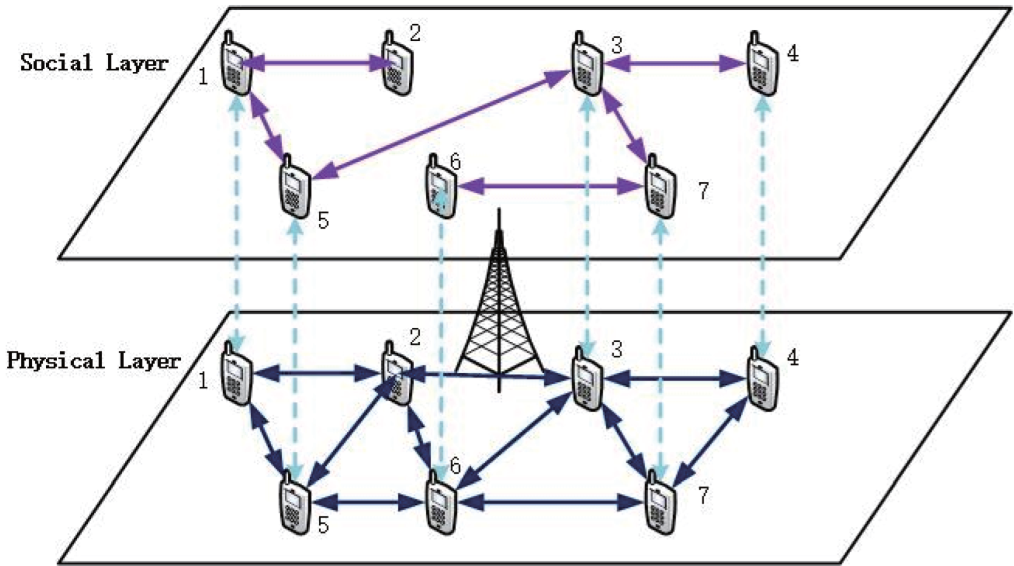 Fig 1: The dual-layer model connecting Social Relationships (Trust) to Physical Layer (Channel Gain).
2. Joint Resource Allocation via QPSO
Once pairs are matched, the network faces a complex math problem: how to distribute sub-carriers () and power () without crushing the Signal-to-Interference-plus-Noise Ratio (SINR).
The paper employs QPSO (Quantum-behaved Particle Swarm Optimization). Unlike standard PSO, QPSO explores the search space more effectively, avoiding the "local optimum" trap. It uses a Penalty Function to transform hard constraints (like minimum rate thresholds) into an unconstrained fitness function:
Experimental Validation
The researchers simulated a single-cell environment (300m radius) with Rayleigh fading.
Key Findings:
- Scaling Success: As the total number of users increases, the proposed scheme's discovery rate grows much faster than random matching because it utilizes "one-hop friend" discovery.
- Throughput Gains: The system sum rate surpasses random matching and traditional cellular methods, particularly as the network becomes dense.
- Convergence: The QPSO approach proves highly efficient, converging within roughly 40-50 iterations.
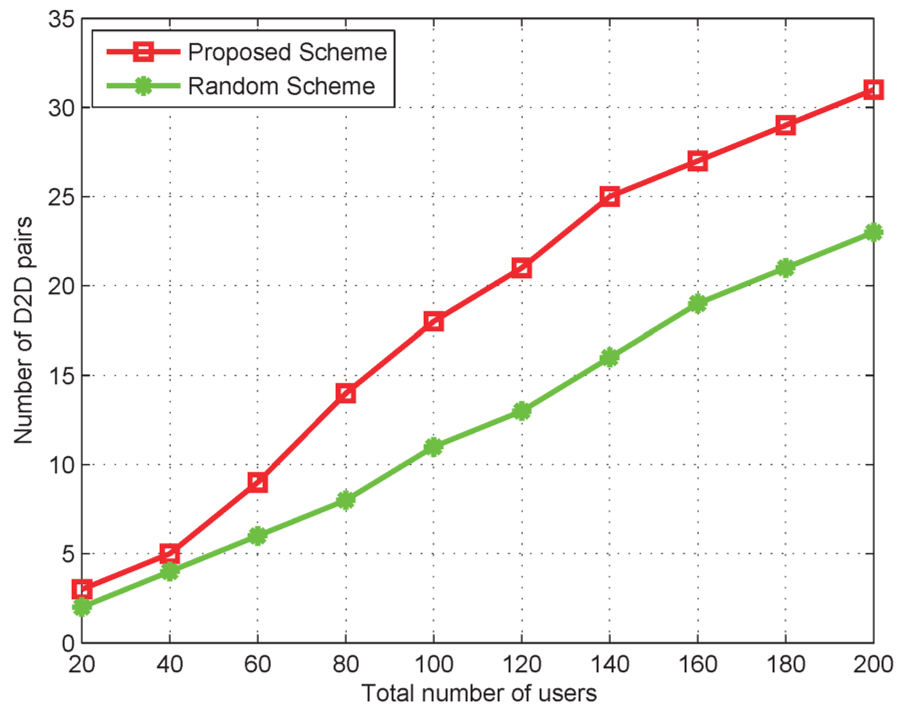 Fig 2: The proposed social-aware discovery algorithm establishes nearly 50% more D2D links than random matching.
Critical Insight & Conclusion
The genius of this work lies in the Cross-Layer Insight. By treating social trust as a "soft" physical constraint and residual energy as a "hard" ranking criterion, the authors solve the technical problem of resource management AND the human problem of user cooperation.
Limitations: The study assumes perfect Channel State Information (CSI) at the Base Station and uses a simplified random social relationship model. In real-world scenarios, social ties are dynamic and CSI is often noisy, which might impact the QPSO's final accuracy.
Future Outlook: This framework paves the way for "User-Centric" networks where the social graph is just as important as the cell tower location.