
SA-LSTM: Bridging Social Influence and Temporal Habits in Sequential Recommendation
Social-Aware Sequential Modeling of User Interests: A Deep Learning Approach
This paper introduces Social-Aware Long Short-Term Memory (SA-LSTM), a hybrid deep learning framework for predicting a user's next Point of Interest (PoI) or item category. It combines stacked LSTMs for sequential interest modeling with Stacked Denoising Autoencoders (SDAEs) to capture social influence from friends' recent activities, achieving state-of-the-art performance on Yelp and Epinions datasets.
TL;DR
Understanding what a user will do "next" requires more than just looking at their past; it requires looking at their friends. This paper presents SA-LSTM, a deep learning architecture that fuses Stacked LSTMs for sequential modeling with Stacked Denoising Autoencoders (SDAEs) for social influence. By treating social data as a dynamic feature rather than a static constraint, the model achieves a massive 33.5% - 185% improvement in prediction accuracy over traditional baselines.
Problem & Motivation: The Static Fallacy
Most recommendation engines treat your profile as a static collection of interests. However, human behavior is inherently sequential and socially driven. The authors identified two critical insights through statistical analysis of Yelp and Epinions data:
- Temporal Autocorrelation: Users have "habits" (e.g., visiting a hotel usually follows visiting a restaurant), with over 80% of users showing repeated subsequences of length 2 or 3.
- Social Influence: The probability of a user visiting a specific category increases monotonically with the number of friends who have visited it.
Prior works like Matrix Factorization (MF) fail to capture the "order" of events, while standard Markov Chains are too shallow to grasp complex, long-term non-linear dependencies.
Methodology: The Architecture of Influence
The SA-LSTM model is designed to be end-to-end trainable, meaning the temporal interest and the social influence are learned simultaneously.
1. Sequential Modeling (Stacked LSTMs)
Instead of simple RNNs, the authors use LSTMs to combat the vanishing gradient problem. This allows the model to remember long-term habits while forgetting irrelevant past actions. The input vector includes not just the category and rating, but also temporal context (weekday).
2. Social Influence Modeling (SDAEs)
This is the "Social-Aware" core. For any target user, the model takes the activities of their Top-5 most active friends within the last week. Because this data is high-dimensional and noisy, a Stacked Denoising Autoencoder is used to compress these "friend sequences" into a low-dimensional latent vector.
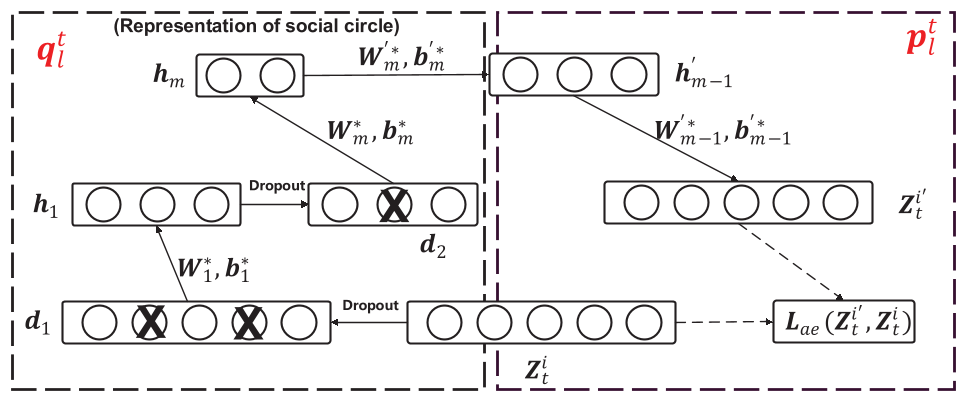 The social influence (blue) and user history (red) are concatenated before entering the LSTM layers.
Experiments & Results: Is Deeper Always Better?
The model was tested against several baselines, including SPMC (Socially-aware Markov Chains) and TrustSVD.
Key Performance Wins:
- Accuracy: SA-LSTM outperformed all models across Recall@N and MAP. The improvement was particularly striking on Epinions, which has a denser social fabric than Yelp.
- The Power of Social: Comparing SA-LSTM to a vanilla LSTM showed a ~10-19% performance boost, proving that social signals are not just "noise" but critical predictors.
The "Sweet Spot" for Depth:
A fascinating finding in this paper is the ablation study on network depth. While deep learning is often synonymous with "deeper is better," the authors found that 2 layers was the optimal depth for both SDAEs and LSTMs.
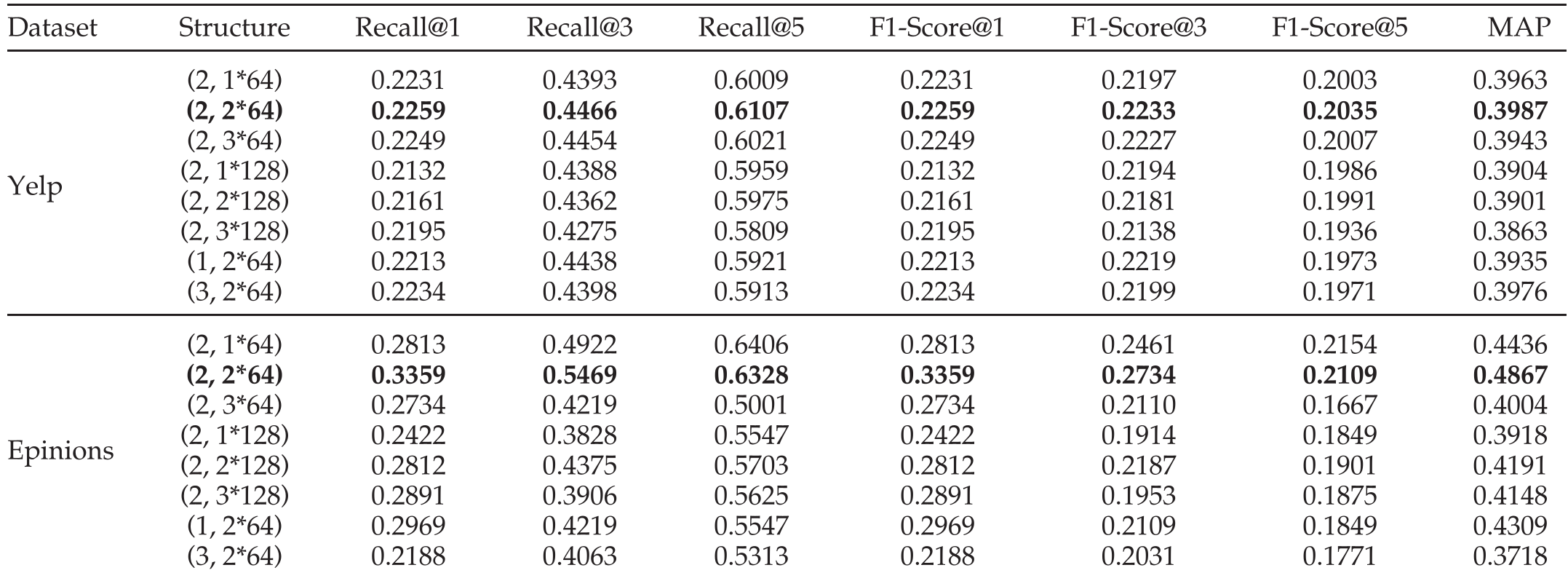 Performance peaks at (2, 264) and starts to degrade at 3 layers or 128 hidden units due to overfitting on the sparse behavioral data.*
Critical Insight & Conclusion
SA-LSTM proves that the "Next-Item" prediction problem is a symphony of two forces: personal routine and peer pressure.
Takeaway for Practitioners: When building recommendation systems, don't just use social graphs as a filter; use them as a compressed temporal input into your recurrent layers. However, be wary of over-engineering the depth—user behavior data is often sparser than image or text data, making 2-layer architectures the robust choice for industrial applications.
Limitations: The model relies on a fixed number of friends (Top-K), which might lose information in extremely large social circles, and uses K-means for category clustering, which could be replaced by more sophisticated embedding techniques in future iterations.