
STI: Decoding Missing Data through the "Eyes" of Your Social Neighbors
How Do Your Neighbors Disclose Your Information: Social-Aware Time Series Imputation
The paper introduces STI (Social-aware Time series Imputation), a deep learning framework designed to impute missing values in time-series data by leveraging both social correlations and temporal dependencies. By combining a Time-Aware LSTM (T-LSTM) with a dual-attention mechanism, the model achieves state-of-the-art performance on electricity consumption and voltage datasets, outperforming 11 baselines.
TL;DR
In the world of time-series data—whether it's power grids or wearable sensors—missing values are an inevitable headache. While most models look internally at a user's own history to fill the gaps, the paper "How Do Your Neighbors Disclose Your Information: Social-Aware Time Series Imputation" (WWW '19) argues that your neighbors already know the answer. By combining Social Attention with Time-Aware LSTMs, the authors achieve a new SOTA in data recovery.
The Problem: The "Independence" Fallacy
Most existing imputation techniques (like KNN, MICE, or even standard GRUs) treat each user as an island. They assume that if person A’s sensor fails, only person A’s past data matters. However, in real-world systems like electricity grids, people living in the same building or neighborhood share similar lifestyles. This "homophily" means that your neighbors’ consumption patterns provide a high-fidelity "clue" to your missing information.
Moreover, real-world data isn't just missing; it's irregular. Gaps of 10 minutes vs. 10 hours shouldn't be treated as equal "time steps," yet standard LSTMs do exactly that.
Methodology: Social + Temporal + Precise Timing
The authors propose the STI (Social-Aware Time series Imputation) framework. It’s a sophisticated encoder-decoder model that looks at two dimensions of influence:
- Surrounding Influence (Social Attention): It looks at the behaviors of neighbors. Instead of simple averaging, it uses a Memory-Based Attention mechanism to weight which neighbors are most relevant to the current user at a specific time.
- Temporal Influence (Temporal Attention): It scans the user's own history and future (interpolation) to capture long-term patterns.
- Irregular Intervals (T-LSTM): They replace the standard LSTM cell with a Time-Aware LSTM. This cell decomposes the previous memory into long-term and short-term components, applying a decay function to the short-term memory based on the actual elapsed time.
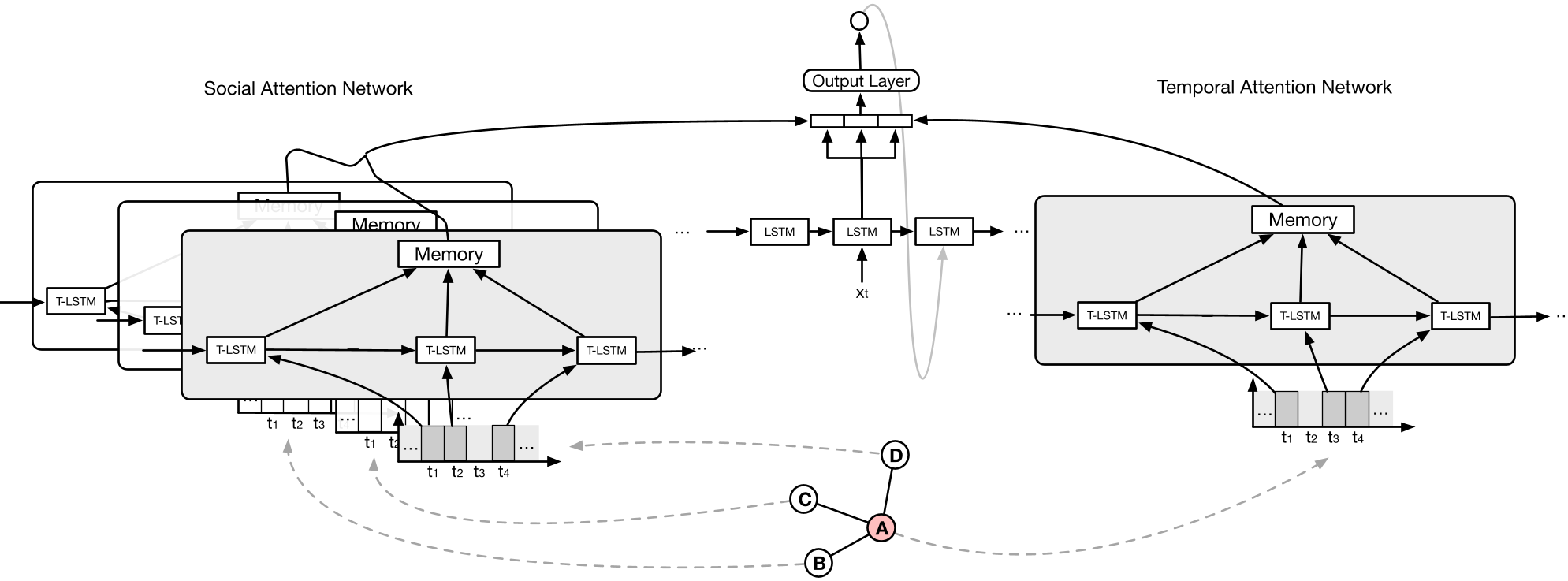 Figure 4: The STI Architecture. The left side captures Social Context, while the right side handles Temporal Context.
Experiments: Dominating the Baselines
The model was tested against 11 baselines, including traditional statistical methods (Mean, Cubic Spline), matrix completion (Soft-Impute), and deep learning models (VAE, GRU-D).
Key Findings:
- Robustness to Missing Rates: As the missing rate increases from 20% to 60%, STI's performance remains stable, while methods like VAE and Cubic Splines see their error rates explode (especially on the RV dataset).
- The Power of Social Context: The ablation study (STI - social) showed that removing the neighbor data consistently hurts performance, proving that "neighbor disclosure" is a real and exploitable phenomenon.
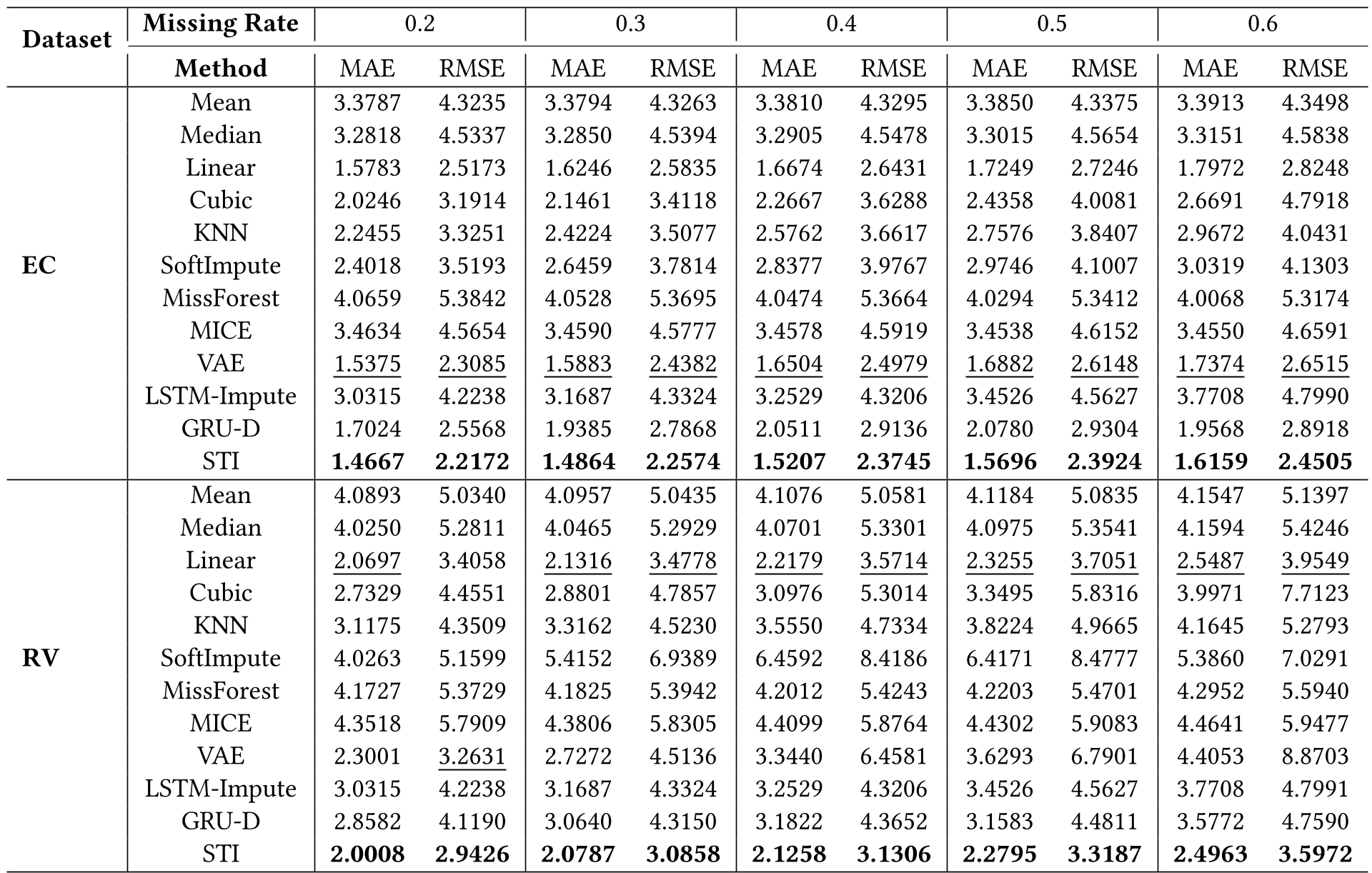 Table 1: Performance comparison. STI maintains the lowest RMSE/MAE across all missing rates (theta).
Deep Insight: Why Does This Work?
The genius of this paper lies in its Inductive Bias. By baking the knowledge of "geographical proximity = behavioral similarity" into the attention mechanism, the model doesn't have to "re-learn" the laws of sociology from scratch. Furthermore, the use of Memory-Based Attention (using a fixed-size memory representation ) makes the model computationally efficient enough for real-world smart grid applications.
Conclusion
STI is a landmark approach for time-series imputation because it shifts the focus from "prediction" to "contextual reconstruction." It acknowledges that in a connected world, no data point is truly lost as long as its neighbors are still talking.
Future Outlook: While this paper used geographical proximity as a proxy for social relations, the same logic could be applied to financial markets (correlated stocks) or transport networks (adjacent traffic sensors).