
SBT-SR: Turning Enemies into Assets — Solving Cold-Starts with Social Balance Theory
A Social Balance Theory-Based Service Recommendation Approach
This paper introduces SBT-SR (Social Balance Theory-based Service Recommendation), a novel approach designed to overcome the "cold-start" problem in recommendation systems. It leverages the sociological principle of "an enemy's enemy is a friend" to identify potential neighbors when traditional similarity-based Collaborative Filtering fails.
TL;DR
Standard recommendation systems break down when they can't find "users like you." This paper, SBT-SR, solves this by looking for "users NOTHING like you" and then finding their opposites. By applying the Social Balance Theory principle of "the enemy of my enemy is my friend," the authors create a path for recommendations in extremely sparse networks where traditional Collaborative Filtering (CF) fails.
The "Zero-Similarity" Wall
Most Collaborative Filtering algorithms (User-based, Item-based, or Hybrid) rely on the Pearson Correlation Coefficient (PCC) to find similar neighbors. However, in the vast ocean of modern Web Services, the user-service matrix is often incredibly sparse.
If a target user has only rated a few services, and those services haven't been rated by others—or were rated differently—the PCC returns a negative or null value. In this "Zero-Similarity" scenario, traditional models have no "friends" to consult, leading to poor-quality recommendations or total failure.
Methodology: The Logic of Signed Graphs
The authors propose SBT-SR (Social Balance Theory-based Service Recommendation). Instead of giving up when no positive similarity is found, they dive into the negative space.
The Four-Step Workflow
- Identify Enemies: Calculate PCC and find users with a similarity below a threshold (e.g., ). These are users with opposite tastes.
- Locate the Enemy's Enemy: For the identified enemies, find their enemies using the same threshold.
- Synthesize Potential Friends: According to Social Balance Theory, if User A dislikes User B, and User B dislikes User C, User A and User C likely share common ground.
- Recommend & Rank: Services liked by these "potential friends" are recommended to the target user, ranked by a calculated Recommendation Credibility.
 Note: The model utilizes indirect similarity to bridge gaps in the user-invocation network.
Quantifying Credibility
The authors don't just assume an "enemy's enemy" is a perfect match. They introduce a Credibility Metric: Since both similarities are negative (e.g., -0.9 and -0.95), the product becomes a strong positive value (0.855), mathematically justifying the friend-of-friend intuition.
Experimental Battleground
Testing against the MovieLens-10M dataset, the authors compared SBT-SR with three heavyweights: WSRec, MCCP, and K-means.
Key Findings:
- Sparsity Advantage: When the matrix density is very low (4% to 12%), SBT-SR has a lower Mean Absolute Error (MAE). It finds signals where others see only noise.
- The Trade-off: When data is dense (16% to 20%), traditional CF wins. This is logical: "Direct" friends are always a more reliable source of truth than "indirect" potential friends derived through double negation.
- Efficiency: The computational complexity is , which translates to millisecond response times in the tested environments.
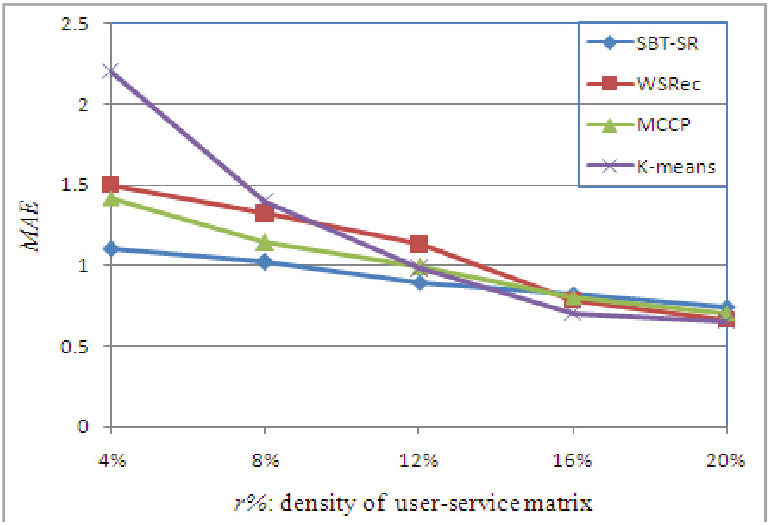 The MAE comparison shows SBT-SR (bottom line at low 'r') outperforming others in sparse data conditions.
Critical Insights & Future Directions
SBT-SR isn't meant to replace traditional Collaborative Filtering—it's a beneficial supplement.
The Takeaway: In the real world, "dislike" is a signal just as strong as "like." Most recommendation research focuses on reinforcing existing clusters. This paper proves that by navigating through negative correlations, we can build a robust safety net for cold-start users.
Limitations to Address:
- Static Thresholds: The similarity threshold is currently manual. Future iterations should use adaptive thresholds.
- Temporal Dynamics: User preferences change. Adding a time-decay factor into the "enemy" relationship would improve accuracy.
- Hybridization: The ultimate system would likely be a ensemble, switching from SBT-SR to traditional CF as more user data is collected.
Conclusion
By formalizing the "enemy's enemy" rule, Qi et al. provide a clever, mathematically grounded way to handle the most difficult edge cases in service recommendation. It reminds us that in data science, what we don't like defines us as much as what we do.