
SBCF: Elevating Friend Recommendations via Social Filtering and Hybrid Classification
Using a Social-Based Collaborative Filtering with Classification Techniques
This paper introduces SBCF, a social-based collaborative filtering model designed for personalized friend recommendations. It enhances traditional User-User Collaborative Filtering (CF) by integrating social metrics (friendship, commitment, and trust) and optimizing performance through a hybrid classification approach using Incremental K-means and K-Nearest Neighbors (K-NN).
TL;DR
The SBCF (Social-Based Collaborative Filtering) model addresses the inherent limitations of traditional recommenders—specifically data sparsity and the cold start problem—by fusing social behavior metrics with collaborative filtering. By employing an Incremental K-means algorithm for cluster stability and K-NN for efficient handling of new users, the model achieves high accuracy (up to 86%) on real-world social data.
Problem & Motivation: Beyond Ratings
In the era of the Social Web, "items" aren't just restaurants or movies—they are people. Traditional Collaborative Filtering (CF) relies heavily on rating matrices. However, if a user hasn't rated enough items, the system goes "blind."
The author's key insight is that social context (who you follow, how long you've been active, and how much others trust your taste) is a powerful proxy for similarity. By quantifying "Social Filtering" (SocF), the system can recommend friends even when collaborative rating data is absent.
Methodology: The SBCF Framework
1. The Social Dimension (SocF)
Instead of just looking at shared ratings, the system calculates a multi-dimensional social score:
- Friendship Metric: A Jaccard-like similarity based on common friends.
- Commitment Degree: A blend of Participation (activity level) and Sociability (network density).
- Trust Degree: Based on Seniority (tenure) and Competency. Competency is mathematically defined by how closely a user’s ratings align with the community average.
2. Hybrid Classification for Scalability
To avoid searching the entire user database, the system groups users into classes.
- Unsupervised (Batch): Uses Incremental K-means to solve the "initialization problem" of standard K-means, ensuring more stable and optimal clusters.
- Supervised (Online): Since re-clustering is expensive, K-NN is used to categorize new users into existing clusters on the fly.
 Note: The architecture combines usage matrices with social affinity profiles to drive the classification engine.
Experiments & Results
Testing on the Yelp "Restaurant" dataset, the researchers evaluated the system's ability to "predict" existing friendships that were intentionally hidden from the algorithm.
Performance Gains
- Social Integration: Adding social information consistently boosted Precision and F-measure compared to pure Collaborative Filtering.
- Algorithm Stability: Incremental K-means showed superior convergence and precision over standard K-means as the number of users grew.
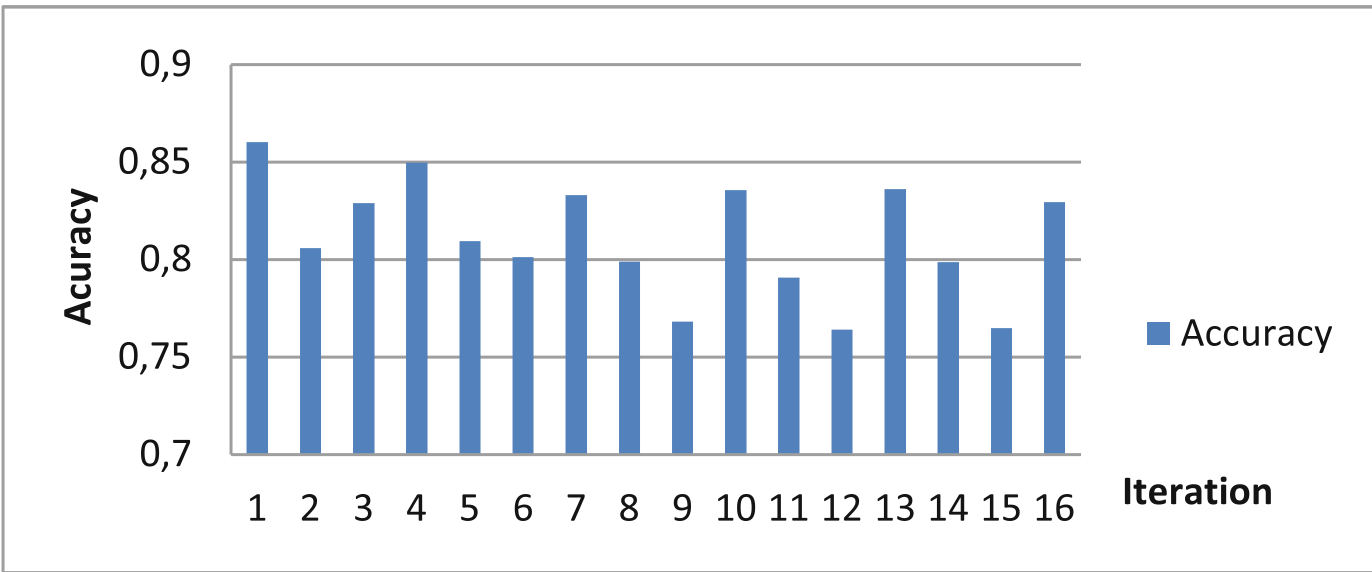 Figure: The system maintains stable accuracy (0.76–0.86) over time, validating the K-NN update strategy.
Ablation Insight: The Power of Social Weights
The study found that the best results occurred when prioritizing Sociability (weight 0.6) and Trust/Competency (weight 0.3) over simple participation. This suggests that the quality and structure of a user's social network are more predictive than the sheer quantity of their ratings.
Critical Analysis & Conclusion
Takeaway: SBCF successfully bridges the gap between social graphs and collaborative interest. The use of Incremental K-means is a sophisticated touch that prevents the recommendation engine from being "stuck" in poor local optima.
Limitations:
- The current model relies on explicit seniority and participation metrics which might be susceptible to "gaming" in an open social network.
- Computational complexity of calculating global trust (Step 2 of the competency formula) may still pose challenges for billion-scale networks.
Future Work: The authors suggest incorporating Semantic Information. Moving from "User-ID" to "Meaning" (e.g., understanding why a user likes specifically "Vegan Italian" restaurants) will likely be the next frontier for this architecture.