
Social Behavior Bias: Why More Information Is Killing Your ROI
Social Behavior Bias and Knowledge Management Optimization
This paper introduces a formal mathematical framework based on "Novelty Management" to analyze individual and social information processing. By applying neuroscience-derived models to financial data from the eToro social trading platform, it identifies a universal Inverted U-shape relationship between information source diversity and trading performance (ROI).
TL;DR
In the "Big Data" era, we assume knowledge is power. However, this research from MIT and Athena Wisdom proves that in social trading, information follows the Inverted U-shaped curve. Using a dataset of 40 million trades, the authors demonstrate that human investors, unlike rodents, fail to optimize their "Novelty Signal-to-Noise Ratio," leading to a performance collapse caused by information overload.
The "More is Better" Fallacy
The central paradox of modern social networks is that while we have unprecedented access to the "Wisdom of the Crowd," our individual performance often suffers. The authors argue that this is a Knowledge Management failure.
Current social trading platforms allow users to follow hundreds of "leads." While this feels like gathering intelligence, the cognitive cost of processing these diverse signals creates a bottleneck. The core insight: Humans are trying to maximize money, but our brains are wired to manage novelty. When these two goals decouple, we fall off the efficiency peak.
Methodology: From Rodent Brains to Wall Street
The paper bridges the gap between Neuroscience and Social Physics through two distinct lenses:
- Individual Novelty Management: Drawing from experiments on rodents and human tactile perception (using artificial whiskers), the authors identify that biological agents seek a stable flow of information.
- SNR Optimization: Agents maximize the Signal-to-Noise Ratio of novelty. Too little new info leads to stagnation; too much leads to "noise" that overwhelms decision-making.
The Macro-Scale Dynamics
The researchers mapped these principles onto the eToro dataset (3 million users). They treated the social network as a physical ensemble where agents interact like atoms.
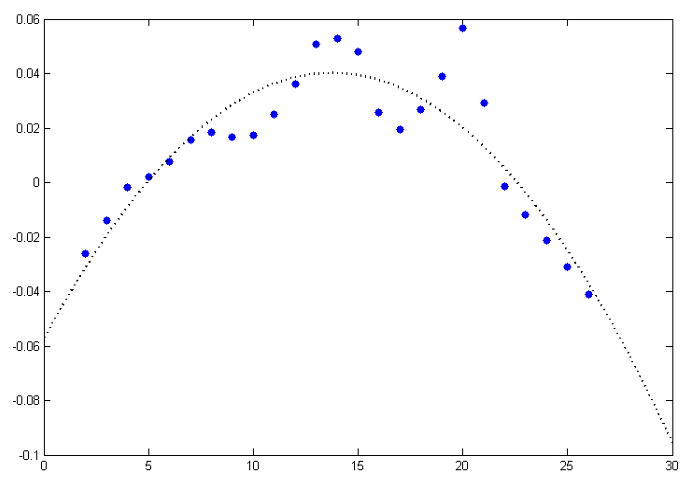 Fig 1: The Inverted U-shape validated. Note how mean gain drops sharply as the number of information sources exceeds a specific threshold.
Key Results: The High Cost of Crowds
The empirical evidence is striking:
- The Optimal Peak: There is a "Goldilocks zone" for the number of information sources. Below this, you lack the context to act; above this, the conflicting signals of a social network lead to poor ROI.
- Human Sub-optimality: Unlike rodents, who naturally "stop" exploring when complexity exceeds processing power, humans keep consuming social data in hopes of higher gains, effectively pushing themselves into the "inefficient flood" zone of the curve.
- Systemic Instability: When a network is composed of individuals scattered across this U-shape, the global performance becomes unstable. The "spread" (variance) of information management strategies dictates the health of the entire ecosystem.
Critical Insight: Social Physics as a Solution
The authors propose a "Thermodynamic" approach to fixing social networks:
- Temperature Control: By adjusting the "system temperature," platforms can either encourage diversity (higher temp) or drive the network toward a more homogenous, optimal state (lower temp).
- Architecture for Choice: Instead of providing all data, platforms should curate information flow to keep investors near the "Peak Novelty SNR."
Conclusion & Future Outlook
This work serves as a warning for the designers of social systems and AI interfaces alike. As we build tools that provide more "context," we might be inadvertently degrading the decision-making quality of the human-in-the-loop.
The Takeaway: The next generation of Knowledge Management systems shouldn't focus on providing information, but on filtering it to match the biological constraints of human novelty processing.
Limitations
The study focuses on social trading, which is a high-risk, high-reward environment. Whether these exact SNR thresholds apply to creative tasks or non-financial collaborative work remains an open question for future exploration.