
Beyond Collateral: Leveraging Social Capital for Decentralized P2P Lending
A social-capital based approach to blockchain-enabled peer-to-peer lending
This paper introduces a decentralized peer-to-peer (P2P) lending platform built on the Ethereum blockchain that utilizes a novel "Social Score" for creditworthiness. By leveraging the Social Capital Theory, the system allows users to obtain unsecured loans without traditional collateral or a credit history, primary targeting the unbanked or asset-light populations.
TL;DR
This research tackles the "barrier to entry" in decentralized finance (DeFi) by replacing burdensome collateral requirements with a Social Score. Built on Ethereum, the platform extracts "Social Capital" from media accounts to determine creditworthiness. It enables unsecured lending for users without traditional financial footprints while maintaining transparency through automated Smart Contracts.
Background: The Collateral Trap
In the current P2P lending landscape, platforms like CoinLoan and Inlock require over-collateralization (often 110%+). If the market crashes, the borrower’s assets are liquidated. On the other hand, platforms like Prosper rely on FICO scores, which are often unavailable to many global users. The author posits a crucial insight: Social connectivity is an asset. If you have a deep, authentic social network, you have a reputation to protect, making you statistically less likely to default.
Problem & Motivation
The fundamental problem is asymmetry of trust. Without a middleman (bank) to verify a borrower's reliability, lenders default to requiring assets as insurance. However, over 55% of the global population uses social media, generating huge amounts of public data that reflect professional stability, community ties, and reliability. The motivation here is to convert this "Social Capital" into a functional "Credit Score."
Methodology: The Social Scoring Algorithm
The core of the paper is a multi-factor formula that translates social behavior into a numerical trust value (0-100).
The Six Hypotheses of Trust
- Transparency: Users willing to link accounts have "less to hide."
- Breadth: Linking multiple platforms (FB, LinkedIn, IG) proves a willingness to forgo anonymity.
- Authenticity: Detecting fake profiles by analyzing follower-to-following ratios.
- Network Size: Higher social activity correlates with lower crime and higher economic success.
- Honesty: Cross-matching self-reported data (DOB, Email) with social profile data.
- Consistency: Similarity of profiles across different platforms indicates a stable identity.
The Formula
The Social Score () is the average of platform-specific scores (which factor in openness, authenticity, and honesty) plus a weighted consistency bonus:
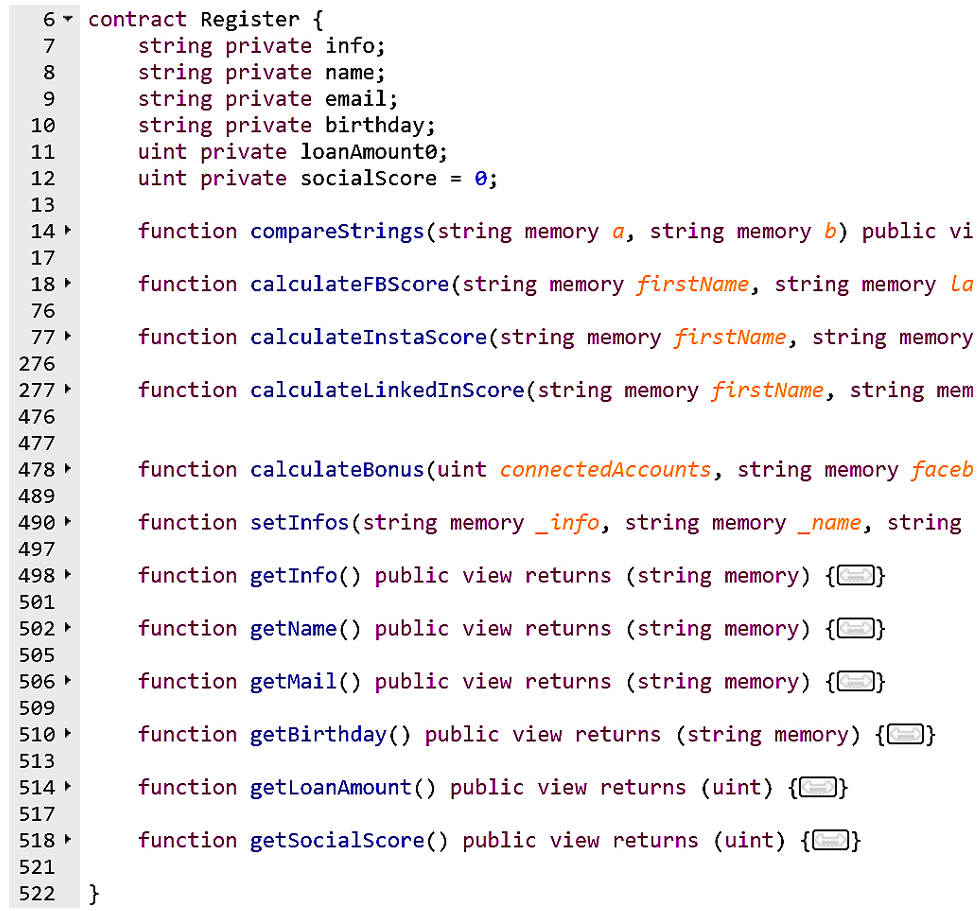 Figure 1: The architecture of the Solidity Smart Contract functions governing the scoring and data storage.
Experiments & Results
The authors validated their logic using the Stanford SNAP Facebook dataset, which contains real-world friendship edges.
- Threshold Dynamics: The study found that social scoring is highly sensitive to parameter tuning. For example, when requiring 200 friends for a "top" score, only 1.2% of users qualified. Reducing that threshold to 50 friends expanded eligibility to roughly 38% of the user base.
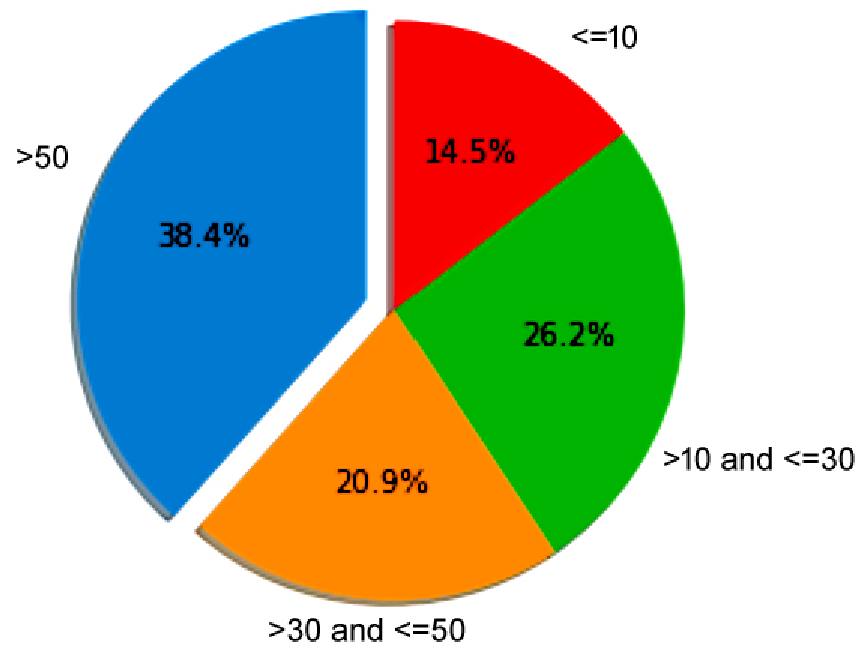 Figure 2: Distribution of friends across the test user base, helping developers determine optimal "trust thresholds."
- Blockchain Efficiency: The prototype was deployed on the Ethereum Ganache network. While view functions are free, the initial registration (
setInfos) and scoring require gas, ensuring that the cost of participation remains a deterrent for low-effort fraudulent accounts.
Critical Analysis & Conclusion
Takeaway
The shift from financial capital to social capital represents a significant democratization of credit. By encoding "reputation" into a Smart Contract, the system creates a self-executing trust mechanism that doesn't need a bank.
Limitations
- Privacy: Centralized social media data on a public ledger is a major privacy risk. The authors acknowledge that names and DOBs are currently stored in plain text for this prototype.
- The "Socially Reclusive": Users who are private or inactive on social media are penalized, even if they are financially stable.
Future Outlook
The next logical step for this technology is the integration of Zero-Knowledge Proofs (ZKP). This would allow a user to prove they have "over 100 friends and an authentic LinkedIn account" without actually revealing their identity or specific friend list on the blockchain.