
Social Capital: The Computational Shortcut to Collective Intelligence
Social Capital as a Complexity Reduction Mechanism for Decision Making in Large Scale Open Systems
The paper introduces a computational framework for "electronic social capital" to facilitate decision-making in large-scale multi-agent systems. It models social capital through three dimensions—trustworthiness, social networks, and institutions—to achieve efficient collective action and superior resource allocation compared to traditional game-theoretic approaches.
TL;DR
In large-scale distributed systems, finding the "optimal" move via traditional game theory is often too expensive or too slow. This paper proposes a framework for Electronic Social Capital, utilizing Trust, Networks, and Institutions as lightweight heuristics. By replacing complex Nash equilibrium calculations with social reliance, agents can solve collective action problems efficiently and sustainably.
Background: The Cost of Being Rational
In the world of Multi-Agent Systems (MAS), we often assume agents should be perfectly "rational"—calculating every possible outcome to find a Nash equilibrium. However, in open systems like Smart Grids or Cloud Markets, computation isn't free. If an agent spends more energy calculating a strategy than it gains from the actual resource, the system fails.
The authors argue that human society solved this long ago not through math, but through Social Capital. We don't recalculate the risks of every interaction; we rely on trust, our social circle, and the rules of our institutions.
The Problem: Why Game Theory Struggles
The paper highlights three critical pain points in current distributed systems:
- Endogenous Resources: The energy for decision-making comes from the same pool as the resources being traded.
- Time Constraints: Decisions must be made in fixed "time-slices," making protracted negotiations impossible.
- The Complexity Trap: Computing optimal strategies in large-scale, repeated games is NP-hard or simply impractical for edge devices.
Methodology: The Three Pillars of Social Capital
The core of the proposed framework is a "Complexity Reduction Mechanism." Instead of solving a strategic game from scratch, agents monitor events and update a multi-faceted Social Capital score.
1. The Architectural Framework
The system decouples Event Monitoring from Decision Making.
- Trustworthiness: Subjective reputation based on direct pairwise history.
- Social Networks: Indirect information gained via gossiping or observing communication patterns.
- Institutions: Belief in a shared rule-set that punishes defectors and rewards cooperators.
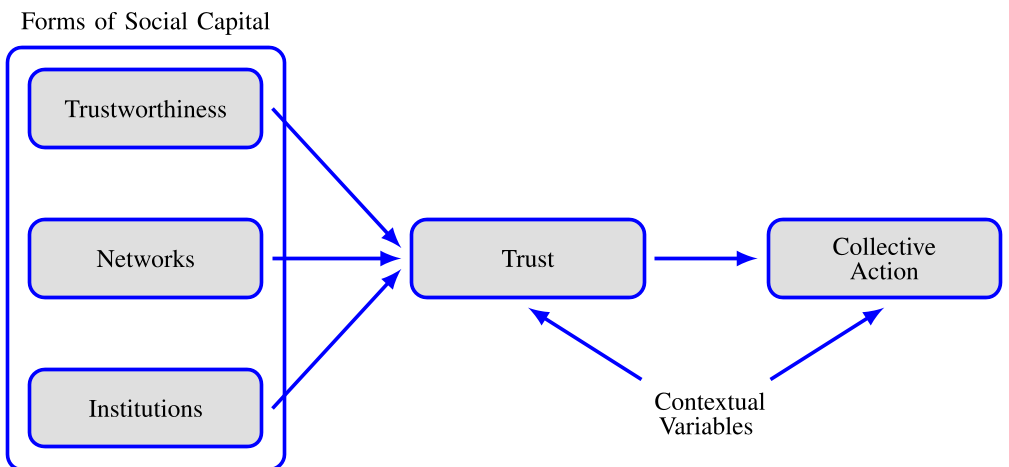 Fig 1: Inspired by Ostrom and Ahn, the model moves from external assets to internal "Reliance Trust."
2. The Decision Module
When an agent meets another agent, it doesn't run a simulation. It calculates a simple aggregation: If the resulting value crosses a threshold, the agent cooperates. This transforms a high-dimensional strategic problem into a 1D heuristic check.
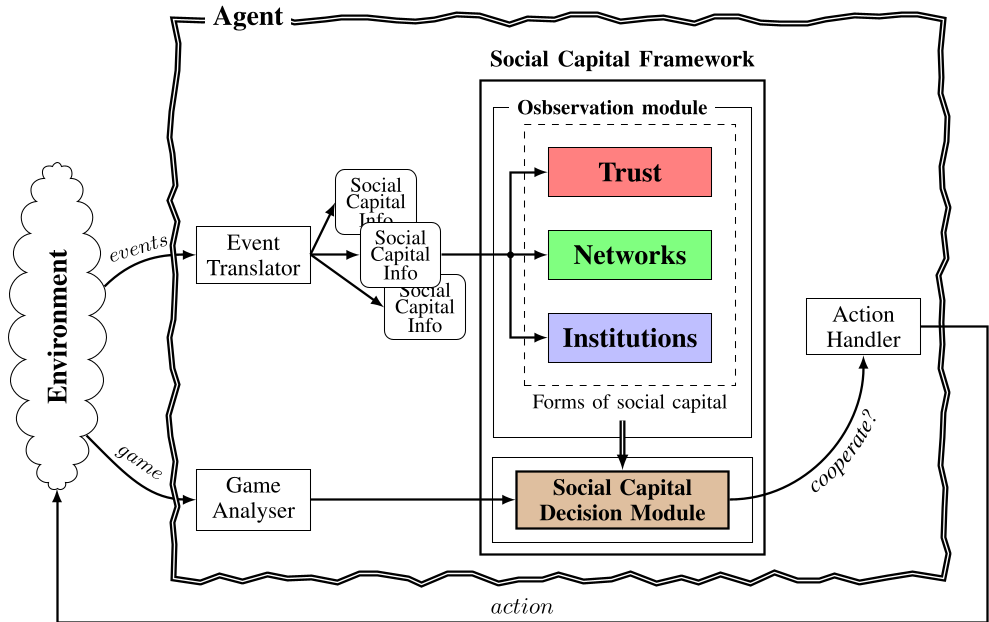 Fig 2: The Social Capital Framework flow, from environmental sensing to decision output.
Experiments and Logic: Beyond the Tragedy of the Commons
By applying Elinor Ostrom’s Nobel-winning work on "Governing the Commons," the authors suggest that self-organizing electronic institutions can avoid total resource depletion.
The paper outlines scenarios such as Smart Grids, where "favors done" and "favors received" act as a currency of social capital. In these simulations, agents who track these social credits achieve significantly higher satisfaction rates for their time-slot preferences than those playing purely "rational" or random strategies.
Critical Insight: The "Shortcut" Value
The true brilliance of this work lies in the realization that Social Capital is a compression of history. Instead of storing thousands of raw interaction logs, an agent stores a few floating-point values representing its "Reliance." This is not just a psychological or sociological mimicry; it is a vital engineering optimization for the next generation of IoT and autonomous systems.
Conclusion & Future Work
The authors are moving toward implementing this in the Presage2 simulation environment, specifically testing it in "Cooperation Games" where agents can choose to join or leave institutions based on the institution's own social capital.
Takeaway for Tech Architects: In your next distributed system, don't just optimize for the best algorithm. Optimize for the "Social" infrastructure—trust levels and institutional rules—that lets your agents stop calculating and start cooperating.
Limitations
- Bootstrapping: How do agents behave in a high-churn environment where no social history exists?
- Vulnerability: Could malicious agents "game" the social capital scores through sybil attacks?