
Social Capital on Facebook: Why "Directed" Interaction is the Only Currency That Matters
Social capital on Facebook: Differentiating uses and users
2011-01-01
Summary
Problem
Method
Results
Takeaways
Abstract
This longitudinal study, titled "Social Capital on Facebook: Differentiating Uses and Users," investigates how specific Facebook activities—directed communication, passive consumption, and broadcasting—impact "bridging" and "bonding" social capital. Utilizing server logs from 415 users over eight months, it establishes that receiving personalized, one-on-one communication is the primary driver for increasing social capital.
## TL;DR
Not all time spent on social media is created equal. A seminal longitudinal study by researchers from Carnegie Mellon and Meta (formerly Facebook) reveals that while "browsing" or "broadcasting" might feel social, only **directed, one-on-one communication** actually builds social capital. Furthermore, the study identifies a "levelling the playing field" effect: passive consumption, usually useless for most, actually provides a vital social bridge for individuals with lower social communication skills.
## The Monolithic Myth
For years, academic and public discourse viewed "Internet Use" or "Facebook Time" as a single, uniform block. Researchers asked: *Does the Internet make us lonely?* This study argues that the question is fundamentally flawed because it ignores **what** you are doing and **who** you are.
The researchers identified a critical gap: existing studies were largely cross-sectional (capturing a single moment in time), making it impossible to tell if Facebook *makes* people social or if social people just *use* Facebook more.
## Methodology: The Power of Server Logs
By combining eight months of longitudinal surveys with actual **server logs** (not just self-reported "vibes"), the team tracked 415 users to see how their social capital changed. They broke down activities into three distinct categories:
1. **Directed Communication**: One-on-one exchanges (comments, likes, messages).
2. **Passive Consumption**: Scrolling the News Feed or viewing profiles.
3. **Broadcasting**: Posting status updates or photos to a general audience.
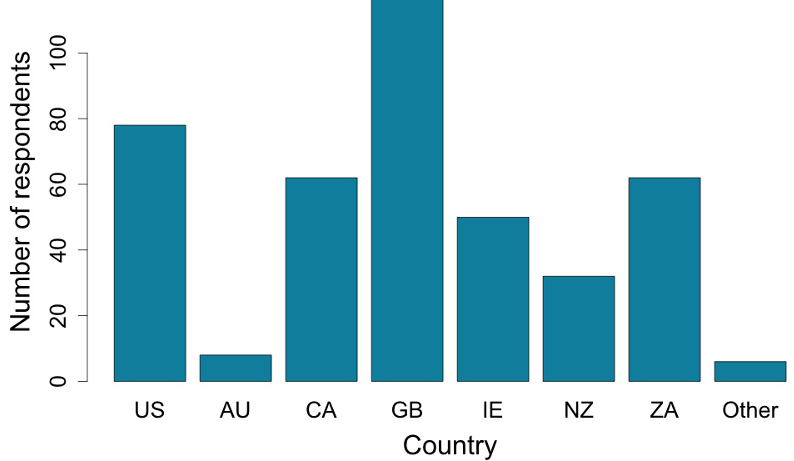
*Note: The study focused on Bridging (weak ties/info access) and Bonding (strong ties/emotional support) social capital.*
## Key Insights: Directedness vs. Noise
### 1. Inbound is King
The data suggests that **receiving** directed communication is the strongest predictor of increased bridging social capital. Interestingly, *sending* messages didn't have the same effect. The logic? Receiving a message signals that someone else values the relationship enough to exert effort, thereby "opening a channel" for future resources or information.
### 2. The Failure of Broadcasting
Broadcasting (status updates) showed virtually **no effect** on social capital. While it feels like you are "keeping in touch" with 500 friends, the undirected nature of the post means it lacks the intimacy and reciprocity required to actually strengthen a social bond.
### 3. The "Social Fluency" Interaction
One of the most profound findings relates to individual differences. For the average user, "scrolling" (passive consumption) does nothing for social capital. However, for users with **low social communication skills**, scrolling actually **increased** their bridging capital.
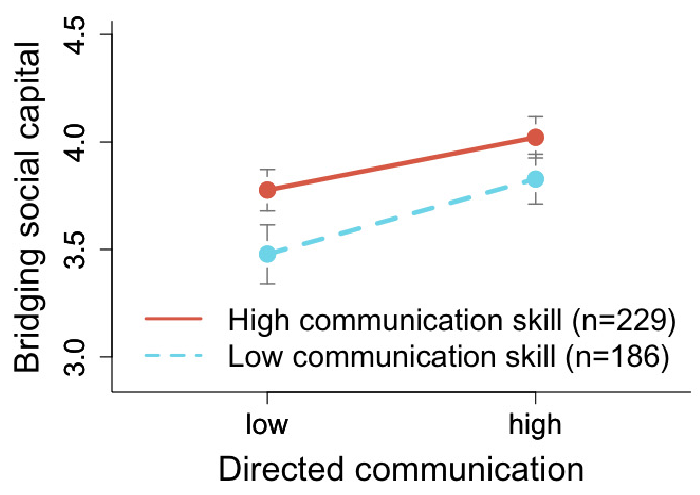
*Figure: Users with lower social skills (dashed blue line) saw a significant uptick in social capital through consumption, unlike their highly skilled peers.*
## Experimental Results: Quantifying the Impact
How much does this actually matter? The researchers compared Facebook use to major life events:
* **Moving to a new city**: Increases bridging social capital by approximately 0.14 points.
* **Doubling your directed Facebook communication**: Provides a nearly identical gain (+0.14).
* **Losing a job**: Decreases capital by about 0.32 points.
This comparison places digital interaction on the same scale as massive physical and economic shifts in a person's life.
## Critical Analysis & Conclusion
**Takeaway for Designers**: If platforms want to improve user well-being, they should stop optimizing for "Time Spent" (which encourages passive scrolling) and start optimizing for "Meaningful Directed Interactions." This could include prompting users to reconnect with "dormant" ties or highlighting posts from friends who have recently undergone major life changes (like job loss).
**Limitations**: The study found little to no impact on **bonding** social capital. The authors hypothesize that our "strong ties" (spouses, best friends) are maintained via "media multiplexity" (face-to-face, phone, text), making Facebook's contribution to these deep nodes marginal compared to its impact on our wider, "weak tie" network.
**Future Outlook**: In an era of AI-generated content and infinite algorithmic feeds, this research serves as a reminder: the "Social" in Social Media only works when it facilitates human-to-human recognition.