
Social Capital in Online Communities: Beyond the Explicit Graph
Social capital in online communities
This paper proposes a quantitative mathematical model for measuring social capital in online communities by formalizing the distinction between potential and actual capital. It introduces the concept of Hybrid Networks, combining Explicit Social Networks (ESNs) with Implicit Affinity Networks (IANs) to calculate bonding and bridging metrics.
TL;DR
Social capital in online spaces is more than just a list of "followers." This paper introduces a mathematical framework that captures Implicit Affinity Networks (IANs)—the latent connections between people based on shared interests—and overlays them with Explicit Social Networks (ESNs). By decoupling "bonding" from "bridging" capital, the author provides a quantitative way to measure how communities realize their potential and mobilize resources.
Contextual Positioning
Published in the wake of the blogosphere's explosive growth (late 2000s), this work acts as a bridge between classical sociology (Putnam, Lin) and modern Graph Theory. It moves beyond simple "PageRank" popularity to understand the qualitative nature of why and how people connect.
The Problem: The "Explicit Bias" in Social Networks
Most social network analysis assumes that if a link doesn't exist explicitly, there is no relationship. However, this ignores the Potential Social Capital.
- Static Data: Traditional surveys are expensive and quickly outdated.
- Invisible Sub-communities: People may share deep interests (implicit affinities) but haven't discovered each other yet.
- Homophily vs. Heterogeneity: Previous models often assumed that more "bonding" (friends like us) meant less "bridging" (connecting to diverse groups), creating a false zero-sum trade-off.
Methodology: The Hybrid Network Approach
The core innovation is the Hybrid Network, which treats social capital as a function of both identity (attributes) and interaction (links).
1. Actual vs. Potential Capital
The author defines a taxonomy of connection types:
- Actual Bonding: You have an explicit link AND shared attributes.
- Potential Bonding: You share attributes but haven't linked yet (an opportunity for the community).
- Actual Bridging: You are linked despite having no shared attributes (connecting diverse clusters).
- Potential Bridging: No link and no shared attributes (the highest "cost" to connect, but highest return).
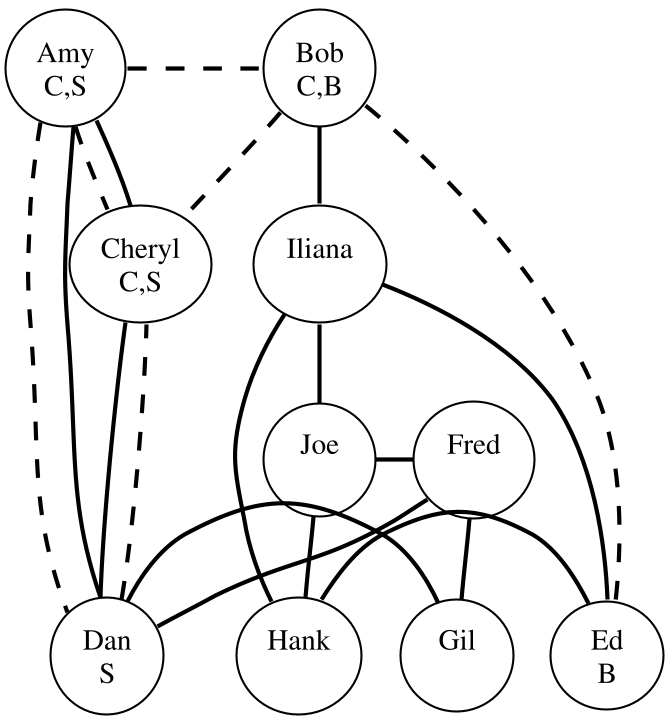 Figure 1: Visualizing IAN (dotted lines) and ESN (solid lines) as a multigraph.
2. The Mathematical Formulation
Instead of qualitative descriptions, the paper provides rigorous formulas. Bonding capital is defined by the strength of affinities () multiplied by explicit link presence ():
Total network bonding is the sum of these actualized links divided by the total potential ties. Bridging is similarly calculated using the reciprocal of similarity, ensuring that the two metrics are decoupled and can both be high simultaneously.
Experiments and Applications
The paper outlines two primary domains for testing these models:
- The Blogosphere: Using Latent Dirichlet Allocation (LDA) to discover "latent concepts" in blog posts to build the IAN.
- Medical Communities: Identifying isolated patients in support groups (e.g., Cancer support) who have high potential social capital but lack explicit links to others facing the same rare conditions.
Performance Benchmarks
By applying this model to existing data, researchers can determine the mobilization efficiency of a community—how quickly it turns latent "potential" capital into "actual" utility (like job referrals or information spread).
 Table 1: The Matrix of Social Capital actualization.
Critical Insight: Why This Matters Today
While this paper was written in 2008, its "Hybrid Network" intuition is more relevant than ever in the age of Algorithmic Feeds. Platforms like TikTok or X (Twitter) essentially use "implicit affinities" to recommend content, but they often fail to foster "actual social capital" (real human connection).
Limitations:
- The "cost" of reciprocity is mentioned but requires deeper empirical validation.
- Attribute extraction in 2008 was limited to basic topic modeling; today's vector embeddings would make this model significantly more precise.
Conclusion
Matthew S. Smith’s work reminds us that the "social" in social media isn't just a byproduct of a graph; it is a measurable resource that can be engineered. By quantifying the gap between what a community is and what it could be, we can design better systems for support, collaboration, and discovery.