
Does Social Capital Drive SNS Usage? Beyond the "SNS as a Tool" Perspective
Does social capital affect SNS usage? A look at the roles of subjective well-being and social identity
This study investigates the causal link between social capital (Bridging vs. Bonding) and Social Network Service (SNS) usage patterns, treating social capital as a precursor rather than an outcome. Utilizing survey data from university students, the research identifies that Bridging capital significantly predicts qualitative SNS use, while Social Identity (Cognitive and Affective) acts as a critical moderator in determining engagement levels.
TL;DR
For years, we've believed that Social Network Services (SNS) are the factories where social capital is made. This study flips the script: it argues that your pre-existing Social Capital—the resources you hold through your offline and online relationships—is actually the engine that determines how and why you use social media. By analyzing 242 active users, the research reveals that while "Bridging" capital (weak ties) drives emotional attachment to platforms, "Bonding" capital (strong ties) is the primary driver of personal happiness.
Problem & Motivation: The Reversed Causality
Most academic literature (e.g., Ellison et al., 2007) views SNS as a utility to nourish networks. However, the author, Sung-joon Yoon, points out a critical gap: if SNS participation is a voluntary "collective behavior," it must be predicated on existing trust and norms.
The core insight is that Social Capital is a precursor. Why do some people check Facebook 20 times a day while others barely post? It isn't just about the platform's UI; it’s about the "mental accounting" of their social identity and the type of capital they are trying to leverage.
Methodology: The Architecture of Social Influence
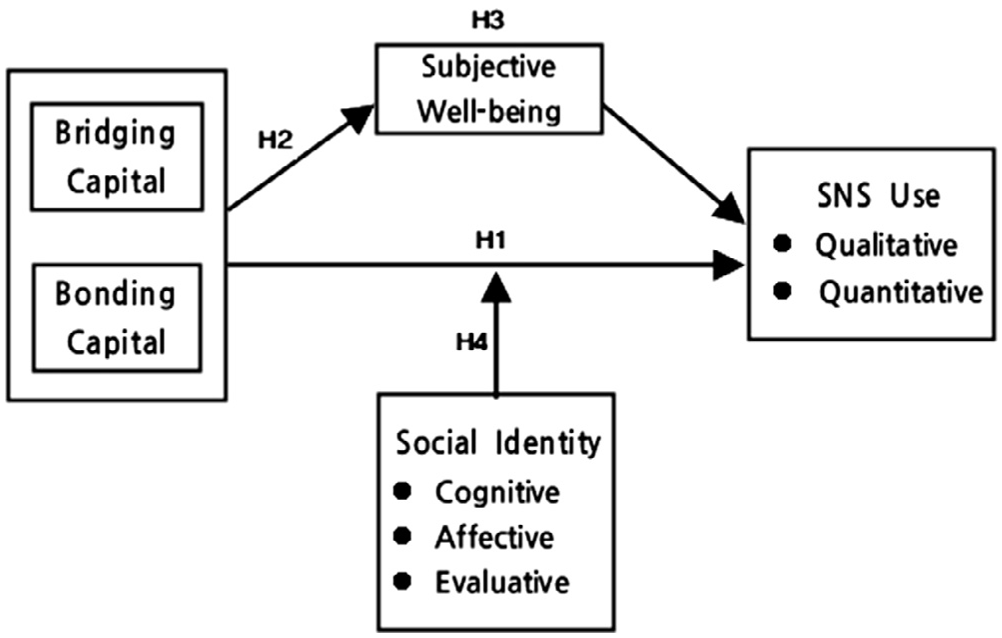
The study breaks down two abstract concepts into measurable dimensions:
- Social Capital Types:
- Bonding: Deep, intimate ties (family/close friends) providing emotional support.
- Bridging: Broad, shallow ties (acquaintances) providing new information.
- SNS Usage:
- Quantitative: How many friends? How often do you log in?
- Qualitative: Do you feel "pride" in the community? Is the SNS part of your "identity"?
The Research Model
The author proposed a model where Subjective Well-being (SWB) bridges the gap between capital and use, while Social Identity acts as a "volume knob" (moderator).
Key Findings: The "Bridging" Paradox
The results yielded several counter-intuitive surprises:
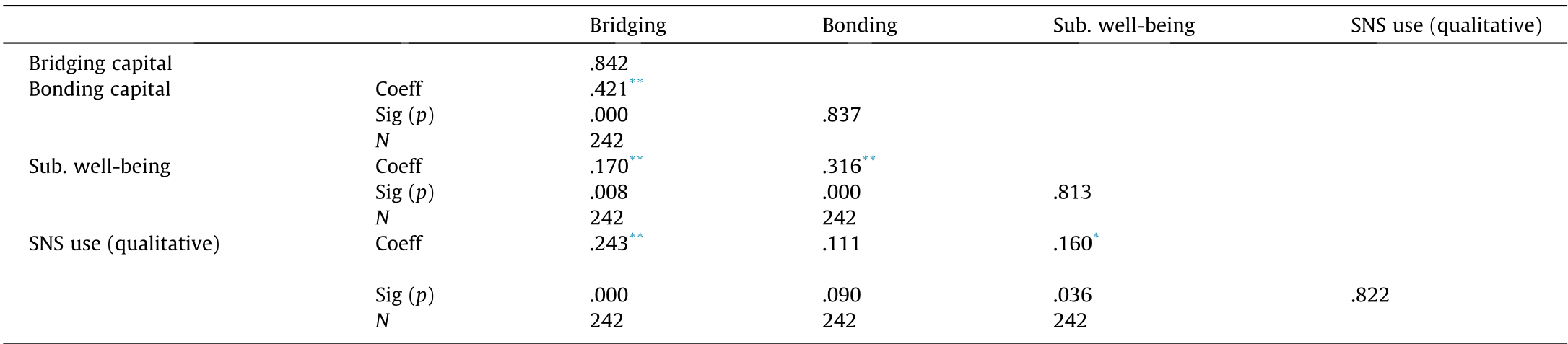
- The Power of Weak Ties: Bridging capital was a significant predictor of Qualitative Use. Users who seek diverse information and "curiosity" are more likely to feel a strong emotional bond with the SNS platform itself.
- The Well-being Dead-end: Contrary to the expectation that "Happy people use SNS more because of their capital," Subjective Well-being did not mediate the relationship. Feeling good about life doesn't necessarily make you use SNS more; rather, Social Identity is the real gatekeeper.
- Identity as a Filter: For users with High Cognitive Identity (those whose self-image aligns with the community), Bridging capital effectively converted into high quantitative usage.
Empirical Evidence
The data showed that Bonding capital is the "happiness engine," but it doesn't necessarily drive you to spend more time on the app.
Critical Analysis & Conclusion
Takeaway for Product Design
If you are building a social platform, this paper suggests a two-pronged strategy:
- For Bonding-focused Users: Create "Look Back" features or private memory sharing (like Facebook's personalized videos) to trigger affective loyalty.
- For Bridging-focused Users: Focus on discovery, "weak tie" suggestions, and information diversity to satisfy their qualitative need for a "larger world."
Limitations
The study focused on university students in Seoul, which simplifies the demographic landscape. In the modern era of 2026, where AI agents and algorithmic "discovery engines" (like TikTok) dominate, the role of human social capital may be further complicated by algorithmic capital.
Final Thought
This research reminds us that we don't just "join" a social network; we "bring" our social history to it. Our digital behavior is a manifestation of our offline assets.