
Social Career Management: Bridging the Employability Skills Gap through Social Media
Social career management: Social media and employability skills gap
This paper explores the "employability skills gap" in the digital era, focusing on how UK business graduates utilize social networking sites (SNS) for career management. Through a quantitative study of 190 students, it identifies a significant disconnect between students' intuitive use of social media and the professional networking skills required by employers.
TL;DR
It is a common myth that "digital natives" are naturally equipped for the professional world. This paper reveals that while business students are social media power users, they suffer from a significant employability skills gap. While they master Facebook for leisure, they lack the strategic insight to leverage platforms like LinkedIn for building professional social capital.
The "Intuitive" Trap: Why Being Online Isn't Enough
In the modern job market, Social Capital—the resources and influence embedded in your network—is often more valuable than the degree itself. However, there is a distinct lack of "informed use" among graduates.
The authors argue that students are navigating these networks intuitively rather than strategically. Prior work suggested a clear boundary between leisure and business networking; however, this paper shows these lines are blurring, yet students remain stuck in a social-only mindset.
Methodology: Mapping the Student Lifecycle
The study focused on 190 business students in the UK, comparing undergraduates (UG) and postgraduates (PG). The researchers aimed to understand the motivation behind joining networks and whether usage evolved over time.
Key Behavioral Differences
One of the core components of the study was comparing the "Why" and "How" of SNS usage.
 Table 3: Differences in work experience significantly shaped how students perceived the utility of social networks.
Core Findings: The PG vs. UG Divide
The data provided a stark contrast in how different student cohorts approach professional networking:
- Time Investment: PG students spend nearly 400% more time on LinkedIn than UGs, recognizing it as a critical engine for career growth.
- Motivation: UGs often join LinkedIn out of curiosity or a transactional desire to "find a job." When a job doesn't appear immediately, they stop using the platform. In contrast, PGs use it for building long-term social capital.
- The "Friendship" Fallacy: UGs are more likely to try and "make friends" on LinkedIn, whereas PGs correctly identify it as a space for professional weak ties and opportunity-seeking.
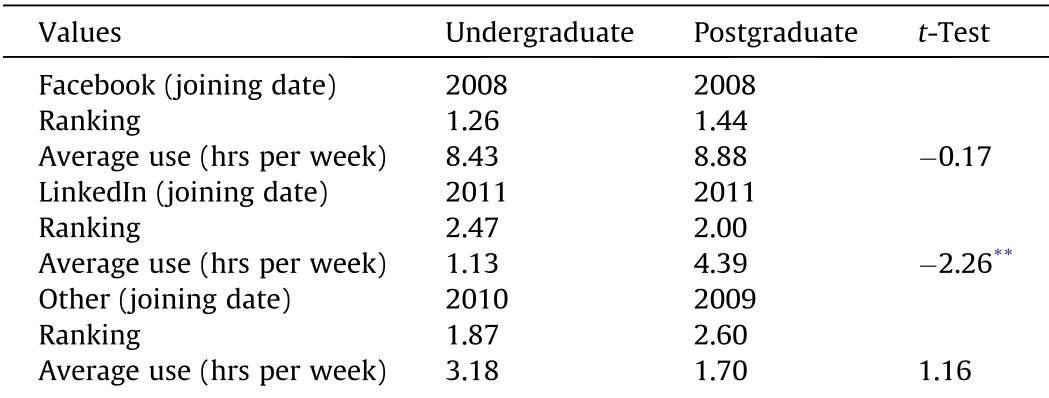 Table 4: While Facebook usage is nearly identical across groups, LinkedIn engagement reveals a massive gap in professional maturity.
Recommendations for Higher Education
The paper doesn't just diagnose the problem; it offers a roadmap for universities to fix it. The authors suggest a tiered approach to SNS Employability Skills:
- 1st Year: Focus on "Professional Hygiene"—privacy settings, profile creation, and understanding how recruiters perform background checks.
- 2nd Year: Focus on "Social Capital"—using networks for internships, placements, and volunteering.
- Final Year: Focus on "Market Intelligence"—critically analyzing organization data and job roles through SNS.
Critical Insight & Conclusion
This research highlights that Social Career Management is a discipline, not a hobby. The primary takeaway is that the "weak ties" (professional acquaintances) described by sociologist Mark Granovetter are the most crucial for diffusing job information, but students are currently failing to build these ties effectively.
Limitations
The study is focused on UK Business graduates, and as the authors acknowledge, cultural differences (especially in Eastern societies) may lead to different networking behaviors. Furthermore, the rapid evolution of platforms like Twitter (now X) and the rise of TikTok for "Career-Tok" suggests that the specific SNS platforms may change, even if the underlying social capital principles remain the same.
The Future Outlook: As AI and algorithmic recruiting become standard, a graduate's ability to manage their digital professional presence will be the ultimate competitive advantage.