
Social Circles: Reimagining the Social Network as a 3D Interactive Space
Social Circles: A 3D User Interface for Facebook
Social Circles is a 3D interactive visualization interface for Facebook designed to manage the information overload of modern social networks. It leverages the Papervision3D engine to represent friends as visual "name cards" within a spatial metaphor, enabling direct manipulation for organizing social connections.
TL;DR
Social Circles is a research-driven 3D user interface for Facebook that replaces static lists with a spatial metaphor. By representing friends as interactive 3D "name cards" and mapping social intimacy to physical distance, the system aims to solve the information overload inherent in modern social media through fluid animation and direct manipulation.
The Problem: When 2D Lists Fail Our Social Brains
As social platforms like Facebook grew, they became victims of their own success. Users were inundated with hundreds of contacts, status updates, and photo albums. The authors argue that traditional "Web 2.0" interfaces—largely built on textual lists and rigid grids—are inherently limited. They require excessive scrolling and clicking to perform simple tasks like "checking in on close friends" or "organizing acquaintances."
The core issue is a lack of structural intuition. In a list, your best friend and a distant high-school classmate often look identical. There is no visual hierarchy that reflects the "social distance" we feel in the real world.
Methodology: Mapping Intimacy to 3D Space
The authors propose a Social Distance model categorized into three tiers:
- Best Friends
- Social Friends
- Acquaintances
Instead of a dropdown menu, Social Circles uses 3D geometry to communicate these tiers.
The Two UI Variations
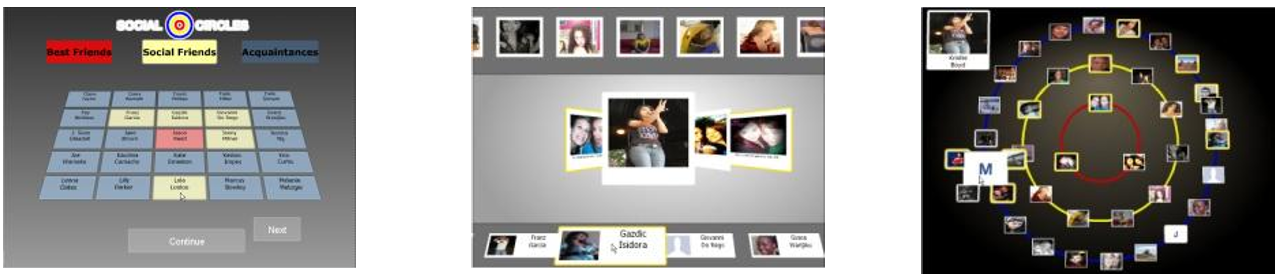
The paper explores two distinct spatial metaphors:
- The Rows UI: Uses a carousel metaphor where card size represents social distance. Larger cards for closer friends are placed in the foreground.
- The Circular UI: Uses concentric circles. The innermost circle contains the closest friends, while the outer rings hold acquaintances, using radius as the primary differentiator.
Direct Manipulation and Feedback
The system is built using Papervision3D (a popular Flash-based 3D engine of the era) to ensure high-velocity feedback:
- Promotion/Demotion: Users can literally drag a friend's card from the "Acquaintance" circle to the "Best Friend" circle.
- Awareness Cues: Yellow borders and icons appear on cards to signal recent updates, allowing for an "at-a-glance" overview without opening individual profiles.
- Dynamic Expansion: Hovering over a card causes it to scale up, showing more detail without losing the context of the surrounding network.
Experiments and Results
The implementation proved that a rich, animated 3D interface could be integrated directly into the Facebook ecosystem. By using a "carousel" and "alphabetical clustering," the system managed to display a dense network without the UI feeling cluttered. While the paper focuses on the design and implementation, it identifies a shift from analytical visualization (looking at graphs) to interactive visualization (living inside the graph).
Critical Analysis & Conclusion
Social Circles represents a fascinating precursor to current Spatial Computing trends. While the technology stack (Flash/Papervision3D) has since evolved into WebGL and Unity, the core design insight remains valid: Spatial memory is powerful.
Pros:
- Psychological Alignment: Mapping social intimacy to physical distance is more intuitive than a sorting algorithm.
- Information Density: Using the "Z-axis" allows more information to be displayed without overlapping 2D elements.
Limitations:
- Scalability: While the circular UI clusters friends alphabetically, a user with 1,000+ friends might still find a 3D space overwhelming without advanced filtering.
- Platform Dependency: At the time of writing, the reliance on Flash was a bottleneck for mobile adoption.
Takeaway: As we move toward the Metaverse and AR-driven social spaces, "Social Circles" provides an early blueprint for how we might navigate our digital relationships as physical entities rather than entries in a database.