
Does Social Climate Matter? Deciphering the "We-Intention" in WeChat Friendship Groups
Does social climate matter? On friendship groups in social commerce
This study investigates how the social climate within WeChat friendship groups drives collaborative shopping behavior. Using a PLS-SEM approach on data from 215 members, the research identifies that social climate—comprising social support, trust, and interaction—enhances member intention and actual purchase behavior primarily through affective and social value channels.
TL;DR
Why do we buy things in WeChat groups that we could easily find elsewhere? This study reveals that in friendship-based social commerce, the Social Climate—the "vibe" created by trust and support—is more important than the actual product information. By satisfying our needs for social connection and fun, groups foster a "We-intention" that transforms passive members into active buyers.
The Shift from "I" to "We"
Traditional e-commerce is a lonely experience. You search, you click, you buy. Even group-buying (like early Groupon) was just individuals seeking a discount. This paper identifies a new paradigm: Collaborative Shopping.
In platforms like WeChat, shopping is an extension of friendship. The researchers argue that we need to stop looking at individual "I-intentions" and start looking at Member Intention (We-intention)—the commitment of a group member to join a collective action.
Methodology: Is it the Product or the Vibe?
The authors surveyed 215 members of a long-standing WeChat group (alumni of an MBA program) who regularly engage in "grocery" commerce (oil, wine, meat). They utilized Uses and Gratifications Theory (UGT) to see which values were being satisfied.
The Core Framework
The researchers modeled Social Climate as a "formative" construct built on three pillars:
- Social Support: Feeling cared for by the group.
- Social Trust: Believing members are truthful and reliable.
- Social Interaction: The frequency and energy of daily chats.
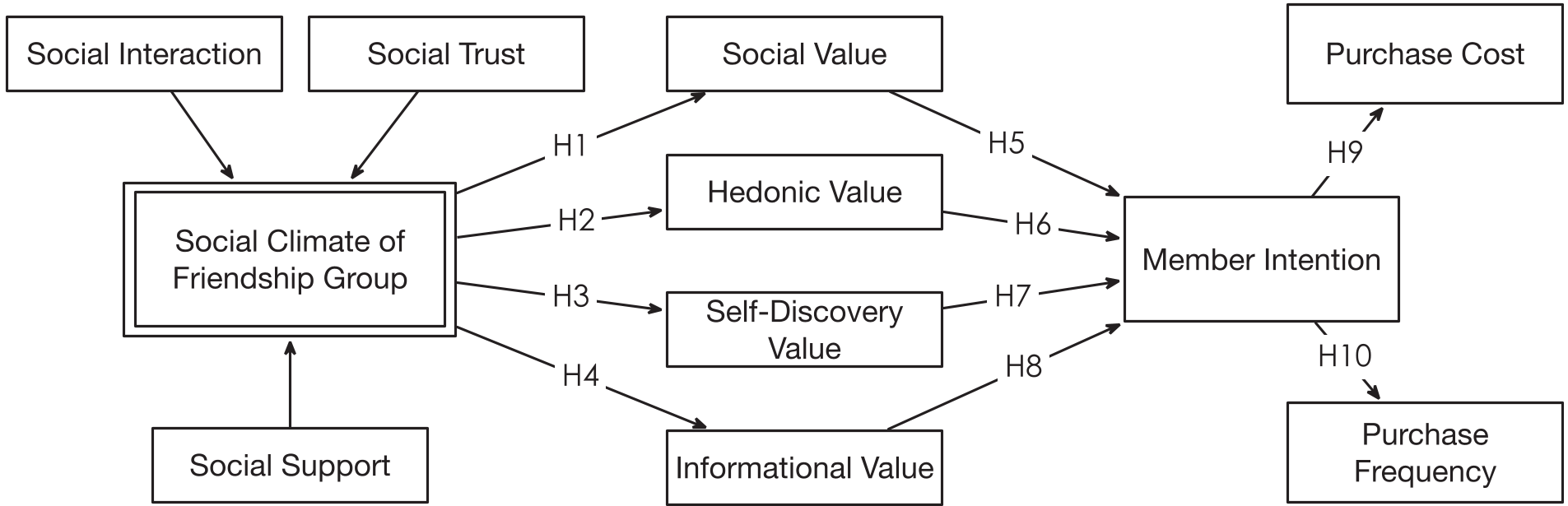
Key Findings: The "Information Paradox"
The study produced a startling result: Informational Value does NOT significantly influence purchase intention.
In traditional e-commerce, product details are king. But in a friendship group:
- Trust replaces Research: Members assume that if a friend is selling it, it’s good.
- Support overrides Utility: Members often buy simply to support the seller or to "save face" within the collective.
- Affective > Cognitive: The decision-making process is driven by the heart (hedonic and social value) rather than the head (price/feature comparison).
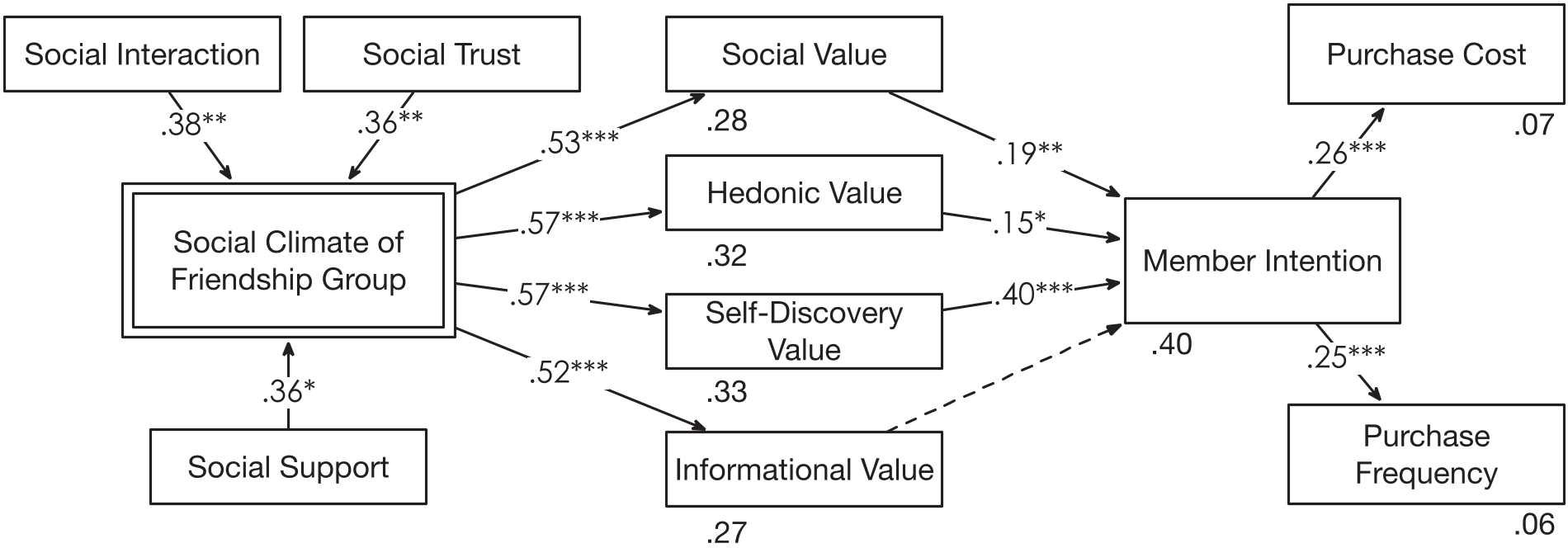 Note: The path from Informational Value to Member Intention is the only major link that failed significantly.
Why This Matters for Modern Business
If you are a vendor in a social space, stop acting like a billboard.
- Don't be Utilitarian: Group members treat direct product pushes as "repulsive."
- The "@" Technique: Use direct social interactions to build rapport before mentioning commercial offers.
- Cultivate the "Climate": Investing in jokes, news, and empathy creates the "Social Climate" that eventually converts into sales.
Critical Insight & Limitations
This study is deeply rooted in Chinese Collectivist Culture, where "losing face" and group harmony are paramount. As the authors admit, these results might shift in individualistic Western cultures where personal utility often trumps group loyalty. Furthermore, the findings are specific to low-cost "grocery" items; high-stakes purchases (like electronics) might still require high informational value.
Conclusion
Social commerce is not just e-commerce on a social platform; it is a fundamental shift from cognitive decision-making to affective, group-driven behavior. For research and for brands, the message is clear: The atmosphere is the product.