
Harmonizing Social and Physical Domains: Effective Multi-hop D2D Link Establishment
Social community aware long-range link establishment for multi-hop D2D communication networks
This paper introduces a social-community-aware Strategy for establishing Long-Range Links (LLs) in multihop Device-to-Device (D2D) networks. By integrating social network features with communication constraints, the authors propose a greedy algorithm and two coalition-graph-game-based distributed algorithms to minimize end-to-end delay.
TL;DR
To solve the latency bottleneck in multihop Device-to-Device (D2D) communication, this paper proposes establishing Long-Range Links (LLs) not just based on who is close, but who is socially connected. By modeling the problem as a Coalition Graph Game, the authors achieve a 3x improvement in delay reduction over traditional "social-blind" methods.
Background: The Latency Wall in Multihop D2D
Multihop D2D is essential for offloading cellular traffic and emergency communications. However, more than three hops usually push end-to-end delay beyond 250ms—a dealbreaker for live video or gaming. While "Long-Range Links" (using higher power or different channels) can bypass intermediate hops, placing them randomly is inefficient because users typically only share data within their own Social Communities.
The Core Insight: Two-Tier Graph Model
The authors argue that a link between two users in different social communities is "less valuable" because the probability of them sharing content is low. They define a dual-layer perspective:
- Spatial Graph (): Physical connectivity governed by radio range.
- Relational Graph (): Social ties based on interests or background.
By establishing LLs predominantly within social communities, the "Average Path Length" (APL) for actual data requests is minimized far more effectively than physical-only optimizations.
Methodology: Gaming the Network
The paper shifts from a complex NP-hard centralized optimization to a distributed Coalition Graph Game.
1. The Greedy Approach
For centralized scenarios, the authors propose a Critical-Edge-Based Greedy Algorithm. It iteratively selects the "critical edge" that provides the maximum reduction in delay relative to its power cost.
2. Distributed Game Theory
To scale, two distributed algorithms are introduced:
- Dynamic Algorithm (CG-DY): Players (devices) update their links based on a "local best response" to maximize their own social utility. It is proven to converge to a Social-Aware Nash Equilibrium (SNE).
- Switching Algorithm (CG-SW): Uses a stochastic switching mechanism to avoid falling into local optima, achieving near-global optimality.
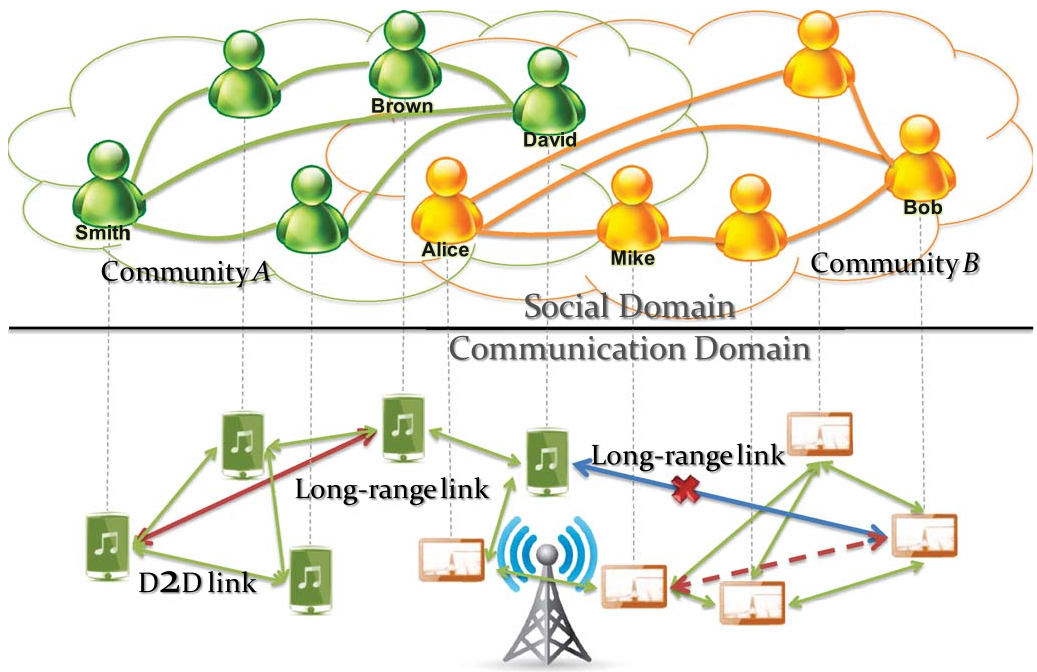 Figure 1: Illustration of LL establishment within and between social communities. Links within the same community (e.g., A) provide higher utility.
Experimental Performance
The researchers compared their algorithms (GREEDY, CG-DY, CG-SW) against Random Selection (RS) and Farthest-First (FF) strategies.
- Delay Reduction: In a distributed content-sharing scenario, the proposed GREEDY algorithm reached sub-300ms delays with only 10 LLs, whereas the "Social-blind" RS method required 30+ links to achieve the same result.
- Single-Sink Scenario: For disaster relief or centralized gateway access, the social-aware approach outperformed peers by roughly 20% in speed of convergence.
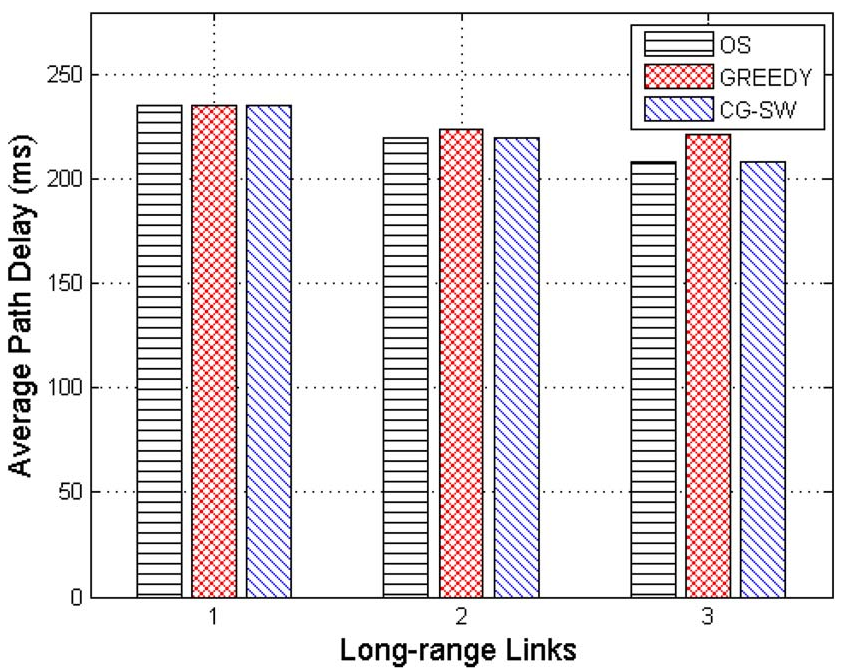 Figure 2: Performance in the distributed network. The Social-Community-Aware approaches (GREEDY/CG-SW) show a much steeper drop in delay as links are added.
Critical Analysis & Conclusion
The strength of this work lies in its computational efficiency. By using potential games, the authors prove that their distributed algorithms converge in polynomial time, making them viable for real-time implementation on mobile devices.
Limitations: The current model assumes a static social community structure ( for inter-community traffic). In reality, social ties are dynamic and overlapping. Future work would benefit from exploring "soft" community boundaries and joint resource allocation (spectrum + power) in underlay modes.
Final Takeaway: This paper successfully demonstrates that the most "efficient" physical network is one that mirrors the social fabric of its users.