
Social-Community-Aware D2D: Bridging Human Relationships and Spectrum Efficiency
10918_Social-Community-Aware Resource Allocation for D2D Communications Underlaying Cellular Networks.
This paper proposes a social-community-aware resource allocation framework for D2D communications underlaying cellular networks. It utilizes social ties to incentivize cellular users to share resources within their "communities" and employs a two-step coalition game to optimize channel allocation, achieving near-optimal system utility.
TL;DR
As the demand for wireless data explodes, Device-to-Device (D2D) communication underlaying cellular networks has emerged as a key solution. However, why should a smartphone user allow a stranger to interfere with their signal? This paper introduces a Social-Community-Aware framework that leverages human social ties to solve the "incentive" problem and uses a two-step coalition game to optimize resource allocation, resulting in a staggering 93.54% performance boost.
The Hidden Bottleneck: Human Selfishness
Existing D2D research often focuses purely on the physical layer—interference, power control, and throughput. But there is a missing link: The Social Domain.
- Incentive Gap: Cellular users (CUs) are naturally selfish. They resist sharing channels because D2D users create interference.
- Interference Hotspots: Users with close social ties (colleagues, friends) often cluster physically. If they all reuse local channels simultaneously, the interference becomes unmanageable.
The authors' insight is simple yet profound: People are more likely to show altruism toward those in their own social community. By aligning resource sharing with social groupings, we can "emulate" cellular users to share resources while managing interference more strategically across communities.
Methodology: The Two-Step Coalition Game
The paper proposes a hierarchical approach that maps nodes from the social domain to the physical domain.
1. The Strategy: Coalition Formation
Instead of every community acting in isolation, they form coalitions based on a Merge-and-Split rule.
- The Goal: Maximize the "Payoff," which balances the D2D throughput against the "Cost" of information exchange.
- Altruism at Scale: A coalition allows D2D pairs in Community A to use the channels of CUs in Community B, provided they are physically distant enough to minimize interference.
2. The Execution: Resource Optimization
Once communities agree to cooperate, the problem becomes a Mixed-Integer Linear Programming (MILP) task.
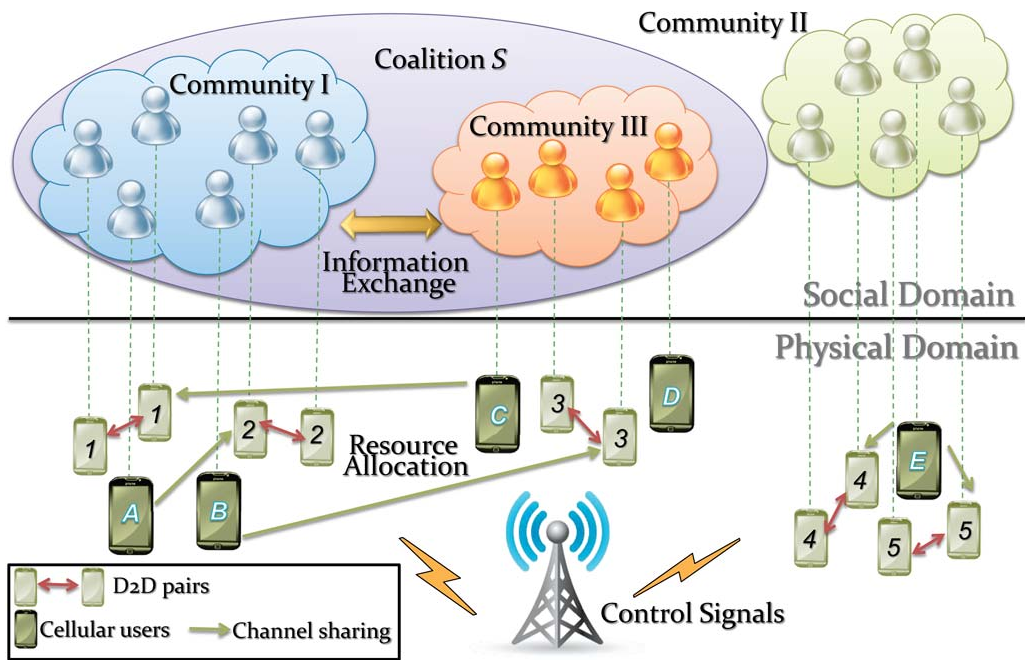 Caption: The dual-domain framework mapping social communities to physical D2D links.
The eNB (Base Station) calculates the Shannon Capacity for each potential CU-D2D assignment. The algorithm ensures that:
- Each CU shares with at most one D2D pair.
- Each D2D pair occupies at most one channel per time slot.
Experiments and Critical Results
The researchers tested their framework using both synthetic random networks and Real Mobile Traces (MIT Reality Mining).
Breaking the Throughput Limit
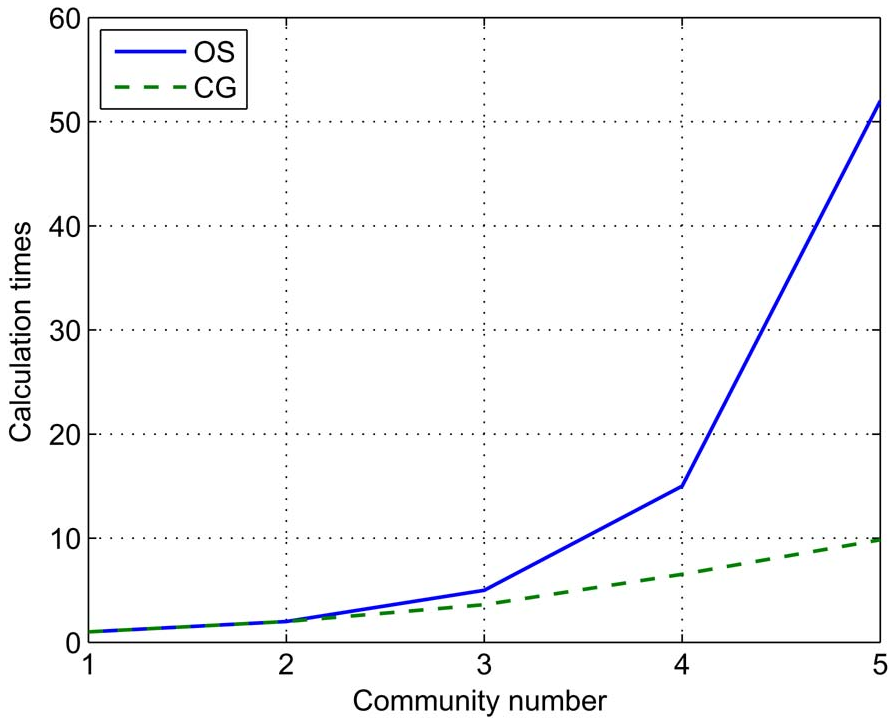
The "Coalition Game" (CG) approach was compared against the "Non-Cooperative" (NC) baseline and the "Optimal Solution" (OS - exhaustive search).
- Efficiency: The CG method achieved over 80% of the theoretical maximum utility but required only a fraction of the computational iterations.
- Stability: Unlike standard optimization, -stability ensures that no group of communities has an incentive to break away from their current coalition, ensuring network harmony.
 Caption: System utility grows significantly as community cooperation increases, vastly outperforming the non-cooperative state.
Handling Mobility
One of the strongest technical validations in the paper is the Mobility Evaluation. By shortening the allocation time window (), the system remains robust even as Rayleigh fading and Doppler shifts occur due to user movement.
Deep Insight: Why This Matters for 6G
The true value of this work lies in its holistic view of the user. By recognizing that mobile devices are extensions of human social circles, the network can move away from "brute force" optimization toward "context-aware" management.
Limitations: While powerful, the model relies on the eNB's ability to accurately detect communities. In a world of increasing privacy concerns, gathering social tie data for resource allocation remains a sensitive hurdle that future work must address through techniques like Federated Learning.
Conclusion
Social-Community-Aware D2D Resource Allocation isn't just a math problem—it's a socio-technical solution. By leveraging human altruism and game theory, the authors have provided a blueprint for more efficient, stable, and high-capacity wireless networks.