
Why We Keep Playing: The Psychology of Social Comparison in Online Games
Online social games: The effect of social comparison elements on continuance behaviour
This study investigates the impact of social comparison elements (e.g., leaderboards, level maps) on user persistence in online social games. By integrating Social Comparison Theory and Self-Efficacy Theory, it demonstrates that specific comparison directions—Upward Identification and Downward Contrast—are the primary drivers of game continuance.
TL;DR
Why do we obsessively check leaderboards? This study reveals that it’s not just about "winning"—it's about how we compare. By analyzing "Farm Heroes Saga" players, researchers found that Upward Identification (viewing leaders as role models) and Downward Contrast (feeling superior to those below us) are the secret ingredients that keep players coming back.
The Engagement Crisis in Hedonic Systems
Online social games are "Hedonic Information Systems" (HIS)—systems where the primary goal is fun, not utility. However, the industry faces a brutal reality: most players quit shortly after adoption. While "social features" are often touted as the cure, this paper argues that social interaction is a double-edged sword. If a leaderboard makes you feel incompetent, you quit. If it makes you feel inspired or superior, you stay.
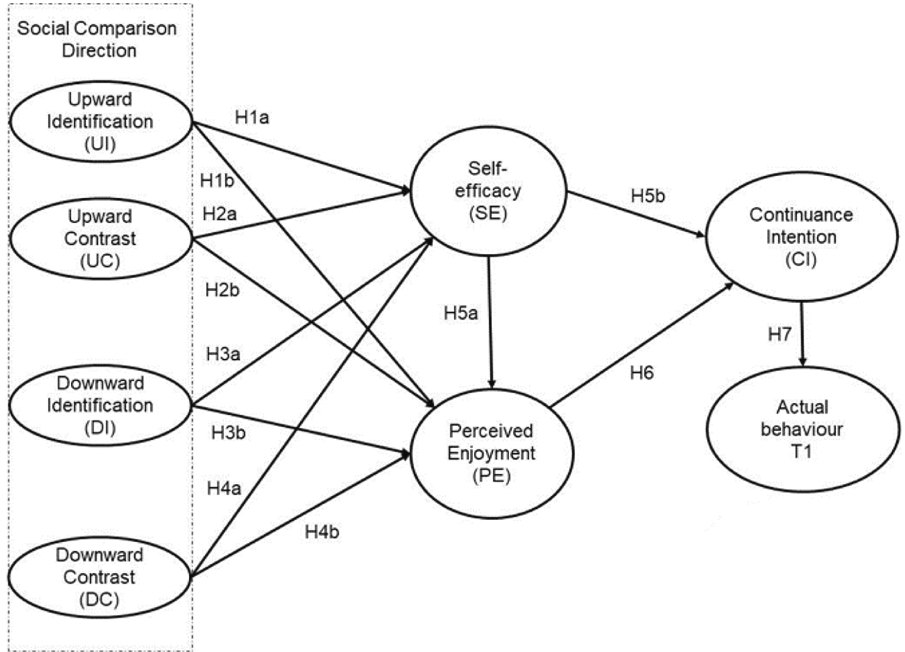
The researchers sought to answer: How do different directions of social comparison influence our "self-efficacy" (the belief in our ability to succeed) and our "perceived enjoyment"?
The Core Framework: Two Theories, One Model
The authors combine two heavy hitters in psychological theory:
- Social Comparison Theory (SCT): Dividing comparisons into four quadrants (Upward/Downward x Identification/Contrast).
- Self-Efficacy Theory: The internal belief that "I can beat this level."
The Four Types of Comparison:
- Upward Identification: "I’m like those top players; I can get there too." (Positive)
- Upward Contrast: "They are so much better than me; I'm a failure." (Negative)
- Downward Identification: "I'm performing as badly as those losers; I'm stuck." (Negative)
- Downward Contrast: "I'm way better than the bottom tier; I've got skills." (Positive)
Methodology: From Survey to Actual Behavior
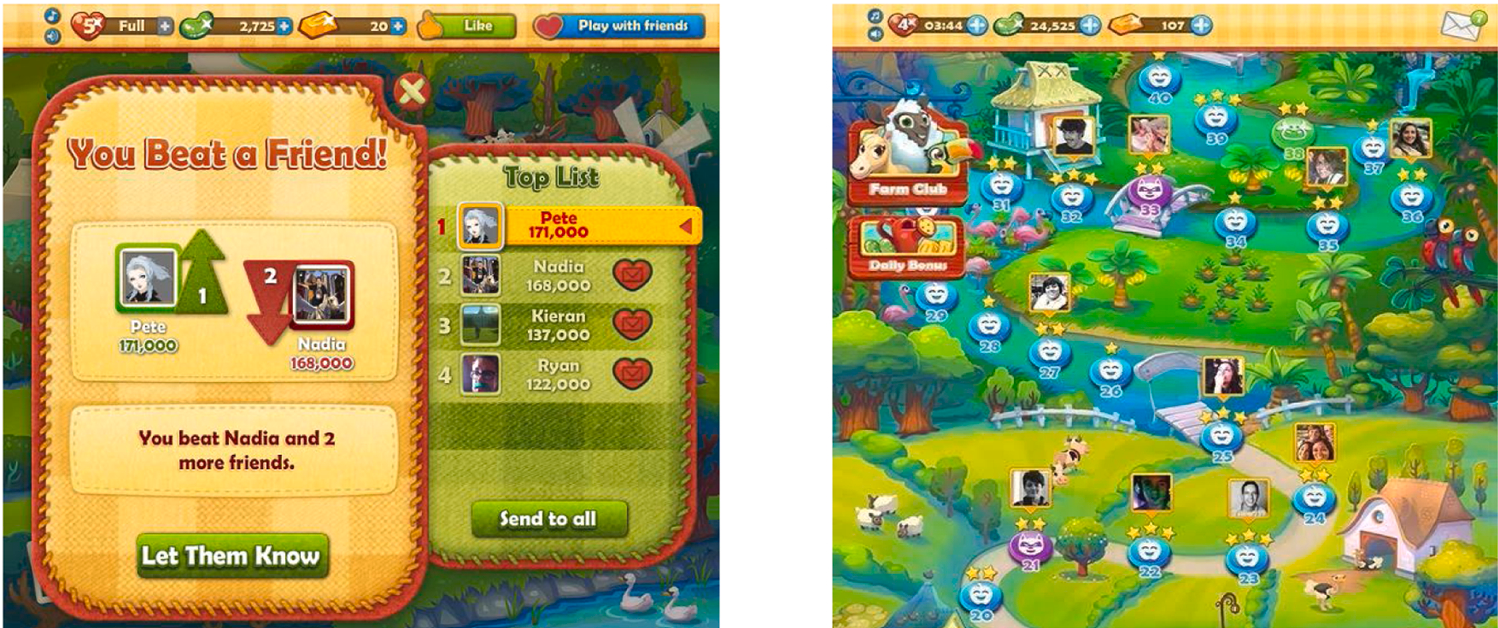
Unlike many studies that rely solely on surveys, this research utilized Farm Heroes Saga to track real-world data. They monitored 212 graduate students over two weeks, capturing:
- Psychological metrics: Self-reported enjoyment and self-efficacy.
- Hard data: The actual game level achieved by the participants.
Key Findings: The Winners and Losers of Motivation
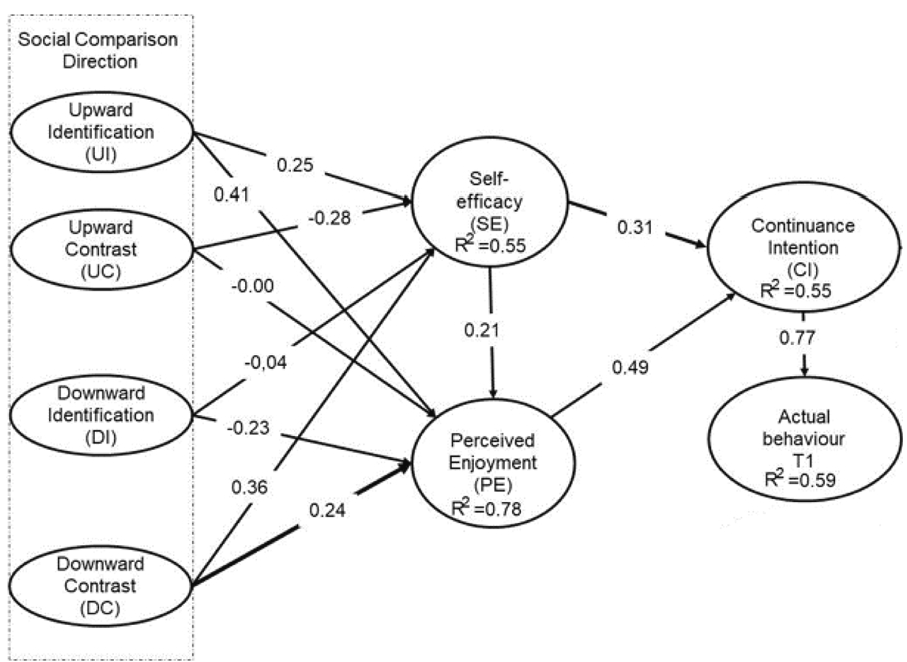
The results from the PLS-SEM (Partial Least Squares Structural Equation Modeling) analysis provide a masterclass in game design:
- Enjoyment is King: Perceived Enjoyment is the strongest predictor of whether a player will continue.
- The Upward Identification Effect: Comparing yourself to better players only works if you identify with them. This creates anticipation and hope, boosting enjoyment (Path Coefficient: 0.41).
- The Self-Efficacy Boost: Downward contrast significantly improves self-efficacy (0.36). Seeing others struggle while you succeed validates your mastery of the game.
- Actual Behavior Validation: The study proved that "Intention to Continue" is a highly reliable metric, correlating at 0.77 with actual game progress.
Critical Insight: Designing for "Identification"
The most profound takeaway is that leaderboards are not neutral.
- For Developers: Don't just show a global ranking. Show a player friends who are "just slightly better" to foster Upward Identification. If a player sees a professional with 1 million points while they have 10, they will likely experience Upward Contrast and quit.
- The Power of Comparison: Gamification should highlight similarities between the user and high performers (e.g., "You and [Top Player] both use these power-ups!") to keep the "hope of improvement" alive.
Conclusion & Limitations
This work moves beyond the "what" of gamification to the "why." It shows that social games are sophisticated psychological engines.
Limitations: The study used graduate students (ages 23-30), which may not represent the "Silver Gamer" demographic or younger kids. Furthermore, it didn't isolate specific features (e.g., do badges work better than maps?).
Future Outlook: The next frontier is Personalized Social Comparison. Imagine an AI that dynamically selects which friends' scores to show you based on which psychological trigger (Identification or Contrast) keeps you personally engaged.