
The Invisible Engine: How Social Computing and Unmanaged IT Drive Competitive Advantage
Investigating Social Computing in Competitive Dynamics
This paper investigates the intersection of social computing and competitive dynamics, specifically focusing on how informal social networks among managers carry out new product development. By utilizing one-mode and two-mode Social Network Analysis (SNA), the authors identify that unplanned network configurations supported by consumer-oriented technologies are vital for organizational agility and competitive action.
TL;DR
Modern business competition isn't just about what you know; it's about who you talk to and the "shadow" devices you use to do it. This study reveals that informal social networks among top executives—supported by personal smartphones rather than just corporate software—are the real drivers of new product development. While this builds "competitive agility," it leaves a massive blind spot in security and management.
Background: Beyond the Organizational Chart
In the frenetic global market, a firm's "collective field of vision" determines whether it leads or perishes. Traditionally, we view Information Systems (IS) as top-down tools like ERPs or formal databases. However, this paper argues that the most critical competitive actions, such as New Product Development (NPD), happen through "invisible work structures"—informal social networks that ignore hierarchy and rely on the "consumerization of IT."
The Problem: The Mismatch Between Formality and Reality
Current research often analyzes IT adoption as a planned, managed event. The reality? Use and adoption have shifted. Workers now voluntarily bring their own devices (BYOD) and social habits into the workplace. The authors highlight a gap: we don’t fully understand how these informal relationships utilize technology to bypass formal bottlenecks and how this influences the flow of "strategically significant" information.
Methodology: Mapping the Managerial Web
The researchers analyzed a global manufacturing firm's top management team (17 executives) through two lenses of Social Network Analysis (SNA):
- One-Mode SNA: Identifying who talks to whom and how often (relational strength).
- Two-Mode SNA: Mapping those specific relationships to the technology used to sustain them (e.g., landlines vs. SMS vs. smartphones).
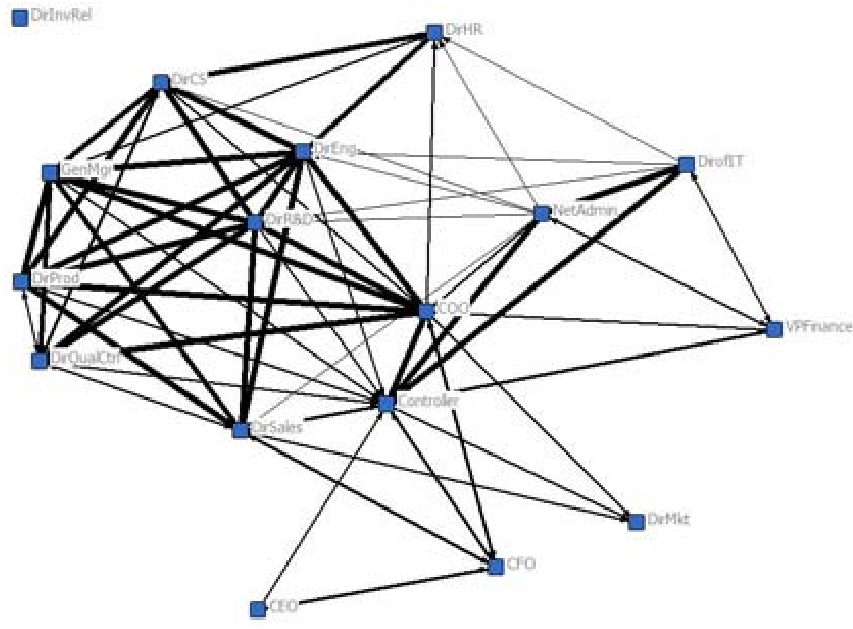 Figure 1: The web of managerial interactions during the conceiving stage of new product development. Note the heavy concentration of ties around the COO and Controller.
Key Insights: Power Players and Unmanaged Devices
The results provide a striking look at organizational "brokers":
- The Power of Centrality: The Controller and COO emerged as the most influential "hubs." With the highest "betweenness" scores, they act as bridges between disparate departments. If they aren't in the loop, information stops flowing.
- The Smartphone Supremacy: Contrary to the hope of many IT departments, traditional landlines and even internal ERP emails took a backseat. The most vital ties were supported by smartphone email and smartphone cellular calls.
- The "Shadow IT" Risk: Interestingly, while managers relied heavily on smartphones, the IT department had almost zero input into how these devices were managed after initial setup. This makes a firm’s most sensitive competitive strategies vulnerable to security breaches.
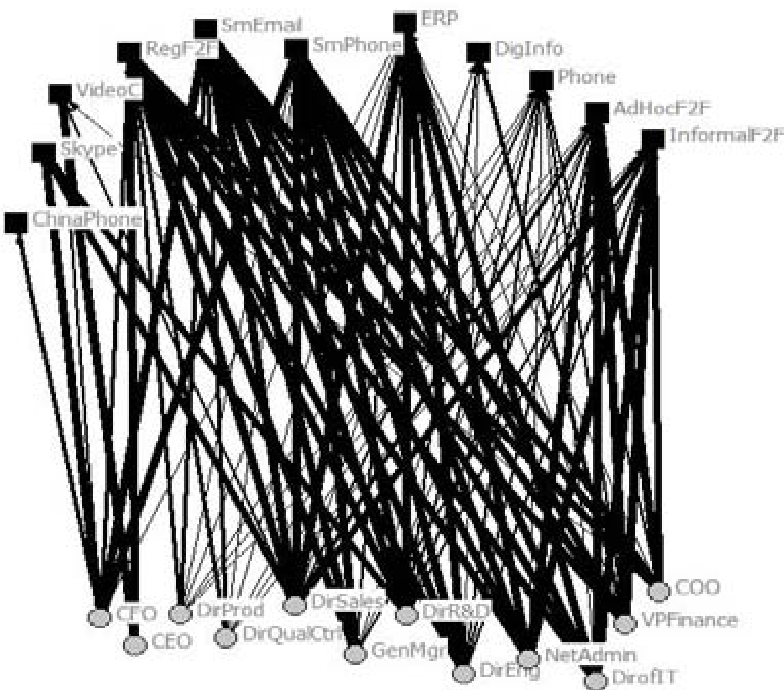 Figure 2: Analysis of the Controller’s media usage. Smartphone-enabled communication (SmEmail and SmPhone) shows significantly stronger ties than traditional landlines.
Critical Analysis & Conclusion
The study proves that Social Capital—the resources embedded in relationships—is mobilized through technology that is often invisible to the organization itself.
The Takeaway for Leaders:
- Acknowledge the Informal: Recognize that the most important product ideas aren't born in boardrooms but in the "hallway" meetings and text threads between key brokers like the Controller and R&D heads.
- Manage the Unmanaged: The reliance on smartphones for high-stakes competitive data is a double-edged sword. It provides the agility to respond to rivals but creates a privacy vacuum.
- Future Outlook: As we move toward 2026, the "consumerization of IT" will only accelerate. Organizations that survive will be those that integrate these "unplanned" network configurations into their strategic vision rather than trying to suppress them through rigid, formal protocols.
Limitations: The study focuses only on the "conceiving" stage of NPD. Future work should examine if these social structures hold up during the "launch" or "response" phases of a product's lifecycle.