
Beyond Ratings: Building Decentralized Trust via Social Computing and Game Theory
Social computing-based trust model in P2P e-commerce
This paper proposes a social computing-based trust model for P2P e-commerce, utilizing game theory and decentralized social network structures to mitigate risks from undesirable participants. The method integrates direct interaction history with indirect friend recommendations to compute a robust trustworthiness score, showing superior transaction success rates compared to EigenTrust and eBay's feedback system.
TL;DR
In the anonymous and decentralized world of P2P e-commerce, trust is the only currency that prevents systemic collapse. This paper introduces a Social Computing-Based Trust Model that moves beyond simple star ratings. By blending the physical intuition of social networks with the mathematical rigor of Game Theory (Prisoner's Dilemma), the authors create a self-cleaning ecosystem where cooperative behavior is rewarded and malicious "reputation farming" is mathematically suppressed.
The "Reputation Farming" Problem
Most users are familiar with the eBay-style feedback system: you look at a seller's score and decide to buy. However, this is prone to a specific vulnerability: a malicious peer can perform 100 small, honest transactions to build a positive reputation, only to default on a 101st transaction involving a high-value item.
Existing decentralized alternatives like EigenTrust attempt to solve this via transitivity but often rely on "pre-trusted" nodes—a design choice that compromises true decentralization. The core challenge is making trust computation dynamic, risk-aware, and socially grounded.
Methodology: The Social-Game Hybrid
The authors propose a dual-layered evaluation metric to define a peer's trustworthiness .
1. Weighted Direct Trust
Unlike simple averages, this model weights every transaction based on two critical factors:
- Value: Higher transaction amounts carry more weight. This prevents "small-money" reputation padding.
- Time: Recent interactions are more relevant than old ones, reflecting the "decay" of trust over time.
2. Social Recommendation Chain
When no direct interaction exists, the model triggers its "Social Computing" module. It queries the user's friend set, aggregating their experiences to form an indirect trust score. This mimics how humans ask for referrals in real-life communities.
3. Evolutionary Game Theory
The paper formalizes the P2P interaction as a repeated Prisoner's Dilemma. The evolution of a node's behavior is modeled by the differential equation: This ensures that the "velocity" of cooperative behavior spread is directly proportional to the network's overall trust level.
 (The combined trust formula balancing direct and indirect metrics)
Experimental Validation
The authors compared their model against the eBay Feedback System and EigenTrust. The simulations focused on "Transaction Successful Ratio" under the pressure of increasing malicious participants.
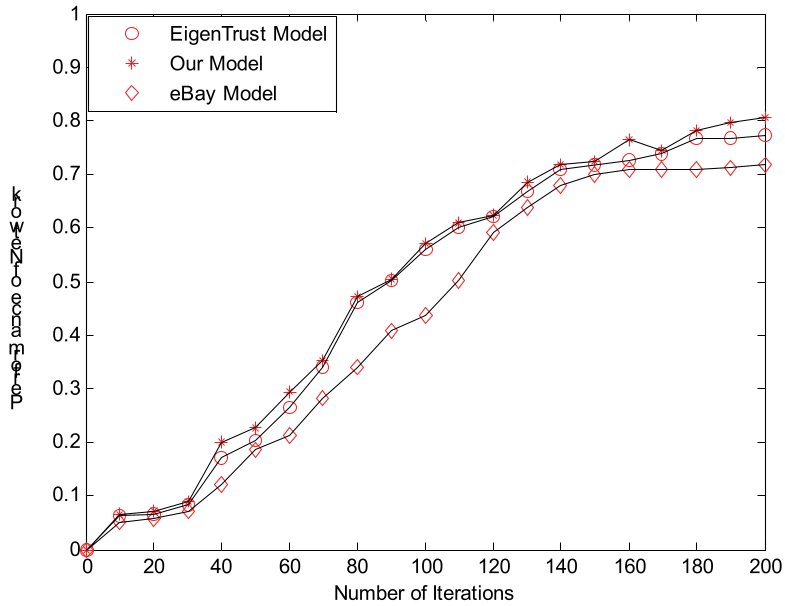 Fig 2: Transaction success ratio across different models. Note how the Social Computing model (represented by the superior curve) maintains a higher success rate even as the network scales or malicious activity spikes.
The results indicate that by incorporating social "friend" structures, the network filters out bad actors much faster than models relying on global averages or simple point sums.
Critical Insight & Conclusion
This work highlights a fundamental truth in digital sociology: Trust is not an absolute value; it is a relationship. By implementing a trust path algorithm that mimics social discovery, the authors successfully localized the impact of malicious peers.
Limitations & Future Paths
While the model is robust, it assumes that "friends" in the social network are inherently more honest in their recommendations. Future research could explore collusion detection—cases where groups of malicious nodes provide positive feedback for each other (Sybil attacks).
The integration of this social logic into modern blockchain-based marketplaces could provide the necessary Inductive Bias to build truly autonomous, self-regulating commercial communities.