
Designing Connections: The Path to the "Socially Connected Designer" in Online Education
Social Connectedness and Online Design Education Outcome: A Relationship Model
This paper introduces a Relationship Model for online design education, emphasizing how "Social Connectedness" (SC) acts as a pivotal mediator between the learning environment and educational outcomes. By fostering intentional learning experiences, the model aims to produce "Socially Connected Designers" equipped with superior empathy and collaborative skills.
TL;DR
The shift to virtual learning has exposed a critical gap in design education: the erosion of social fabric. This paper proposes a Relationship Model that positions Social Connectedness (SC) as the engine driving creative ideation and empathy. By transforming the learning environment into a space of "intentional interaction," the authors argue we can train designers who are not only technically proficient but also socially sensitive and collaborative.
Problem & Motivation: The Loneliness of the Digital Studio
Design is inherently a social act. Whether it is empathizing with a user or critiquing a peer’s work, the "Lone Genius" myth has long been replaced by collaborative practice. However, online education often reduces these rich interactions to sterile transactions.
The authors identify a specific pain point: the lack of "Relationship Salience." When students feel disconnected, their motivation wanes, and more importantly, their ability to develop User Empathy—the cornerstone of modern design—is stunted. The challenge isn't just "technical connectivity" (Wi-Fi and Zoom), but "social connectedness"—the subjective sense of belonging.
Methodology: The Relationship Model
The core of this research is a framework that maps the journey from a student's personal background to the professional trait of being a "Socially Connected Designer."
1. The Input: Intentional Learning Experience
The model suggests that a curriculum must be "intentional." It isn't enough to put students in a Slack channel; the pedagogy must involve teamwork, shared creative ideation, and instructor-led social mediation.
2. The Mediator: Perceived Social Connectedness
SC is influenced by external factors like family and culture, but the learning environment can act as a force multiplier. The authors argue that high SC leads to a virtuous cycle:
- Better Communication → Increased Trust.
- Trust → Higher Motivation & Learnability.
- Motivation → Enhanced Creative Ideation.
 Note: The model depicts how social connectedness acts as the bridge between educational inputs and design outcomes.
3. The Output: The Socially Connected Designer
This is a term coined by the authors to describe a professional who possesses:
- High User Empathy: Derived from the ability to connect with strangers.
- Cultural Sensitivity: Understanding the broader context of design.
- Collaborative Fluidity: The ability to work across disciplinary boundaries.
Experiments & Insights: Empathy can be Trained
The paper draws on secondary research to validate its claims. One of the most striking insights is the link between empathy and social connection.
- The Empathy Factor: Referring to studies by Hutcherson et al., the paper notes that even simple "loving-kindness" exercises can increase connection toward strangers. In a design context, this means that pedagogical interventions can literally train a student's "empathy muscle."
- Persistence vs. Performance: The model highlights that while academic skills predict grades, Social Connectedness predicts persistence. In the high-burnout world of online education, SC is the "glue" that keeps students in the program.
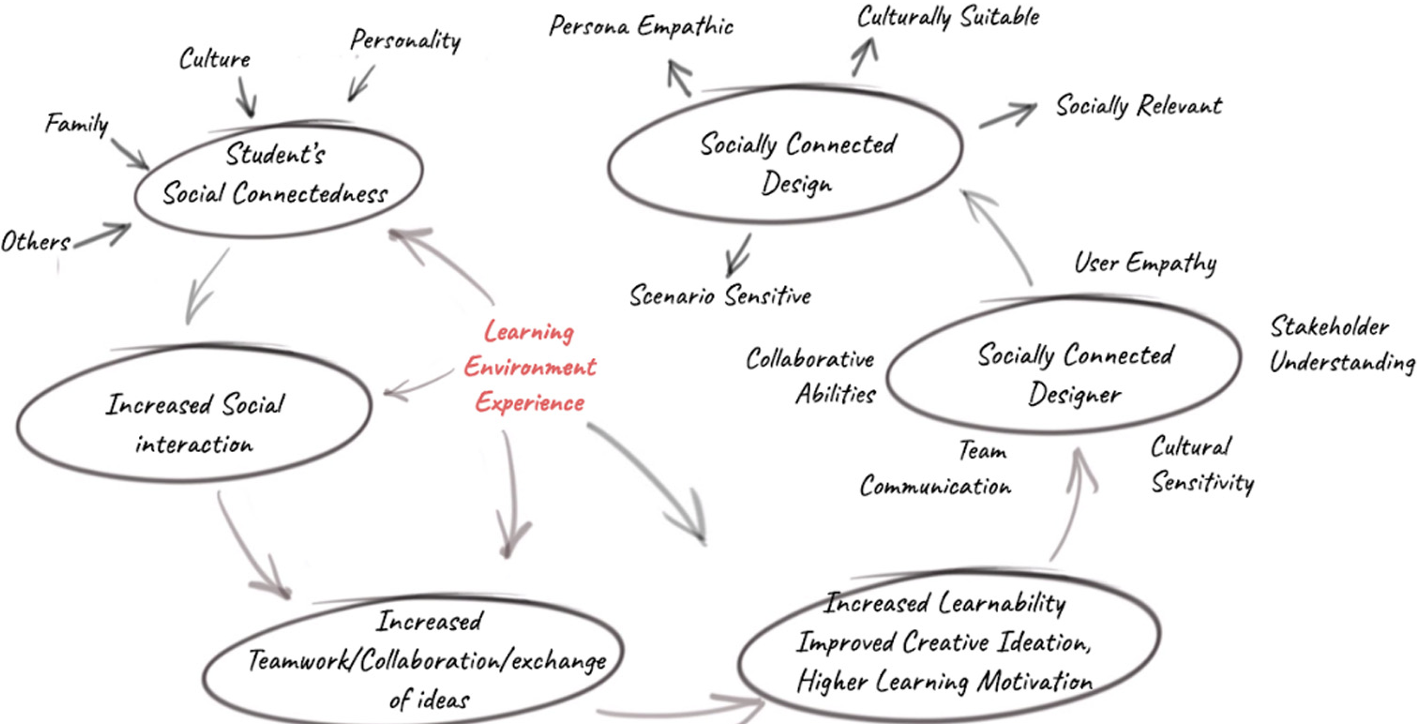 Note: These visual components represent the building blocks (Motivation, Ideation, Collaboration) that the model seeks to optimize.
Critical Analysis & Conclusion
This paper provides a much-needed theoretical "scaffolding" for the future of design schools. It moves the conversation beyond "how do we use Figma?" to "how do we build communities?"
Limitations
As a theoretical model derived from a doctoral section, the specific quantitative weights of each link (e.g., exactly how much SC increases Ideation) are still being researched. Furthermore, the model acknowledges that individual personality (Introversion/Extroversion) plays a role that might require personalized pedagogical approaches.
Future Outlook
The "Socially Connected Designer" is the answer to an increasingly fragmented and automated world. As AI takes over the "execution" of design (building layouts, generating assets), the designer's value will reside in their social intelligence—their ability to connect with users and stakeholders. This model provides the roadmap for how we might teach that intelligence in a digital-first world.
Takeaway: In the future of design education, the "Social" is just as important as the "Design."