
Personalizing the Path: A Social Context-Aware Approach to Itinerary Recommendation
A Social Context-Aware Recommender of Itineraries Between Relevant Points of Interest
The paper presents a personalized, context-aware itinerary recommender system that suggests sequences of Points of Interest (POIs) by integrating Foursquare popularity data, user profiles, and social ties. It employs a multi-objective scoring function and a graph-based routing algorithm to generate optimal tourist paths between user-defined start and end points.
TL;DR
Researchers from Roma Tre University have developed a recommender system that doesn't just suggest places to go, but crafts entire journeys. By leveraging Foursquare's social data, real-time context like weather, and a user's specific social ties, the system generates optimized itineraries that balance popularity with personal preference and physical constraints.
Context Matters: Moving Beyond Static POIs
Most location-based services treat Points of Interest (POIs) as isolated islands. If you search for a restaurant, they give you a list. However, tourism is rarely about a single spot; it is about the itinerary—the logical flow from one experience to the next.
The authors identify a critical gap: existing systems often ignore that a "good" route depends on:
- Physical Context: It’s raining; should I be suggested an outdoor park?
- Social Context: If my friends loved a specific museum, shouldn't that carry more weight for me?
- Logic of Flow: Is the travel time between POIs realistic given my mode of transport?
Methodology: The Anatomy of a Recommendation
The system operates through a structured four-stage pipeline:
- Profiling: Users are represented as weight vectors based on their category interests (e.g., History, Gastronomy).
- Graph Construction: A rectangular region is defined between the user's start and end coordinates. POIs within this area become nodes, and edges are weighted by travel time.
- Contextual Filtering: POIs are pruned based on real-time data. For instance, if the GPS/accelerometer detects the user is walking, the "travel time" weights increase, and outdoor spots might be filtered out during bad weather.
- Strategic Routing & Scoring: The core of the system is the following scoring function:

The function intelligently balances Popularity (), Distance ( - negative impact), Path size (), User Affinity (), and Social Contribution (). The social contribution is a key innovation—it provides a "bonus" to POIs visited by the user's friends on social networks.
Proving Efficiency: Real-World Testing
To validate the system, the researchers didn't rely on simulations alone. They tested it with 40 real users across specific scenarios (e.g., "You have six hours in Rome, it's Monday at 2 PM, and it's raining").
Performance Metrics
The researchers used nDCG (Normalized Discounted Cumulative Gain) to measure the quality of the ranking. This metric is crucial because it rewards the system for placing the most relevant itineraries at the very top of the list.
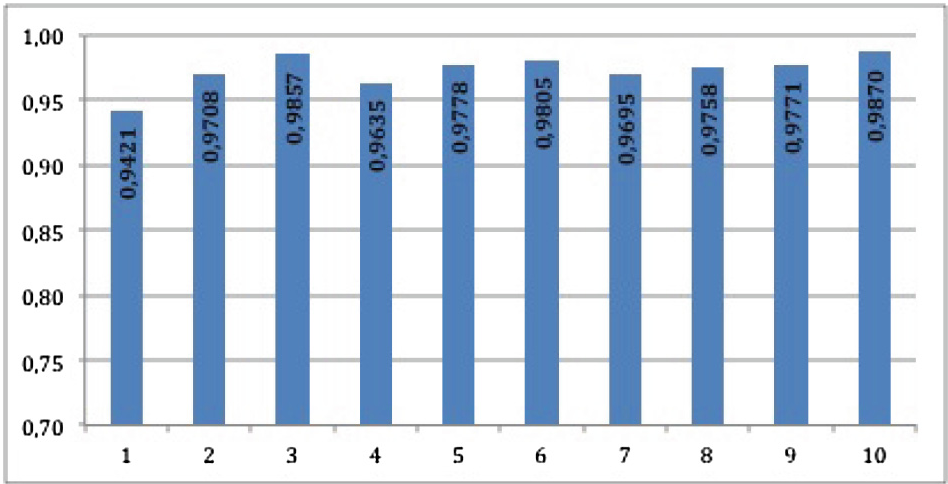
The results showed high nDCG values across the top 10 results, indicating that the system's "choices" were very close to the users' "ideal" preferences.
Critical Insight & Future Outlook
The true strength of this paper lies in its hybrid nature. It combines explicit user intent (start/end points) with implicit social signals and environmental constraints.
Limitations & Evolution: While effective, the system currently treats "social influence" as a static bonus. The authors suggest that future iterations should make this dynamic—if you consistently disagree with your friends' tastes, the system should learn to de-emphasize their "social bonus" in your profile. Furthermore, the integration of Sentiment Analysis (mining what people actually said about a POI, not just that they checked in) represents the next frontier for this tech.
Conclusion
This work moves us closer to a truly "intelligent" travel assistant—one that knows that a perfect trip to Rome isn't just about the Coliseum, but about how the weather, your social circle, and your personal tastes converge on a rainy Monday afternoon.