
TDTrust: Leveraging Social Psychology and Tensors to Combat Fake News
Social Context-Aware Trust Prediction: Methods for Identifying Fake News
The paper introduces TDTrust, a novel context-aware trust prediction framework designed to mitigate the spread of fake news by identifying reliable information sources. It leverages Tensor Decomposition and incorporates social psychology theories like Social Penetration Theory to model trust relationships across different contexts.
TL;DR
The spread of fake news is fundamentally a crisis of trust. TDTrust represents a shift from simple network analysis to a context-aware, psychology-driven prediction model. By using Tensor Decomposition to map users across specific domains (like politics or medicine) and measuring "Self-disclosure" through linguistic analysis, it predicts who to trust even when no prior social link exists. It outperforms existing SOTA methods by up to 15% in prediction accuracy.
Problem & Motivation: The "Web-of-Trust" Fallacy
Most traditional trust systems assume a "Web-of-Trust" (the friend-of-a-friend concept). However, in the vast ocean of Social Media:
- Sparsity: Most users have zero direct connection to those they read content from.
- Context-Blindness: Trust is not a global variable. You might trust your doctor for health advice but not for investment tips.
- Static Assumptions: Existing models ignore the "human" element—the psychological behavior that makes a person appear trustworthy to others.
Methodology: The Core of TDTrust
1. Social Psychology as a Feature
The authors incorporate Social Penetration Theory (SPT). The insight is that users who reveal more of their personal motives, feelings, and experiences (Self-disclosure) tend to build deeper intimacy and trust with their audience. They use the LIWC (Linguistic Inquiry Word Count) tool to quantify these "intimate" words in posts.
2. The Tensor Engine
Instead of a flat 2D matrix (User A trusts User B), the authors build a 3D Tensor (User, User, Context). This allows the model to learn hidden features that vary across different topics.
 Note: The model captures Level of Expertise (activeness + popularity), Interests, and Interaction Quality (ratings).
3. Mathematical Optimization
The model is solved using Alternating Least Squares (ALS) with specific updating rules for the user dimensions () and the context dimension (). The objective function minimizes the error between observed trust and the inner product of the low-ranked latent factors, regularized by a trust degree matrix .
Experiments & Performance
The model was tested against hTrust (Homophily-based), sTrust (Social Status-based), and Zheng (prior context-aware SOTA).
| Training Data | Metric | Zheng (SOTA) | TDTrust (Ours) | Improvement |
|---|---|---|---|---|
| 90% (Ciao) | MAE | 1.019 | 0.969 | ~5% |
| 90% (Ciao) | RMSE | 1.029 | 0.991 | ~4% |
The results clearly show that even on varied datasets like Epinions (where interaction data is missing), TDTrust maintains a lead, proving the robustness of the expertise and self-disclosure features.
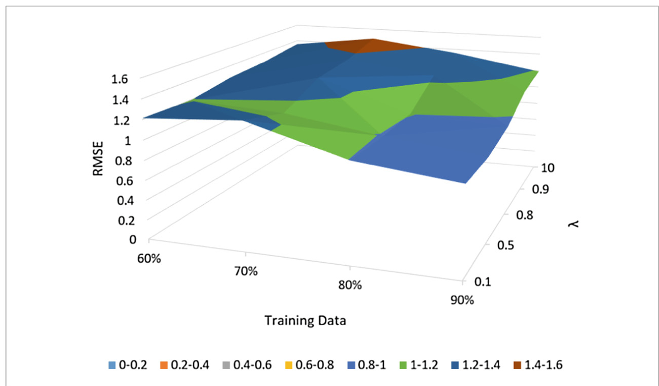 Figure: Analysis of the regularization parameter . The study finds peak performance at , balancing the observed data with social context factors.
Critical Analysis & Future Outlook
Strengths:
- Psychological Grounding: Moving beyond pure graph topology into behavioral analysis makes the model much more "human-centric."
- Contextual Precision: Solving the "Domain Transfer" problem of trust.
Limitations:
- The Time Factor: Trust is transient. A person might be an expert today and a "sell-out" tomorrow. The authors acknowledge that a time-aware tensor (4D) is the necessary next step.
- Semantic Depth: LIWC is a word-count tool. Future iterations should use LLMs (Large Language Models) to understand the sentiment and logic of self-disclosure rather than just the frequency of words.
Conclusion
TDTrust provides a sophisticated mathematical framework for identifying the "islands of truth" in a sea of misinformation. By combining Tensor Decomposition with Social Penetration Theory, it paves the way for social platforms to filter content based on multidimensional credibility rather than just simple popularity.