
Social-Contextual Search: Bridging the Gap Between Intent and Mobile Queries
The Use of Social Context to Enhance Mobile Web Search Experience
This paper introduces a context-aware mobile search framework that utilizes social network data (specifically Facebook) to refine ambiguous mobile queries. By integrating user "Interests" into the search process and employing various query formulation techniques, the system aims to improve search relevance in the entertainment domain.
TL;DR
The paper "The Use of Social Context To Enhance Mobile Web Search Experience" tackles the notorious ambiguity of mobile search. By intercepting queries through a proxy server and augmenting them with personal "Interests" extracted from Facebook, the authors demonstrate how social signals can turn a generic search like "cinemas" into a personalized recommendation engine.
Background & Motivation: The Mobile Search Bottleneck
Searching on the move is fundamentally different from desktop browsing. Users face time pressure, small screens, and input limitations, leading to extremely short, one-word queries. These queries lack the nuance required for search engines to distinguish whether a user looking for "football" wants scores, local matches, or merchandise.
The authors argue that while location-aware search is common, Social Context—the rich fabric of likes, interests, and community trust found on social networks—remains an untapped goldmine for improving search precision.
Methodology: The Social Proxy Architecture
The core of this research is a middle-tier "Proxy Server" that acts as an intelligent layer between the mobile device and a generic search engine (Google).
1. The Manager & Extraction
When a user submits a query, a Manager component triggers the Social Context Extraction module. This module taps into the user's Facebook profile to pull "Interests" relevant to the entertainment domain (e.g., specific music genres or types of food).
2. Query Classification & Formulation
Crucially, the system doesn't just "dump" keywords. It uses a Query Classification component to see if the query already has context. Then, the Query Formulation engine applies different strategies:
- Keyword Stemming: Reducing words to their roots.
- Operator Augmentation: Using Google’s
~(synonyms) or+(mandatory) operators.
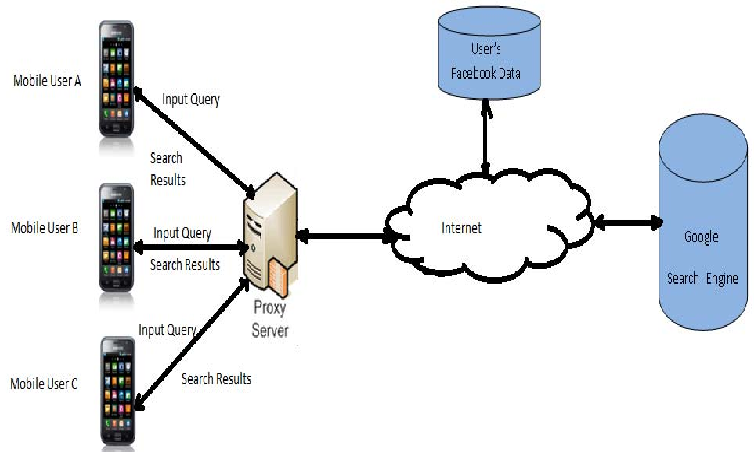 Fig 1. The high-level flow from user query to social-aware results.
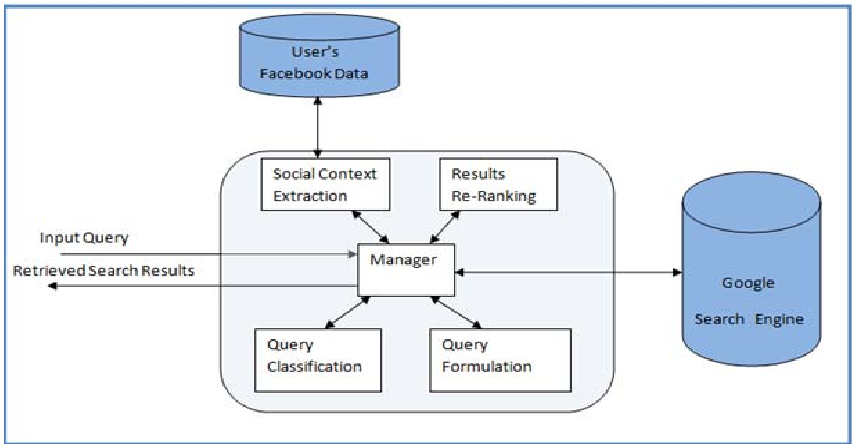 Fig 2. The internal logic of the Proxy Server.
Experiments: Precision vs. Recall
To validate the approach, the authors used a two-pronged dataset: the AOL search logs for query variety and a curated crawl of entertainment sites (Cairo360, CairoDining) for ground-truth evaluation.
The researchers tested how adding 1, 2, or 3 contextual keywords affected search quality across four different formulation techniques.
Key Observations:
- The "Context Relevance" Rule: Adding "Pizza" to a "Restaurants" query works wonders; adding "Pizza" to a "Cinemas" query yields garbage results. Simple concatenation isn't enough; semantic relevance is key.
- Operator Effectiveness: Interestingly, the study found that Google’s synonym operator (
~) often failed to behave as expected (e.g., it did not consistently link "Football" to "Soccer"), suggesting that search engine black-boxes are often less flexible than researchers hope. - The Sweet Spot: Keyword stemming combined with social augmentation generally provided the best balance of Precision and Recall.
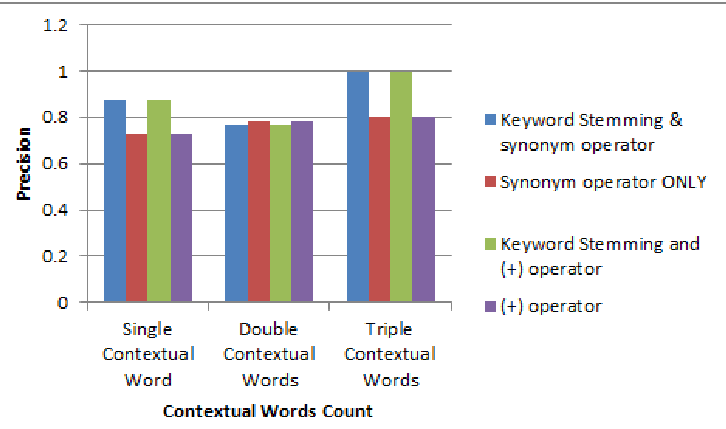 Fig 3. Precision trends as the number of social contextual words increases.
Academic Insight: Is Social Context the Silver Bullet?
This paper serves as a vital proof-of-concept for Socially-Aware Computing. While modern LLMs now handle some of this "intent parsing" naturally, this paper highlights a fundamental truth: search engines are only as good as the context they are given.
By leveraging existing social graphs (Facebook) rather than forcing users to build a new profile from scratch, the authors provide a frictionless path to personalization. However, the study also reveals a limitation: without a deep ontology or knowledge graph to link "Social Keywords" to "Query Keywords," the risk of "Semantic Noise" remains high.
Conclusion
The integration of social context into mobile search is not just about better ranking; it's about reducing the cognitive load on the user. While this work focused on the entertainment domain, the principles of using a proxy-based reformulation layer can be extended to e-commerce, local services, and professional research.
Future Outlook: The next step in this evolution is likely the move from keyword augmentation to semantic embedding representation, where social context and user intent are mapped in the same latent space to ensure that the augmented search remains relevant and privacy-preserving.