
Social Dendro: Transforming Data Curation into a Collaborative Social Experience
Social Dendro: Social Network Techniques Applied to Research Data Description
This paper introduces Social Dendro, an extension to the Dendro research data management platform that integrates social network techniques—such as posts, shares, and comments—to encourage early-stage metadata production. By mapping social interactions to Semantic Web ontologies (schema.org), the system transforms data curation into a collaborative, real-time social process.
TL;DR
Social Dendro is an innovative extension to the Dendro RDM platform that reframes metadata creation as a social activity. By introducing "posts," "shares," and "comments" into the data management lifecycle, researchers can collaboratively curate datasets in real-time. Preliminary tests show that while social mechanisms are technically viable via ontologies, user experience and academic-specific features (like peer review) are critical for adoption.
Problem & Motivation: The "Last-Mile" Metadata Crisis
In the current research landscape, data management is often an afterthought. Surveys show that a staggering 70% to 90% of information created during research stays trapped in local lab environments. Why? Because the tools are too formal and disconnected from the daily workflow.
The authors argue that researchers possess the most "tacit knowledge" about their data, but they lack tools that capture this knowledge during the production phase. Social Dendro aims to change this by adopting the Science 2.0 concept: treating data management as a social process involving likes, ratings, and shares.
Methodology: Building Social on a Semantic Foundation
The core of Social Dendro is its ability to translate social interactions into machine-readable Linked Data. The platform utilizes a graph data model based on the following schema.org ontologies:
- SocialMediaPosting: Triggered whenever a metadata descriptor (like a Dublin Core "Creator" field) is added or modified.
- Like/Comment/ShareAction: Represents peer interactions with those metadata changes.
Architecture Overview
When a researcher updates a folder’s description, Social Dendro doesn't just save a value; it generates an event in the RDF graph. Any team member can then "like" or "comment" on that specific metadata entry, creating a provenance trail of peer validation.
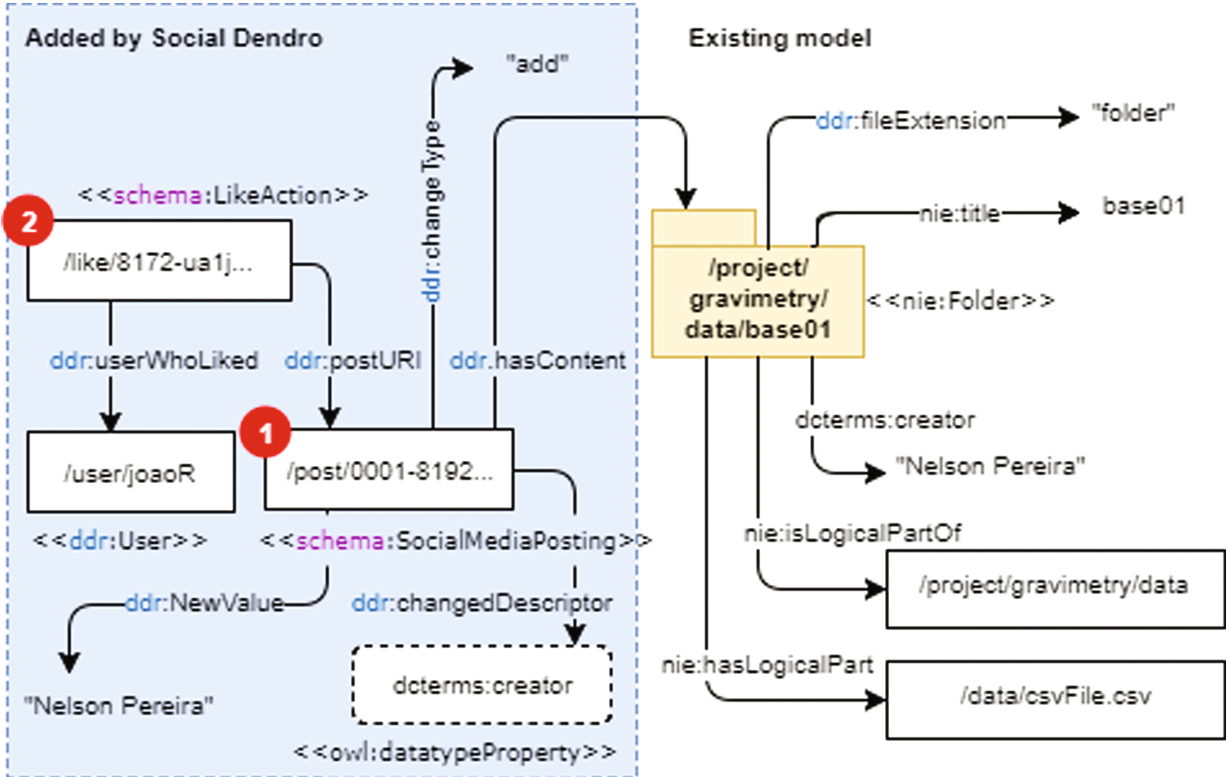 Figure 1: The data model showing how social interactions (LikeAction) connect to metadata updates (SocialMediaPosting).
Experimental Results: Usability vs. Utility
The authors conducted usability tests focusing on five metrics: learnability, efficiency, memorability, errors, and satisfaction. The results highlighted a significant gap between "social" familiarity and "academic" utility.
Performance Metrics
Comparing specific tasks (TA) from the study:
- The UI Gap: Finding the Social Dendro section took over 2 minutes (TA1), suggesting that the "timeline" wasn't as intuitive as expected.
- Onboarding Friction: Adding a collaborator (TA2A) was the slowest task (>5 mins) due to the complexity of handling full URIs.
- The Utility Paradox: While users are frequent social media users (QI4), they rated the "Like" button as the least useful feature for RDM (average score 3.5).
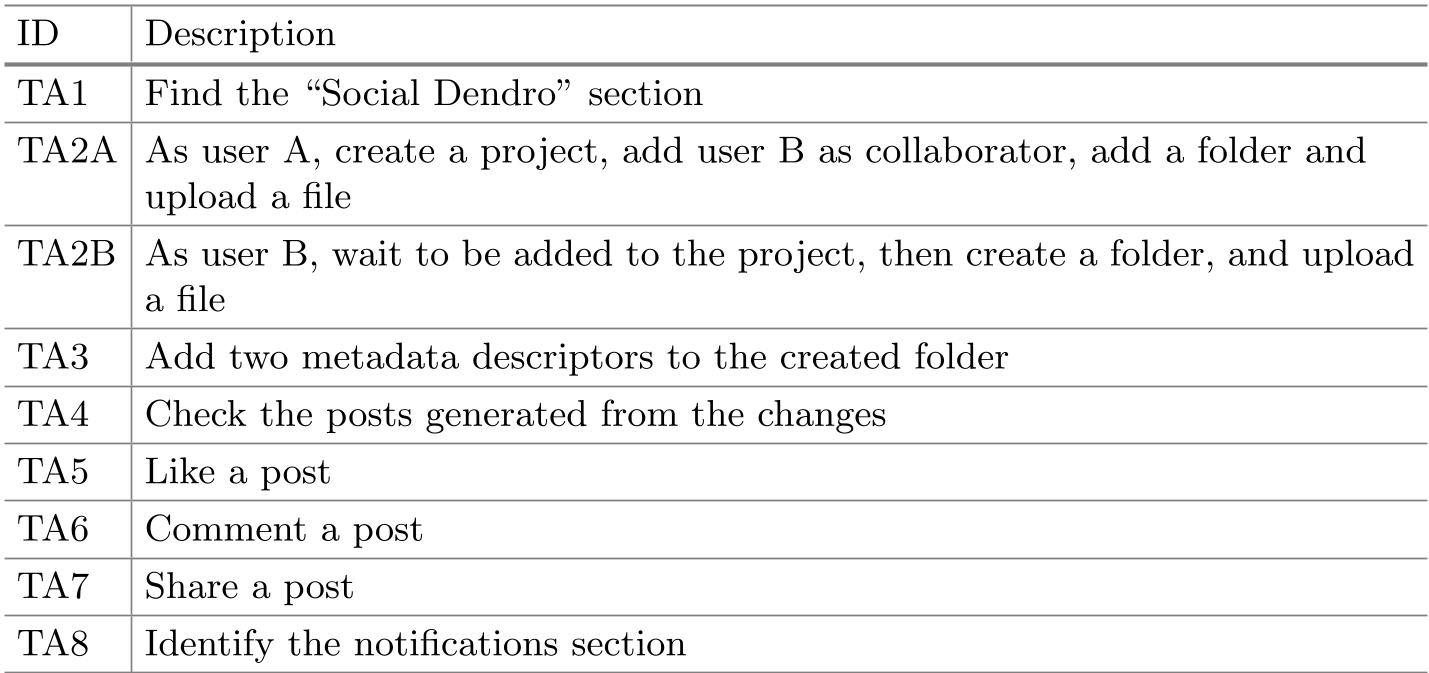 Table 1: Tasks used in the usability study, highlighting the collaborative nature of the tests.
Critical Analysis & Conclusion: From "Likes" to Peer Review
The most striking takeaway is that simulating Facebook is not enough for Science. The authors found that a simple "Like" is too ambiguous for research. Instead, the scientific process requires a more nuanced approach—specifically, an upvote/downvote system that mirrors rigorous peer review.
Limitations & Future Work
- Interface Complexity: The current Dendro UI confuses general project changes with social timeline updates.
- Scale: The study only included 8 users; a larger, domain-agnostic trial is needed.
- Future Pivot: The next iteration will move toward formalizing social interactions as a form of "In-Group Review" to ensure metadata quality before it ever reaches a repository like Zenodo.
Social Dendro proves that while we can build social layers on top of RDM, the true value lies not in the "socializing" but in the collaborative validation of research outputs.